Episode 557 min

Leandro Cabrini
Founder & CEO, Proppel
Hiring abroad isn't about saving money
He had never run a recruitment agency. Three months after starting one as a side project, it was out-earning the marketing agency he actually ran.
Where to watch and listen
- Founded Proppel, after never running an agency
- 2024
- Before the side project out-earned his agency
- 3 months
- Of Proppel's work is marketing roles
- 60%
- Of revenue is video editors and graphic designers
- ~30%
- Monthly for a LATAM creative strategist, vs $150K a year in the US
- $6 to $8K
- International hires Mike made at Freshly
- 700+
Follow Leandro Cabrini
“We were more concerned about, can we go get someone that we technically can't afford?”
Leandro Cabrini is Argentine, lives in London, and staffed his own performance marketing agency out of Latin America because he knew what the talent there was worth. Clients asked him to do the same for them, and the favour became Proppel. The argument he and Mike land on across this hour is that hiring abroad is not a discount: you hold the budget still and buy talent you could not otherwise afford.
Leandro Cabrini runs a recruitment agency and had never run one before. His background is marketing, a performance marketing agency and an e-commerce brand, both of which he staffed out of Latin America. Clients and agency friends started asking him to hire for them the way he hired for himself. He said no for a while, then ran it as a side project, and three months later it was out-earning the marketing agency, so he went all in. Proppel now places marketing and operations people across LATAM, the US and Canada. Sixty percent of the work is marketing roles, the brand-to-agency split is roughly even, and the single most requested role is video editor, with graphic designer second. Those two alone are about thirty percent of revenue. The one growing fastest is creative strategist.
Mike has run the same play at a scale most founders never reach. Freshly ended with 2,500 full-time employees and more than 700 international ones, across Belarus, Poland, the Philippines, South Africa and Latin America, and Petfolk is building Latin American engineering teams now. Across all of those hires he never once recruited in-market himself, not even when Belarus was a hundred-person office with its own building. The reason is the argument of the episode. A mid-tier engineer in the US cost him $150,000 to $175,000, and that same budget in Belarus bought a person the US market paid $400,000. He is blunt that the saving was never the objective: the question was whether they could go and get someone they technically could not afford.
Leandro's version of the same idea is about time rather than headroom. The saving is real, he will say up to eighty percent on salary, but what it buys is the ability to hire earlier than revenue would otherwise allow, and three months earlier is three months of the founder's own attention handed back. He is precise about the numbers underneath it. A good creative strategist in the US is $100,000 to $150,000 base plus bonuses; the equivalent in Latin America is $6,000 to $8,000 a month, with no FICA or SUTA on top because these are contractors. He does no part-time and no temporary work at all, only full-time permanent people working exclusively for one company, on the grounds that anything else does not retain.
The method he gives away is the most useful part of the hour. Write the list of tasks before you write the job description, because the person who edits your video is not the person who runs your calendar, and asking for both is buying a lottery ticket. Know the purpose of every interview stage before you sit down, and always set a test project. Then build the onboarding, because everyone can hire and almost nobody onboards: SOPs, guides, a named person responsible. He priced the company the same way he argues, turning down the familiar model of charging $3,000 a month and passing perhaps $1,000 of it to the candidate, in favour of a one-off fee payable only on a hire, with a three-month guarantee.
Mike's closing note is the one to keep. Operators measure the cost of hiring and almost never measure the cost of not hiring, which is the larger number and the harder one to see. He also discloses the relationship plainly in the first minute: Proppel is the show's launch sponsor, he found them through Google and ChatGPT, and he was a client before he was a partner.
What the conversation covers
The budget stays, the talent changes
Mike's mid-tier engineer band was $150,000 to $175,000. The same money in Belarus bought someone the US paid $400,000. He never treated it as a cost line.
Three months of your own time
Leandro's case for the saving is not margin, it is timing. Cheaper talent means hiring before revenue strictly allows, and the founder gets those months back.
Tasks before job descriptions
Write down what the person will actually do each day, then work out how many people that is. A video editor who also runs your calendar is two roles and a lottery ticket.
Never interview without a test project
Every stage has a stated purpose before he sits down. Editors get a brief and raw footage. Winging the conversation is the failure mode he names first.
Everyone can hire, nobody onboards
SOPs, guides, and a named person responsible. The window that decides retention runs from the first interview to three months in, and great candidates have other options.
Priced so the agency only wins on a hire
He turned down the $3,000-a-month model that pays the candidate a fraction of it, and took a one-off success fee with a three-month guarantee instead.
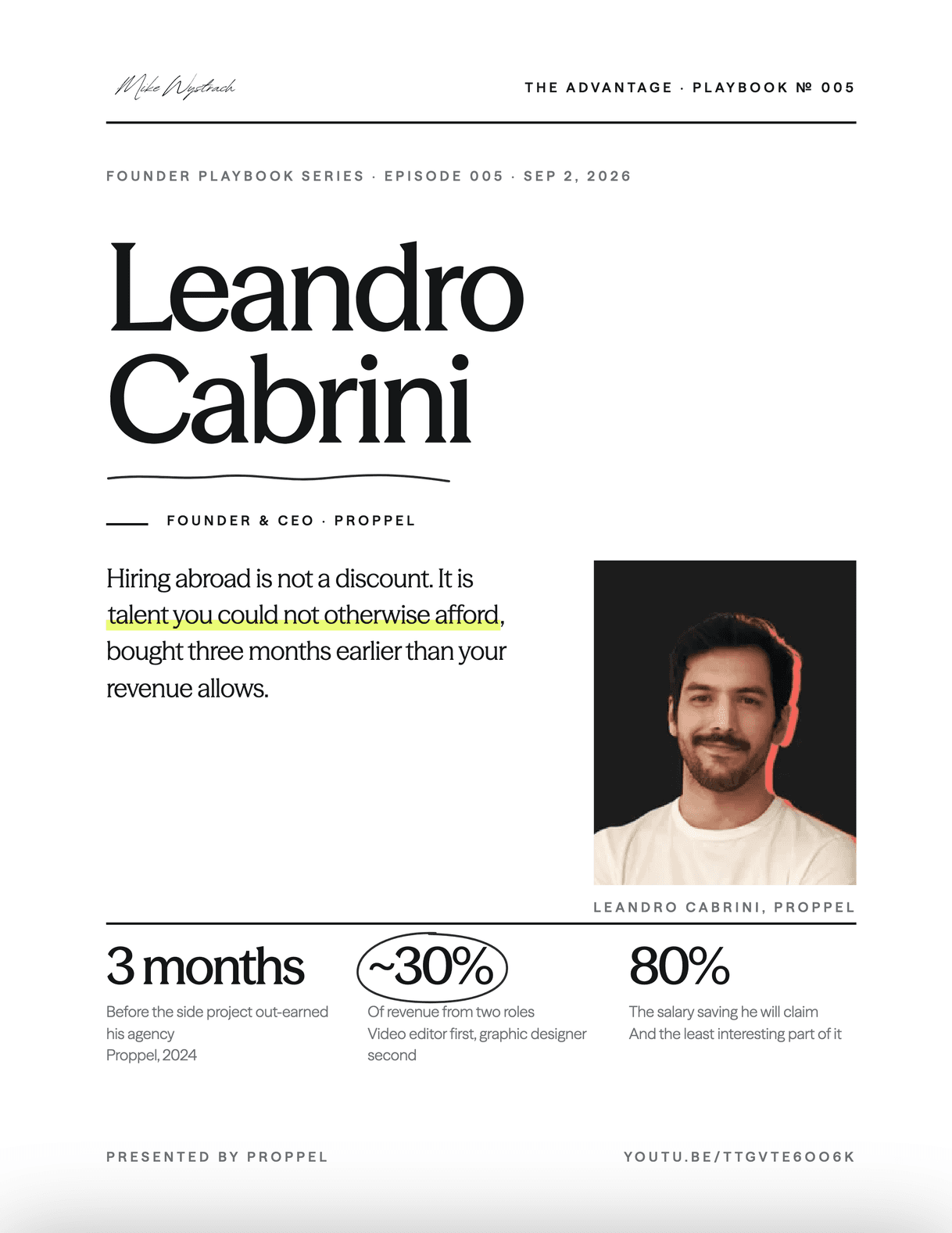
The Episode Playbook
The Cabrini Playbook
Six moves on hiring internationally, from a recruiter who was an operator first and a client who has made 700+ international hires. Verbatim quotes from this episode, what happened at each step, and a run-this-week checklist. Free.
Get the free playbookTimestamps
Mentioned in this episode
Companies
- Proppel — Leandro's agency. Marketing and operations talent across LATAM, the US and Canada, on a one-off success fee with a three-month guarantee
- Freshly — Mike's company. 2,500 full-time employees at the end, more than 700 of them international
- Petfolk — building Latin American engineering teams now, for the same reasons
- Upwork — Mike's contrast case: task-by-task contractors, which is a different thing from hiring someone onto the team
Roles and numbers
- Video editor — the most requested role Proppel fills. Graphic designer is second, and together they are about 30% of revenue
- Creative strategist — the fastest-growing request, and the one he says is hard enough that difficulty is why people call
- US comp — $100,000 to $150,000 base plus bonuses for a good creative strategist
- LATAM comp — $6,000 to $8,000 a month, with no FICA or SUTA on top because these are contractors
- Beyond marketing — operations and supply chain managers, project managers, executive assistants, bookkeepers, accountants, front and back-end developers
- US placements — managers, directors, heads of department and VPs, mostly in marketing and operations
Concepts
- Built by operators, for operators — Proppel's positioning, and literally true: he built the thing he needed for his own agency
- Hire ahead of the curve — the saving is not margin, it is the ability to hire three months sooner than revenue allows
- Tasks before roles — list the daily work first, then find out how many people it actually is
- The test project — give an editor a brief and raw footage. Never run an interview stage with no stated purpose
- Time zone as the cheat code — Mike's rule for a team without dialled-in SOPs: same hours beats better process, early on
- The cultural translator — a good in-market recruiter explains each side to the other. In Belarus a 10% annual raise was the norm, and not knowing that reads as a demotion
- The real cost of hiring is not having to hire — Mike's line on opportunity cost, the number operators measure worst
- Penny wise, pound foolish — his frame for saving money on the search and paying for it in the hire
Show notes
We turned the six moves from this episode into one free PDF, The Cabrini Playbook → https://mikewystrach.com/get/leandro-playbook
Presented by Proppel. Get 10% off your first hire: https://www.weareproppel.com/theadvantage
Follow Mike on Instagram: https://instagram.com/mikewystrach
In this episode Mike and Leandro cover the task list that has to exist before the job description, the purpose every interview stage needs, the test project, the onboarding almost nobody builds, and the time zone trick for founders with no process yet. The rule underneath all of it is the one Mike has hired by for a decade: go get the person you technically cannot afford.
Full disclosure, and Mike says it in the first minute: Proppel is the presenting sponsor of this show. He found them through Google and ChatGPT, hired through them, and went to them about sponsoring afterwards.
⏱️ CHAPTERS
00:00:00 Intro
00:01:38 He Started A Recruitment Agency Without Ever Running One
00:06:41 Freshly Had 2,500 Employees And 700 Were International
00:09:01 Cheaper Talent Lets You Hire Three Months Earlier
00:14:40 Everyone Can Hire. Onboarding Is Where It Breaks
00:17:35 Write The Task List Before You Write The Job Description
00:21:50 Time Zone Is The Cheat Code When You Have No Process
00:23:29 Hire The Person You Technically Can't Afford
00:34:55 A US Creative Strategist Costs $150K. In LATAM, $6 To $8K A Month
00:45:44 The Real Cost Of Hiring Is Not Having To Hire
🔗 LEANDRO CABRINI
Proppel: https://www.weareproppel.com/theadvantage
LinkedIn: https://www.linkedin.com/in/leacabrini
The Talent Standard: https://www.youtube.com/@Proppel
🎙️ THE ADVANTAGE
Apple Podcasts: https://podcasts.apple.com/us/podcast/the-advantage-with-mike-wystrach/id6783458081
Spotify: https://open.spotify.com/show/033DuFkyBRu3qvgp8ozPz1
All episodes: https://mikewystrach.com/podcast
Free playbook: https://mikewystrach.com/get/leandro-playbook
⚡ PRESENTED BY PROPPEL
Get 10% off your first hire: https://www.weareproppel.com/theadvantage
#howtohire #Proppel #TheAdvantage #MikeWystrach #Hiring
Full transcript
Mike Wystrach in conversation with Leandro Cabrini. Lightly formatted from the episode audio.
speaker-1: I never ran a recruitment agency before when I started my recruitment agency. We kinda started doing it as a side thing and then after three months later, Propel was doing better than the Performance Marketing Agency.
speaker-0: When I built freshly, we ended with twenty five hundred full-time employees, but we had over seven hundred international employees as well.
speaker-1: You can say up to eighty percent in salaries.
speaker-0: Over the years, what has been the most popular job you
speaker-1: Now number one is by far. There are lots of companies out there that where they charge you 3k a month, yeah, and then the agency pays maybe a 1000 to the candidate. What percentage?
speaker-0: What do you think of your business is is just market?
speaker-1: I would say probably maybe like sixty percent. If budget allows you can hire in the US someone good between a hundred to a hundred and fifty base. in Latin America we're seeing six to eight K a month.
speaker-0: Did we hit everything you wanted to hit? Leandro, very, very excited to have you on the podcast. And really excited for multiple reasons. First of all, you are the person who first bet on us and and I think our missions are aligned on and really helping out the startup ecosystem and and you know how do we continue to build this ecosystem. So very much appreciate Propel sponsorship as our title sponsor, but really excited on this because this actually happened a little more organically, which is We started talking about you guys in the newsletter, started talking about on podcasts and and people ask started asking me a lot of questions on primarily in the newsletter, asking for more information. So I said, you know, let's just get you on the podcast and share some of this information. So thank you for coming on.
speaker-1: Thank you, Mike. That's great to be here. Thank you for inviting me. So I think
speaker-0: I think let's start 'cause I think your background is obviously very important in the agency you've built. you know, you guys say built by operators for operators, which I love. And I think so, give me a little bit about your background.
speaker-1: yeah, so that's that's obviously a big part of what we do, you know, like being, as you said, you know, built by operators for operators. my background I used to I used to run my background is in marketing, actually, not in recruiting. So I used to run a performance marketing agency and an e-commerce too. And because I was born in Argentina, as I was building these companies, I always knew that we had some great talent in Latin America. So I kind of like started thinking about it and I was hiring people in the in the UK where I'm based, actually in London. but then I was like, we have some great talent over there, why not start hiring people over there? so we started doing that, you know, and after a few years, some of my clients and some agency friends and partners used to you know, they they started asking me, like, hey, can you help us do the same for you for us? and that obviously it was like, well, you know, at the beginning I was like, no, I don't wanna, you know, I wanna focus on this, I don't wanna do 10 million things. But then at some point I was like, Okay, let's start doing it as a side thing, you know. And we kind of started doing it as a side thing. And then after like three months later, Propel was doing better than the performance marketing agency. So then so then I was like, Well, I should probably focus on this, you know. So then I just went all in and then that's that's how we started.
speaker-0: Let me pause here for a second. The show is brought to you by Propel. They find brands like yours exceptional marketing and operational talent in the U.S., Latin Am markets, and beyond. For now, the links are in the show notes, and all of our listeners get 10% off your first hire. Okay, let's get into it. That's awesome. And and you guys are now, I mean, and so now you've expanded even beyond just doing Latin recruiting. You're now doing recruiting here in the States. You're doing kind of walk through a little bit of the trajectory of the business just in total, because I think it's been pretty phenomenal just as like for for all you people thinking about startups are thinking is like I do think sometimes you accidentally fall into a startup idea even without knowing and it's like and I always think scratching your own itch is like the the best way to do a company and and like if you have the pain, if you're currently doing the thing and you're recruiting and then it's amazing that was kind of like how freshly started is I I wanted to solve I just wanted to eat healthy. And I started solving it for myself. And then people were like hey could you do this for me? And and Very similar to you, very quickly freshly became bigger than the restaurant that I had. And so I was like, well, wait a minute. I've got this accidental business that's bigger than the the core business. But now you guys are doing wait now to walk through kind of where Propel is today. But where are you guys today?
speaker-1: Yeah, so we do like marketing and operations is our core thing that we do. that's for both for Latin America, but we also started having some of our clients reaching out to us after hiring a few people in Latin America, they started reaching out to us because they had some US roles too, like US based for US based candidates. so we you know again because we had built a team, like a very strong team, we had lots of people, you know, we have employees in the US, we have people all over Latin America. Who had lots of experience hiring in the US. We were like, why not, you know, kind of like take on those roles. So we took some of them as a trial first. We did really well and we had great success with that. So basically expanded from only Latin America to the US, also Canada too. so that was that was really good. So we're doing that. and we're also providing some more strategic support to to some of our clients, in terms of like talent strategy and things like that, which is super important too.
speaker-0: Yeah, as you think about like any talent. Yeah, talent as you think just holistically is you guys are in the talent recruiting business and then thus have to recruit your own talent. So you're kind of like living your your own challenges.
speaker-1: Yeah, definitely. Look, I think I used to I used to deal with meta and meta has lots of issues, lots of things that are unpredictable and now I deal with talent. So talent is is also, you know, like sometimes you you're dealing with people. So it's it's important to have a plan and to you know, to make sure that you you know what you're doing.
speaker-0: So our introduction to Propel, which is is like so many, was through a combination of both Google, but then also I think ChatGPT. So what we were trying to do is so as I'm building up the advantage, we have a team both in-house, and then now we were looking to supplement to how can we supplement what out of house and for different roles within marketing. Now I've done a lot in marketing, meta marketing, these things, but I haven't done that much directly in kind of social kind of influencer marketing and So we felt like really good opportunity for us to look at international talent. But because we really felt there needed to be a high degree of kind of like interconnective, like day-to-day working the same hours, Latam made a ton of sense because time zones. and so you know, backing all the way up when I built Freshly, we ended with 2,500 full-time employees, but we had over 700 international employees as well. And so those international employees were everything from Technology, data, customer service operated out of Belarus, Poland, Philippines, South South Africa, and then Latam, different countries in Latin America. And then when we built Petfolk, we've done the same thing now with supplemental. And I think there's two ways I think about it like bringing on international talent. One is there is cost savings. So there is no doubt that when we look at it that But the bigger things in really competitive markets is you're tapping a different and I think this is maybe the under like in Belarus and Poland where we had most of our data and engineering, that was not as much about costs. It was more about access to talent. And what we were finding is the access to the the talent that we could get in those markets. And that's what we've been so surprised with Laddam from a marketing standpoint, is the access to t really world-class talent is also there. So how much like and so and then again I'll I'll stop for a second, but we I was really excited because we actually spent a lot of time on your site and we're gonna we're gonna post in here in the descriptions. They have a ton of information. If you just wanna get smart on, you know, recruiting, and you guys have put together a ton of amazing information on recruiting in Latin Am. But like what do you like, what are kind of some of the the questions that people come to you that you think are like the number maybe top one or two things people like don't know about. recruiting kind of international talent. and then, you know, or they have completely wrong.
speaker-1: well that they don't know. There are lots of people that are still not even hiring in Latin America. Like they they just you know, sometimes I I jump on client calls and and you start telling them like, you could actually hire this role and that role and this role and then they start, you know, like thinking about it and th you can see it in their eyes, you know, like you can see like, wow, I can hire these people and like you know, they have like maybe fifty people you know, all all in the US, which is great too, but like when you start thinking about outside too Overseas talent and again the cost savings is a big part. Another part that I think not many people look at is like how you can hire a lot ahead of the curve when you're hiring abroad because of the cost savings. Which means that you as a founder, as you're building a business, you know, you need as much time as you can to do stuff. If you can hire someone three months before, that means three month three months more that you have for yourself to like really focus on the things that matter, you know? So I think that's that's a big thing that it's not just yes, it's gonna be cheaper, that's great. But but that helps you build a a better business. Margins help you, you know, provide a better service. Healthy healthy margins means more profit, you can pay better salaries to your your people, you can go on more holidays if that's what you want, you can do whatever you want and with that more marketing, you know, like it's it's just a no brainer, I think. so yeah, that's that's the the main thing is like a lot of I I find that even though people who know about Latam, they are like, Yeah, that's great, like we know how it works and everything. But there's still like maybe fifty percent of the people that we talk to. it they are they haven't hired in Latam yet, you And what
speaker-0: you think the value, because I I mean I'll c I'll give you mine, but from your perspective, what do you think the value is of having a an agency, but someone who's who's really who knows that market really well and knows the Latam market, knows the culture, all those things? Like how much value do you guys bring on on making sure that you're, you know, from the recruiting standpoint, you know, when you go into a different culture, it is important to have someone who understands it.
speaker-1: Yeah, so I think there is there's lots of value in terms of having a team of people who are doing this every single day and at scale, you know? It's not the same like we we've had some clients that have an internal recruiter, but just one person can never compete with having, you know, like a twenty person team working on this every day. And you have you're not only thinking about a twenty person team, like you're thinking about people in Latin America who knows that you know, they know the candidates, they know the candidates' culture. They can communicate with them on a very personal level. Plus, we also have our leadership team who are based in the US and they can they have a really good understanding of the US side and the how you know companies operate here. So when you combine those things, plus you know, 25 years of experience some of our leaders have in recruitment. So obviously that you can't just buy you know with with someone in in-house in some in unless you are a big company. so there is there's lots of value of that combination of experiences plus obviously the operator background that we we discussed before, that that's that's been s with us since we launched. When you combine those three things, it is very difficult to to build that internally as a you know, as a as a startup, let's say.
speaker-0: Yeah, and that's always again, my advice and and this is authentic across every business is is as you look to recruit in a market, an international market, make sure you're getting someone who's who's who really understands that market. Because I always think what we saw the benefit is is it's like having a transl a cultural translator between the two parties. And and what we s what we benefited from is always having someone who could say, Hey, Here's the expectations of this kind of employee base. Here's here's how they think about things. Like I know in like in when we were in Belarus, no longer in Belarus since the the Russian war, but when we this is pre-Russian war, the culture there was very much around that if you're a good employee, every year you got a 10% raise. And so if you didn't give a 10% raise, that was viewed as like a negative thing. So it was always our recruiter was very like, hey, here's where we're gonna start them. But y every year you're you're gonna the expectation is this is gonna so it was it was really beneficial because like in the US that would not be the case. Like if you're not getting a promotion, you're not getting a 10% year over year increase. but so I I think that culture, but then it was also likewise very helpful to have a recruiter talking to our potential candidates and saying this is the expectations of what a US company is gonna look like, right? And so I think, you know, where obviously if you're recruiting in the US for recruiting. For US talent, there's kind of like there is not as much of a cultural barrier. Maybe inner like company culture where like not every company is the same, but that that was a huge benefit for us as we looked at every market. And that's why when we looked at Latam, like our my immediate thing is let's find the best recruiter in that market who's really focused on the area. Because as you said, it is a bit of network. Like when you're in the Latin American market and you're focusing on marketing. then the best marketers are coming to to your site and they know you and and that translation. And and we've been I I I mean, I've been thoroughly impressed. And that's why we reach out as saying, hey, we love because I I think what we our focus was when we brought in a sponsor was is this something valuable to our community? And I think I think, you know, having access to international talent and I think especially in that you guys are success based. So like, you know, again, this is the other thing I'd say with recruiters is you always want to try to pay them on success. Now So in that you guys are success based is like we only pay you if you succeed for us. So that's that's always I think amazing for for for me is like but we were so thoroughly impressed. And again, we're gonna link all this stuff in like all of the the PDFs, the documents you di kind of walking through was w I thought phen phenomenal.
speaker-1: That's great. Yeah, yeah. Yeah. I think two things there. Like what you mentioned before, the you know, the recruiter is not just helping talent understand the the company culture, but also the company understand the the like the culture in or what things are normal in in those countries where you're hiring. I think it's one very important thing that lots of people don't think about is onboarding and retaining the talent. Because everyone can hire, you know, you can say, Yes, this is a good C V looks good, let's just hire them. And then they, you know, you can't retain them because they they don't work out or because they leave because, you know, you didn't have a proper onboarding plan, or you didn't do those races that you mentioned, you know. So I think that's super important for us as an agency to kind of educate, you know, our our clients in a certain way to like, hey, this is how you deal with this, like, you know, o offer some like PTO, for example, maybe some some kind of like like US holidays and things like that, which makes a a big difference for them. so yeah, that's that's it that is super important. And then working on a performance basis is also very attractive, you know, for for people. we have a really good system. So we are, you know, we know that we're gonna do a great job. So it's it's easy for us in some ways to just say, you know, will you only pay us if if we find someone great, you know? Yeah.
speaker-0: And you and I I think I mean again, I think that obviously it speaks for c you guys have grown so and if you're only growing on success, then you obviously have to like so I think it's a testament to obviously, but where my advice always, and this goes to any any founder out there or anyone thinking about founding, is I like to think about where I found any kind of external talent, whether it's I I do like I'm a big butts and seats guy. And I think when you're hiring and you need generalists and you need people to connect everything, it's I've at least found that it's difficult to hire that out of house, whether that out of house is in, you know, Argentina, whether that's in but where I do think we have found, and you said this, is like as you grow to a certain point, and it do you know, the I I think it's not necessarily a revenue, but it's more of a team size, and you start getting specialists. And what I mean by this is it's very clear like You know, we went with just like the advantage where it was like, okay, we have a generalist who's kind of doing everything. And and then Greer now needs specialists. So she needs a a specialist editor, she needs a specialist socialist, social manager, social strategy. And that's where I think you can supplement and and really important as you start growing is I think that's where companies really start succeeding, is when you go from being a bunch of generalists to being a bunch of specialists. And so I do think that's a Big part of succeeding in at least in my experience with international expansion is really understand like what very, very specific skill can this person do. And I think your guys' website does a great job of kind of like not just saying, okay, here's a marketing person, which is like, well, that's very difficult, but like exactly what the specific roles are. So walk through kind of like your that's my experience is. As being on the other side, what is your experience on if you were gonna give advice on like what are the two, three, four things you need to do to really successfully hire international talent anywhere, you know, in the Latin? What what is the what needs to be done on the operator side before you can be successful with the with the employee?
speaker-1: Well, I think that the first and main thing is to really know what you need. Because a lot of people they just think, Well, I need someone who maybe can do this and someone who can do that, a little bit of ed video editing, a little bit of like calendar management, and then it's like, Well, you need two people for that. You know, you're not gonna get a video editor who can also manage your calendar. Maybe that's an executive assistant or or maybe it's a project manager, or what is like so the first thing to do, I think, is just to write down a list of tasks that you need you know, like someone to to take care of. and then really understand what they're going to be doing on a daily basis. and that that way you can you know if you need like one, you know, one video editor or you need a project manager or you need a copywriter or you need a social media manager. You know, there are different kind of roles. You can combine s some roles sometimes. But under st really understanding what you need, I think that's the first thing. I think number two I would say is the onboarding. Like you know, well the interview process and the onboarding. Both of them like have a very clear plan about how you're going to run these interviews. Like just don't go to the interview and say, well, I'm just gonna chat to them and then we'll see what happens, you know. think about what are you what's the purpose of the first interview? What's the purpose of a project, t a test project? We always recommend that people do test projects, you know, that you do If if you're hiring a video editor, for example, you give them a brief with some raw videos that they can edit and and that's a way you can test them, you know? so really know what's gonna happen at each stage. And then maybe if you do a second interview, know that you're going to, you know, ask maybe a little bit more technical questions. Maybe you're going to review the project together, ask them questions about that. so that's that's super important. So then you can run a tight process, you know. You don't wanna just be like winging it as you go. and then with the onboarding, the same. This is something again, like you can be great at like, yes, I can find great people, but obviously you can pay us too to do that. We'll be great at that. But then once you hire someone, you need to be very good at the onboarding side of things. You don't wanna just, you know, even if someone is great, they are not going to know how you like to do things. So you need to have certain SOPs, you know, processes, you need to have guides, you need to have someone who's gonna be managing them, who's gonna be showing them around. Again, even if they are great, they need some kind of support at the beginning just to you know, know how you like to do things. so that's super important, I think, for just to make sure that you are successful because otherwise you lose people and the best, you know, best candidates have lots of opportunities if you don't have a good experience from the beginning, you know, like this is from the time you met them on that the first interview until or you reply to the first email to them until three months in. That needs to be really, really good to be able to, you know, get the best talent. And if you wanna build a great company, you need great people. That's the only way you're gonna do it.
speaker-0: And I think that is a big distinction that people need to is that like there's there's obviously businesses like Upwork and all sorts of businesses where you can go get a con like a contractor and you can just give them a task and they go do that task. This I do think when you go to the level of saying you're you're bringing on kind of like international employees. So i whether or not they're still, you know, they're not necessarily W two, you really have to view them as part of your team. And do the same things you would do if you were, you know, hiring someone, you know, in the US is you have to kind of really put in that same effort, which I think is also so key, is really making sure then you manage time zones. And I can't stress this enough, is that when we chose to start in Belarus, that decision meant that our engineers and our engineering team were often working till 12 To two o'clock, so that we had overlap because the time zones were drastically different. And where it meant that when we hired those international teams, they had to work those time frames. And when you do look, it's like especially young startups where you don't necessarily have the best SOPs and processes. Yeah. Time zone is really important. And so when we started looking for the advantage, we're we've, you know, it's a one person show right now with underneath me. So it's technically a two person show. We knew we didn't have process. We knew we didn't have these things. So we knew time zone was important because we needed someone on Slack with us. And we knew that like when they had a question, we just needed to answer. We needed to hop on Zoom. We needed to do those things you do. So I do think, you know, sh can't stress enough as you get older and more mature and you're really like you can you can move a lot of different time zones. But in the early days, you know, if you are US based, you know, my strong suggestion and and we've been very presently surprised is like, you know, I think sometimes people are concerned with You know, English is a second language, is that there's a, you know, there's a high degree of continuity that we've been able to see with spoken, like got in on Zoom calls, no challenges whatsoever. But I I think z time zone when you're when you don't have a really defined process, the cheat codes time zone. Cause like it's just like, okay, I can put you on Slack, and even if my onboarding isn't perfect, you can just like we can we're working the same hours. The other thing I would say really strongly suggests is morning stands. That's now the problem is again with us with Belarus, like their morning stand was our nightstand. So like, but we knew it was really important if we did a morning stand to kick those teams off. So, you know, it worked great. We had a big team over there, teams amazing. A lot of that team is now moved to Poland and moved different companies with me. And I do think you said this earlier, but like treating these the the international team as like a as as part of your core team is really important. And and the retention piece that you talked on is key here. And I I I again I strongly I I'm like, I think people sometimes look at this as like cost savings. We never looked at it as cost savings. We ultimately said, okay, if we have, you know, our engineer, this is dating me back, you know, whatever, 10 years, it's gone drastically up. But let's say our mid-tier engineer was at 150, 175. We knew that if we went into Bel Belarus at 150, 175, we could get the absolute top-tier talent. So we were more concerned of like not necessarily saving money. We were more concerned about like, can we go get someone that we technically can't afford because in the US that person's making $400,000. So we can go get that person. we were a great job. And I think that's kind of what I've I've seen as well on on like in Latin America is like, yes, you can save money for sure. There's a it's just a lower cost, but you can also make your budget, you can get significantly better talent dollar for dollar. Let me pause here for a second and introduce you to our title sponsor Propel. Every business I've built has had a huge, huge, huge piece With international talent. And as we started building the advantage, we wanted to bring in international talent focused around media, podcasts. And we started doing a lot of research and we came across papel. And we were really excited first and foremost to use them for us. And we later reached out as a sponsor. Here's the best part. It's all performance-based. You only pay one off fee once you actually hire someone. That means no retainers, no ongoing costs, plus every hire comes with a three-month guarantee. I think bringing on international talent is really hard. Really rewarding. As we all know, bringing a talent onto your team is the most important part about building a business. And with Propel, I can speak for ourselves. They have been a huge part of our ability to recruit great talent to our team. Every advantage listener gets 10% off their first hire. For more information, check out the show notes.
speaker-1: Yeah, one hundred percent. y and you can still like even if you instead of saving, you know, you can save we always say you can say up up to eighty percent in salaries. Even if you saved thirty percent, but again you get a lot more for your for your money. That makes a lot of of difference, you know? So
speaker-0: And and so someone's w listening to this. They come on, what's their expectation? They go, they reach out to you guys. What should their expectations be in kind of like I need an employee, I want a social media manager, here's like what what should their expectations be on on day one working with you guys?
speaker-1: so from day one we're going to be working with them on everything they need. So we can help them, you know, build job descriptions, guide them on salaries, salary ranges, which is also something important. I think a lot of people don't know like how much you have to pay or, you know, just how to get started. so they can we'll we'll work with them on all of that. then we will assign a recruiter to them. So they will be they will they will be working with one of our recruiters and one of our recruiting team leads to to make sure that we're finding the right talent. We also have an alignment call that we call an alignment recruited alignment call with the clients, which I think it's also super important to get not because a JD tells you, you know, some bullet points of what the responsibilities are, but we want to know beyond what you're looking for in terms of like you're you're talking a lot about culture, you know, like soft skills and culture are super important. Again for retention. We don't want to place someone who's gonna leave in in in two months, you know. We wanna place someone who's gonna stay with you for for the long run. So all of these things that we do are to find the best of the best. Then we're going to be headhunting these people to make sure that we're finding the right talent for you. and then after that, they also get obviously we're going to be supporting them throughout the whole interview process. And then once they hire someone, they're going to get a three month satisfaction guarantee. So for whatever reason, you the candidate doesn't work out, we'll replace them for free.
speaker-0: What do you think makes like a really good recruiting company versus like a mediocre recruiting company? If you were gonna kinda judge like what do you think you guys are exceptional about? And even if someone's looking across, what would you say like are the three things you really gotta look for in your recruiting company?
speaker-1: well for us I think our standards are very high. We because because again operators built fr by operators for operators, you know, like I never ran a recruitment agency before when I started my recruitment agency. So I I w I didn't build a recruitment agency as a r a recruitment agency. I was like, this is what I would love to have as as an operator, you know. So and we build it like that. So standards, super high standards in terms of who we are presenting, how we are presenting them. obsession on you know client client support and client experience and candidate too because this goes both ways that's that's super important just to make sure like hey a client is trusting us with this role we need to give them our best service ever and obviously that's kind of like connected to standards too and just you know make sure that someone who cares and who is you know not just throwing you to one junior recruiter there and to to to see what happens, you know. I think I think that's like keeping the client at at the forefront of what we do, I think is is the best. And look, this is connected also to why we charge on a performance basis. When we when when I launched the company, I thought, you know, there are lots of companies out there that do Latam talent where they charge you like 3K a month or something like that. And you pay the the agency and then the agency pays maybe a th 1000 to the candidate. And I was like, that's great because it's recurring revenue for me, but I really thought about it from a first principles perspective. And I was like, What is the best for the client and what is the best for the candidate? The best for the client is that we get paid one off only if we find someone great. And the same for the candidate, because the candidate gets the whole, you know, like paycheck. so I think if if if the company was born that way, you know, you're you're already thinking about what's best for the client. When the company started, that's that's the best you can you can get, you know.
speaker-0: Yeah. No, I love mean, it's it it's a perfect I mean, it's a win I obviously it's the from an operator standpoint, it's the you know, which is what got us excited. It's the first thing I always ask is is like, is this entertainment or is this because if it's success, it's zero risk. And I think that now what I will say for everyone out there is that it is garbage in, garbage out, in that your success as an operator, as a company, is solely based on your willingness to do the work. Because at the end of the day is I I do think the commitment is really Do you want to run a good process to find the best person there? And, you know, I do think, you know, when we spoke in in in depth on on this process, was like you you have to have a recruiter who's what I've seen in sometimes is the recruiter just wants to get you a person, right? And so that's where I always hate the retain because if you pay a f a a flat rate and you say, okay, it's 10 grand per search. Okay, great. That sounds, you know, or five grand per search, right? So it's like, okay, well, then now they're their their incentive is to get you. Someone quickly, right? Okay. I'm gonna get you as quick as whereas success is like we only win if if if if you win with the right person, you guys are guaranteed a ninety day. But then the only way we get a referral or you to come back is that person is the right person. And and so I just I I love that model, but I do think like you gotta you I think thinking through this as like an in in-house if you do it right, I c again I can say I've hired over I we've hired not me personally, but we've hired over I don't know, six, seven hundred international employees. And I've done it both good and bad. and the bad was always very fast and like, we just thought about like we want to go really quickly and get someone. And the good was being methodical and thinking through the hiring process that no different than in the in the US. And what I what I've really found is that the retention has been like the best thing for us is we really built a good process. We matched the right culture, the right fit. We gave it differentiated opportunity because working for Our companies was different than working for another Belarusian, but we also really adopted them into the culture. We did a lot of things that really had them feel we, you know, over time we would s the after a few years retention, they would come visit for a month and work out of, you know, visa dependent, but work in office and and really build that bond. And and and so that's where I I I just, you know, I can't stress it enough when you're ready and when this fits in an organization. I think it's a massive unlock. And that's why I was like, got a lot of questions. I was like, we definitely got to get you on on the pod because and that's why I was excited to have you as a sponsor as well. Because I think, you know, as you scale and grow a business, and especially if you're scaling and growing quickly, I think it's an and. I don't think you're hiring, at least for me, is I've never been able to succeed just hiring international talent. but I think it's a huge supplemental piece of a team. And I don't think about it as like we were, you know, this is different. It's like, no, it's just that you live in a different region, a different area. But I do think the partner you had in all 700 of these international employees, we've never tried to self-recruit because we've always known getting a local partner in the local market and paying a little more is just it's even when we had, I mean, in when we were in Belarus, we had a complete, we had a full office of nearly a hundred people. We had an office for the whole thing and and and we still used out-of-house recruiters. Cause it's it, you know, there's just like it's we're not trying to save money. We're on the recruiting part. We're trying to get the absolute best talent we can get. You hit on another thing, which I think is really important, is which I think sometimes, and you guys do a good job even laying this out, but a lot of times as markets are evolving and moving and by By knowing exactly like when you just place talent and being like, okay, here's what top talent's actually making in the market or here's where like, yes, there there aren't that many jobs for this. Like, 'cause sometimes like different markets are moving differently. How much do you think you guys I mean, your guys are in these markets all the time. That proprietary information that you have is like on where to price or how things, you know, how aggressive to be on offers.
speaker-1: Yeah, yeah, definitely. I think that's one another point what makes a great agency, you know, like this being specialist in something. We do marketing and operations very well. And especially for, you know, like lots of e com brands and and e-com performance marketing agencies and things like that. w we work with lots of them. So by working on similar roles, we understand, you know, what they are looking for, who performs well, who doesn't, who works out, who doesn't. And obviously how much people are getting, you know, how much companies are paying, how much talent is you know, worth depending on the seniority and all of that. And that's that's super important I think as a as an agency, as a partner to to know to make sure that, you know, our clients are successful.
speaker-0: Over the years, what has been the most popular job you've filled? Like what's the like the the if you said like this is absolutely the n most popular job we filled, what's that?
speaker-1: video editor by far. Video editor. Video editor by far and then graphic designer number two. Okay. I think those two are probably account for like maybe thirty percent of all our
speaker-0: What's the one that's trending fastest now that you have like y it hasn't historically been that big, but now a lot of people are are looking for this kind of role?
speaker-1: now number one is creative strategies by far. Everyone wants a creative strategist. But it's a very difficult role. That's why they come to us.
speaker-0: And when you look I'm gonna paint with broad strokes, but we'll put you on the spot a little. When you look for like if I were saying I want a gr amazing creative strategy, how much should I be thinking about this from a cost standpoint?
speaker-1: well it depends on where you like it depends if if those are roles that sometimes if budget allows you can hire in the US. and that would be anything between, you know, like someone good between a hundred to a hundred and fifty base plus bonuses, hundred and fifty K a year, I mean. in Latin America we're seeing five to eight, six to eight K a month as a salary. But again,
speaker-0: seventy thousand versus basically half. Yeah. and then that and then in the in the Latinam market, what are are there other costs that are gonna go along with that? So like obviously in the US you're gonna have you're gonna base bonus, you're gonna have FICA, Sutra, you know, all of the benefits and stuff. Are there any other additional costs on top of that?
speaker-1: No, maybe some bonuses. So at that level you are paying some kind of bonus or some kind of commission for performance, but not not much more because they are contractors, you know. So
speaker-0: And then where so when you think about this the jobs that so and creative strategists obviously can go both ways because sometimes creative strategies you gotta be very close to the brand. Their editors is is, you know, I would imagine a an easier kind of international position. What do you think the top jobs that you if you're making a recommendation and saying, okay, I'm building out, I have a marketing org and let's just say it's a massive marketing org, what what parts of the marketing org do you think people should look at least look to say like this this can be really good international. Like we feel like these guys succeed the most the most often. what are those jobs that you think absolutely succeed the most often internationally?
speaker-1: I would say definitely video editors, graphic designers. And graphic designers is not just like designing ads. You can also have designers for email, you can have designers for packaging, you can have designers for out of home advertising, for whatever you can think of that for sure. then in terms of you know the the UX UI design, landing page design, all of that stuff too, like web developer web development, like all of the roles that you mentioned, obviously they are super super popular. then for brands on the operational side also super, super popular, you know, anything operational, operations managers, supply chain managers, all of that stuff, it's actually very popular. You can get some really good talent over there.
speaker-0: Much of you branched off just marketing. I know marketing is where you started. What other kind of big categories? So operations you just hit on, up supply chain management, what other things?
speaker-1: So operations is kind of like also as popular as as you know, we like project managers and things like that are super popular with us, executive assistants and things like that. then we also do some finance and IT roles. So finance, you know, bookkeepers and accountants are the two most popular ones there. We do a lot of that. And IT, you know, front end developers, back end developers, any any of that, you know, web developers, UX UI designers.
speaker-0: Yeah, and we've started doing at least at Petfolk, we've got a lot of international like Latinam teams on the engineering side now. So we're we're we're building that out. We've seen just tremendous talent in there. and then as the cost basis has gone up and kind and andor challenges with kind of traditional Eastern Bloc countries from just like post-Russia, Russian invasion of Ukraine and Ukraine was obviously a hotspot for a lot of talent talent there. Latinam's certainly an opportunity. When like so When you think about your core customer, what do you think like is like the bet like when does it make sense to to start thinking about bringing on international talent? what what do you think is like the like the magic spot? Is there a magic spot or is there something that like you you think is like if you're advising a company saying like you're not ready or yeah, you are ready?
speaker-1: I think it depends on the skill set of the founders at the beginning. Like when you're very tiny, you know, if you need someone to help you with maybe you need a project manager to help you organize your things because you are not organized, you know. And then if maybe it's like your number three higher or number like four higher, you know. So it's you can you could start really early if you have again like the or the time to be with them as you were say as you were saying, or or you have some processes in place, you know. The good thing about putting processes in place that you do it once and then that's it. They can read it, you know. but yeah, that's I think from there on I would say you we've seen everything. You know, we've seen companies doing really, really well with like maybe three, four, five people in the US and then they have like fifteen overseas talent, overseas candidates. so I think from there and then obviously as you grow, this helps you, you know, economies of scale. You can hire more people. And that means that you're saving a lot more in salaries instead of hiring, you know, you had a hundred people in the US or you can have forty people in the US and sixty, or maybe eighty, you know, in Latin America. And again, you get a lot more for your money and it's it just makes a massive difference, you know, in the to the bottleneck.
speaker-0: Yeah, and I also think for a lot of companies, a lot of you out there that like so I think the challenge with a lot of these hires is that if you're in a fast growing startup and you're more of a VC back kind of startup and you're giving equity in these different things, you can kind of compete on price if you're giving equity. So at Freshly and and Petfolk, we've done that. But then if with the advantage is kind of we're scaling that more is like the traditional mom and pop cash yeah. So there's not like an equity piece. So it's very difficult to compete with to compete in these markets, you know, you're competing against super large companies that are paying really high salaries. It's very difficult to compete on like that, you know, you were saying like on the, you know, creative creative strategist. Well like the 150 US, but like the best people in the US are, you know, they're getting offers for 300, something like that. So if you really want the best person, it sometimes I have at least seen for different companies where you don't have an equity offer, because I do think one of the exciting things is joining a startup is obviously you can offset an equity and that can be highly rewarding, but it's just difficult if you're building a different a little if you're building your different business different. How much of your guys' business is actually marketing agencies that are looking to supplement their their agencies?
speaker-1: so I would say maybe like fifty percent. So fifty, fifty I I always say like fifty percent brands, fifty percent agencies basically. Okay. Brands when I say brands it's like C P G, e com DTC brands.
speaker-0: And what what do you think when you think 'cause I always think like what do you what should the norm be on kind of like, is it a normal forty hour work week? Are you managing like what how's the expectations with that like, you know, that kind of that employee in the Latinam market?
speaker-1: For us, so you can find everything. For us, what we do is forty hours a week full time permanent and only working for you. You can find people part time outside what we do. We don't do part time roles, we don't do temporary roles. We only do full time permanent because again, we believe that as you said, you know, bringing someone as part of your team makes a huge difference. And again, they can stay longer time for you with you and that's that's just better for everyone, you know. So
speaker-0: Yeah, and I think I mean that's obviously why it makes a ton of sense for agencies because it they're scaling like very tight verticals at scale. And I think for companies, this is where I think it's being it's it's being very methodical on when the job goes from being a generalist to a specialist. And then you can y there's enough work to fill that 40 hours. because that's at least in my experience, that's where success is when you can really say like 'Cause your point, it's like very hard to be a good project manager, an engineer, a graphic designer. There are them out there. It's just it's very difficult. And I think going to a recruiter or anyone with like a here's my unicorn wish is like it just i I mean, it you can occasionally find success, but someone's winning the lottery every day. It doesn't mean you're going
speaker-1: We won't take those roles, but yeah.
speaker-0: to rec lot of recruiters will and they'll just tell you like, yeah, well you've got someone who can do that. And I I love that you guys are very specific on that. Of like, no, you really need to You know, how much you like when so if people are curious on this and I think I'm sure there's gonna be a ton. So first I would start with some of the links and you could dig in. What what's usually the next step? You do an introductory call or what's the what what do you think the best next steps after kind of reviewing some of the information you guys you guys put out there?
speaker-1: the the first step would be to reach out to us, on the link in the description. this the video and then I would say yeah, we'll have an introductory call with one of my team members and then from there we'll we'll get started, you know, like it's as soon as we have we just need like a we usually need a job description sal a salary range. We need to align on that to make sure that we are aligned with the market and everything. and then for video editors or graphic designers or any creative role we'll roles we would need some kind of examples f of you know the editing that you need and then from there we can get started with the with a team. But there we go.
speaker-0: And then walk me through just kind of going through like obviously you guys, it makes a ton of sense after you really have placed a bunch of candidates to now say, okay, well, now we can support with US talent as well. So also like in that you guys are now I I also think very interesting and and you know, for those of you again, I love the fact that it's success. So if you're also thinking US based talent, because sometimes I think if you're going for a little more of a generalist or it's not as tight, sometimes you can be more successful with US kind of in in talent. Ha walk through kind of that. You guys have now, I mean again, you started off just purely kind of Latinam and then now like where do you think like where are you guys succeeding with like the internet the the US talent?
speaker-1: So the majority of what we do in the US are more like managers, directors, heads of department and VPs and within marketing and operations, I'd say. Yeah. So more like senior level, you know, talents, senior level candidates for those role for those roles. you know, directors of performance creative, dire directors of growth, heads of growth, things like that.
speaker-0: Yeah. And so I I I guess what I would do you know recommend is least as a like think about for people is that if you are thinking about at some point you want to go with and start building kind of a a international team, kind of recruiting in that mindset and that basis is is is is helpful and having a recruiter who's kind of full service. Cause I I do I again, I I think a big benefit I've found is is having a f at least one, if not to trusted recruiters who really know your company, know your culture, know how you like to do hiring processes and stuff. If you are scaling like, you know, pretty rapidly, it it is a it's a huge benefit. And I always think people are overly focused. Like the real cost of hiring is retention. And I always just tell people it's like the real cost of hiring is not having to hire. again, cause like the the worst thing to do is if you bring in great talent is is that that talent is is is just worth so much. And when they leave that day, it's is is like that cost is hard. it's hard to to measure because it's an opportunity cost. so you know, I just strongly suggest getting really good talent recruiters and you know, if you want to build it in-house, I think you can supplement it. But I do think in in specific regions or really specific task, it's almost always better to have a specialist for for my two cents. Do you yeah I and then on how much what what percent do you think of your business is is is marketing just marketing roles?
speaker-1: I would say probably maybe like sixty percent or something like that. Okay. So it's still sixty, yeah. We we just we are very heavy on that because again we started with that and that's my background and it just like a lot of our business comes from referrals too. So when people talk to other people about us, it's like, we hire a video editor with this guy. So then then then then we get a referral for a video editor, you know?
speaker-0: And then I know you're now again, I it's always great when like businesses get built on like, you know, customers asking to do stuff. But you were talking and we were brief briefly talking, but like you said you're starting to get more into strategy and consulting for long term. What does that look like? What what kind of what's your guys' service offering on that?
speaker-1: So with that we have a couple of different things. We have one which is interview guides. We we help companies create interview guides when they haven't hired, you know, a a specific role before. So they don't have even the leadership team or the, you know, like a startup. We had a start up like one one of our like very good partners. They are like at a a C B G brand at a hundred million revenue a year. And those guys, they were looking for a data engineer, but they didn't have anyone in house who could, you know, like bet this person. What do we ask them? Like how do we know they are good? How do you know they're not saying anything bad, you know, they or they are just like yeah, just if they know the stuff, you know. So we basically build like a whole interview guide for them to like really know what kind of questions to ask, what red flags to look for. to make sure that we are finding the right, you know, person, what's the project look like, all of that. And then basically we had with they had a great hire with that. so so yeah, that's one thing. That's that's super important. especially when you're hiring someone that something that you don't know how to hire. And then something else that we do is compens something what we call compensation and talent strategy, which is to help companies understand, you know, like you have a company of like let's say fifty people, half of them in the US, half of them in in Latin America, you don't want to lose any of them because you you said it, you know, it's like that's the worst thing that can happen. So how do you put a a plan, a strategy for all of these people to grow within your company? You know, like some of these companies, even if you are some, you know, we have some people with a hundred million dollars in revenue and they don't have an HR team or like an HR department or anything like that. And It's like, you know, you as a CEO or as a founder, you can maybe figure out a couple of things, but sometimes, you know, it's good to have some external help. So we put together all these those plans for them and like we say, like, look, this is how we think this person can go th through depending on how what they what they like to do, what they have been doing, what kind of salaries could you think of, like when do you have to increase their salaries, what their salary will be like. So then you you get Not just like a conversation every one on one with no prep every th three months or whatever, you know, a performance review or something like that. You now you have a plan for the next year, for the next year and a half, for the next two year, two years, where you can have a real conversation with them and say, like, hey, look, this is where you're going, this is what's gonna happen. And that means that people are thinking a lot more about how okay, well, it's great. This I have I have a goal. I have a I know where this is going. It's not just like I don't even know if they are gonna fire me tomorrow or if they are gonna promote me or anything, you know, you have a plan, so
speaker-0: Yeah, I mean you know, I mean, so my evolution, I can ex again, speaking for myself, is like the first startup I did, you're you're you're really working in the business, not necessarily on the business. And then you realize and and that works when you're young and and and and not necessarily by age, but by by company formation, you've got but then what you realize is now all of a sudden you get to some some degree of there's ten, twenty, thirty people, they've been there and now there's like They want expectations. They want to have conversations on promotion. They want to have conversations on. And I do think like one of the things I found on being successful is putting your hand in the air and saying, I don't know. Yeah. And then looking and bringing people. And I think you hit on a few of these things. Lack of a strategy is not a never the the accepted strategy. Like I always tell people it's like, you can have the wrong strategy, which is sometimes, but having no strategy is always 100% the wrong strategy. So the first thing, and then to me, it was always like, Yeah, there's a degree in startups of the fake it be f fake it till you make it. But then I think there's another thing of like just ask for help. Yeah. And so that's where I've always like, and and so and sometimes it is, and a lot of times it's like you get what you pay for as well. So like, you know, and I'm not saying you I'm a huge AI fan. You guys know that from Pauline, and AI is great, but For me, as AI is like 80% there. If you really are trying to get something right, again, whether it's Propel or anyone else, my strong advice to you is if if when it comes to talent, when it comes to people, is really think about it's the opp what you what you are I think what often operators are or or startups are very bad at is measuring opportunity cost. And and the opportunity cost is always the thing I try to spend more time on and I say, like, okay. My team's gonna spend a bunch of time hiring someone. My team's gonna be spend a bunch of time onboarding that's that person. And and the opportunity of that person being right or me missing out and not hiring the right person, what is the what is the reps? What is the value on that? And so like by being pennywise and pound foolish, you really are pennywise, pound foolish, is is you think you're saving, you know, a penny, but it's really costing you a ton in the opportunity cost. And I I just Yo, again, I I was so excited on the on the partnership for us because I I was like, yes, I I only want to bring on partners that I believe is like fundamental in growing your business. And and again, not everyone will need a to bring on you know international talent. And I'm not saying it's right for everyone, but when it is right for you, get a great partner. Whether I again I put we're gonna put a bunch of descriptions here, take the time to look at Propel, have a conversation. You, you know. Two of you guys can assess whether it's going to be a good fit on both sides. And I do think it's important. But make sure you're, if you really are serious about scaling and getting international talent, like get the right partner. Get someone that that that you feel is is gonna match you and your culture and your company. and that's what they're dedicated on doing. And I just, I do feel like the the value is is massive and growing. And then, you know, I also think. What I would again, I'm gonna keep going back because I think it's I always said we well, I mean, again, speaking my journey is like use the information or provi provided to say, is this the right time? And and certainly have the conversations reach out and say, is it the right time? I I do think it's a massive unlock. I think ta you know, thinking about talent as international, thinking about talent everywhere and thinking about the the number one job of an operator, a leader, a founder is to go get the best talent you can possibly get at what you can afford. And I do think it's like Yes, it's it's not about like I want to reduce the cost, because I I've at least found in our organizations is like these were never like replacing a hire. We were never going and saying, like, we're gonna get rid of so and so. It was always like, we don't have so and so. Yeah. We don't have a creative strategist, we don't have an editor, which we're we're like literally going through. And it's like, how do we get that? how do we get that? And then and then balancing. And I think the balancing sometimes for me, and and we've had this conversation, is like, when do I need that person sitting next to me? And then when do I now really know what that role's gonna look like? And I now can really get someone successful, whether they're on Zoom. But I do think that that for me at least in this small smaller business, really important for us to be in the same time zone. Cause I just know like we're not gonna have like dialed in SOPs and KPIs on this. So this person unfortunately is gonna be like, Well, what do I do on this? Or how do I do this? Or like, you know, and and so I think that Time zone, being on Slack, being on the same, you know, Zooms and stuff like that. Doing the morning stands is really important. But I'm super fire, as you can tell, I'm super fired up on this partnership. and I think it's gonna be like a one of the as I when I when we talked, I was like, I guarantee this is gonna be bi-directional successful because it's gonna be so much value for you, the listeners, the viewers, the watchers, the readers on the advantaged newsletter. and I think it's gonna be successful. You guys, you guys are already killing it. so I was excited. For you taking a bet on us too, 'cause I know we we didn't have much to show. We had no podcast out or anything and you took the bet.
speaker-1: I I took the bet because of you, because of your trajectory, what you've done, so and I know this is gonna be great too, so
speaker-0: we're gonna put a ton of links in here. I've already written, so I will put some stuff that I've already written on what I think the, you know, some of the things that I went off and talked on. you're also make sure to follow the advantage newsletter, follow our podcast. You'll see these guys show up a lot. But I'm really excited. Thank you for coming to New York to visit us as well. this has been awesome and we're gonna have a ton of fun and I'm I'm really excited on this. check out all the the links and stuff. Again. I think propel is amazing. I can single-handedly say we're using it. But even if they're not right, the materials they have are awesome. And and like find the perfect fit for you. But I think having a a really thinking about talent b broadly, and I know there's probably all a lot of people, hopefully there's a lot of people not just in the US that are watching and listening to this, is is talent is all over there. And you have really thoughtful, smart, creative people. if you were worried about English as the first language, you can you could you have, you know, we've I've never had a challenge with that. so I just think think about this is is how do you get the best? What I have been successful, number one thing that has gotten me successful is hiring amazing talent, getting people. I am generally a very good generalist, and I'm a very bad specialist. So I always try to fire myself with specialists who who now make me look like an idiot. And I've done that time and time again, where I'm like, my God, I can't believe how bad I was at this. But really excited on what you guys are building. excited to be a partner with you and and this is gonna be a fun, great partnership.
speaker-1: Thank you, Mike. Great to be here. All right. Thank you. Thank you.
Get the written version
Every week Mike writes up what he's learning from these conversations and the companies he's building. Free.