Episode 1053 min
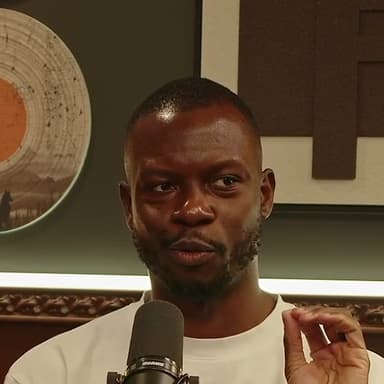
Tobi Oluwole
Founder, Magnate Ventures and The Founder's Blueprint
The safest way to become an entrepreneur
He won't quit a job until his side income has doubled his salary for six months, and he built a LinkedIn business he runs three days a week.
Where to watch and listen
- Application that finally got him into Shopify
- 7th
- Impressions on his first framework post, with 1,000 followers
- 200,000
- Views in his fourth year on LinkedIn, up from about 4 million in his first
- 136M
- How long his side income must double his salary before he quits
- 6 months
- His working week: Tuesday, Wednesday and Thursday
- 3 days
- The offer he turned down: you're a shark and I'm a dolphin
- $400K
Follow Tobi Oluwole
“If you go big or go home, this is how a lot of people end up at home.”
Tobi Oluwole applied to Shopify seven times before they let him in. During onboarding they taught him Freytag's Pyramid, a storytelling framework he thought was nonsense, so he tested it on a LinkedIn post. He had 1,000 followers and woke up to 200,000 impressions. He has posted every weekday since May 2020, and he calls himself the most risk-averse entrepreneur in the world: he will not quit a job until his side income has doubled his salary for at least six months.
He grew up selling things. At 14 it was lollipops at school, a dollar each, until the principal caught him three lollipops in. At boarding school it was instant noodles after dark. At university it was hoverboards, sold on Shopify, which is how he found the company. He then went into tech sales and was, by his own account, terrible at it: laid off from his first job, fired from his second, threatened at least three times in his third. He applied to Shopify every year for three years, seven applications in all, on the theory that a bad entrepreneur with good ideas should go learn from the people who build for entrepreneurs.
He did not start with a niche. His rule is that your niche will find you, so for the first year he posted about himself, his siblings, his life and Shopify, including his seventh-attempt resume, which 2,000 people gave him their email for. The data told him what to double down on. His views went from about 4 million in year one to 11 million, then 77 million, then 136 million, and he now does about a million a week. His formula has not changed: weekdays between 9am and noon, 8 to 12 lines, one visual. For anyone starting, he has them write 20 stories first, their 10 best moments and their 10 worst.
The money came before the website. After that first post his inbox filled with people asking how to work with him, and he took the calls with three questions: what is going on in your life that made you reach out, what are you trying to solve and why can't you do it alone, and what do you want your life to look like in two to three years. He now runs an accelerator five or six times a year for 30 to 40 founders at a time, packaging what corporate employees already know into coaching, consulting or agency offers. One of his examples is Noah, a customer success manager in Finland who went from a $47 ebook to a $2,500 program and, he says, $750,000.
He built the business around a few rules: no alarm, online Tuesday through Thursday, more weekends than weekdays, and eight weeks off every summer. He once turned down a $400,000 offer to build anything he wanted, because, as he told the investor, you're a shark and I'm a dolphin. His case for most people is not an exit but freedom now: $20,000 a month on 20 hours a week. Mike, who wakes at 4:15 and works seven days a week, agrees with the principle anyway. There is no right or wrong, he says, only your right and your wrong.
What the conversation covers
The six-month doubling rule
He won't quit a job until his side income has doubled his salary for six straight months. Go big or go home works for crazy people, he says, and it is how a lot of people end up at home.
Your niche will find you
A year of posting about his life, his siblings and Shopify gave him the data to double down. Views went from about 4 million to 11, 77 and then 136 million a year.
Write 20 stories first
Your 10 best moments bring opportunities and your 10 worst bring trust. That is the first year of content, posted weekdays between 9am and noon, 8 to 12 lines and one visual.
Your company is not your family
If the company hits a hard time it has to save itself, not you. Options on the side mean a bad boss can't hold you for two years.
Content before cash, cash before a website
His inbox filled after one post. He closed deals with no website by asking three questions about the caller's life, problem and two-to-three-year goal.
Missionaries and mercenaries
Most people want to change their own world, not the world. He turned down $400,000 because the investor was a shark and he is a dolphin.
Timestamps
Mentioned in this episode
Companies
- The Founder's Blueprint — His accelerator for founders, coaches and consultants building on LinkedIn, run five or six times a year
- Shopify — Where he worked after seven applications, and where he learned the framework behind his first viral post
Concepts
- The six-month doubling rule — Quit only when side income has doubled your salary for six straight months
- Your niche will find you — Post broadly for a year and let the data show you what resonates
- 20 stories — Your 10 best and 10 worst moments: a year of content
- Missionaries vs mercenaries — Most people want to change their own world, not the world
- Freytag's Pyramid — The five-part story structure Shopify taught him in onboarding
Named in the episode
- The 7 Habits of Highly Effective People — Where he got the exercise of writing his own eulogy
- Atomic Habits — The line that freed him: you are not Steve Jobs
- Naval — The only true test of intelligence is whether you get what you want out of life
- How to Win Friends and Influence People — The Dale Carnegie course Mike's first Freshly investor made a condition of her check
Show notes
Tobi Oluwole applied to Shopify seven times before they hired him. At Shopify, he wrote one LinkedIn post using a storytelling framework from his onboarding and woke up to 200,000 impressions on 1,000 followers. He has posted every weekday since May 2020, now has about 400,000 followers, and works three days a week.
This episode is presented by Proppel. Hire A-player marketing and ops talent from the US and LATAM, and get 10% off your first hire: https://www.weareproppel.com/theadvantage
Follow Mike on Instagram: @mikewystrach ‚ https://instagram.com/mikewystrach
In this episode:
- Why he won't quit a job until his side income has doubled his salary for six months
- His exact posting formula: weekdays, 9am to noon, 8 to 12 lines, one visual
- Write 20 stories first: your 10 best and 10 worst moments
- How one post filled his inbox with buyers before he had a website
- Why he turned down $400K: "You're a shark and I'm a dolphin"
CHAPTERS
0:00 1,000 Followers to 400K
1:52 Arsenal at $100K a Week
6:47 Shopify on the Seventh Try
7:47 One Post, 200,000 Impressions
11:43 He Wrote His Own Eulogy
13:19 Your Niche Will Find You
14:44 Write 20 Stories First
15:20 The Weekday Posting Formula
16:47 Your Company Isn't Your Family
17:35 The Six-Month Doubling Rule
23:38 No Website, Just DMs
24:19 Creators vs Money Makers
28:30 $47 Ebook to $750K
31:33 No Alarm, Three-Day Weeks
38:37 $20K a Month, 20 Hours
44:18 He Turned Down $400K
51:52 Final Thoughts and Wrap Up
TOBI OLUWOLE
LinkedIn ‚ https://www.linkedin.com/in/thetobioluwole
Founder's Blueprint ‚ https://foundersblueprint.ai
Website ‚ https://www.tobioluwole.com
THE ADVANTAGE
Apple Podcasts ‚ https://podcasts.apple.com/us/podcast/the-advantage-with-mike-wystrach/id6783458081
Spotify ‚https://open.spotify.com/show/033DuFkyBRu3qvgp8ozPz1
All episodes ‚ https://mikewystrach.com/podcast
PRESENTED BY PROPPEL
Proppel places marketing and operations talent from the US, LATAM and beyond, from video editors, designers and media buyers to managers, directors and VPs. It's performance-based: a one-off fee only when you hire, no retainers, and a three-month guarantee on every hire. Get 10% off your first hire ‚ https://www.weareproppel.com/theadvantage
#TobiOluwole #LinkedIn #TheAdvantage
Full transcript
Mike Wystrach in conversation with Tobi Oluwole. Lightly formatted from the episode audio.
WiseTrack Co.: We have an accelerator that runs five, six times a year, 30, 40 founders at a time, and we help them launch and build their businesses on LinkedIn. I think you've built the life you wanted. I have a couple rules, like I have no alarm, nobody can wake me up before I wake up. I work three days a week. Now you're empowering people to basically build that life in a similar fashion. They don't want to be rich. They want to be free. I will not quit my job until my side income has doubled my working income for at least six months. I woke up to 200,000 impressions. I had a thousand followers, so that made no sense. My 30, I got 77 million views, then 136 million views. What are the kind of businesses you love angel investing? The first is the highly productive, very smart corporate employee that looks up one day and says, I don't want my boss's job. We package it into a high-ticket coaching or consulting offer or an agency offer, and then they go. Get clients, right? What does life look like for you in 10 years and 20 years? One of the exercises was to write your own eulogy. Yeah, I write my own eulogy. What did the eulogy say? Toby, I'm really excited for this conversation. Thank you for being on. I've got like, I'm gonna just be peppering with you with questions. Just watch a bunch of the podcasts and YouTubes that you were on. So I'm really excited on this. Thanks for being on. Thanks for having me, man. So first and foremost, and I was like dying pre pr before we did this of like, but your background is really cool and I think unique. But I would love to hear like born in Nigeria. Yeah. when and then living in Canada now, when did you move from Nigeria to Kenya? So when I was I was born in Nigeria when I was eight years old, my parents moved us to Belgium. So we stayed in Belgium for two years and then we moved to Atlanta for a year, Tennessee for three months, back to Nigeria for five years, and then against my will, my dad sent me to Canada in two thousand and ten to, you know, further my education, study business. so that's when I moved to Canada was two thousand ten. And why was that against your will? 'Cause my vision for my life was to play soccer at Arsenal Football Club and make a hundred grand a week. That was what I had already pitched to my mom. I pitched it to my parents. I was supposed to go to an academy, play soccer, become a footballer in the UK. And my dad just was like, No, you're going to Canada and his whole reasoning was there's a better path to great life there. There's a better path to having a passport and building a family and The UK wasn't as friendly in terms of, you know, immigration at that time. So he made a call and it was I was so mad for like a year and a half, just pissed, and turned out to be the best decision. So sometimes parents know best. Yeah. Well I unf well now that I'm a parent now that I'm a parent parent I would say parents always know best, but that so you were obvious so huge into soccer, which f football. Yeah. and and when you moved to Canada How old are you you moved to Canada? Fifteen. Fifteen. By yourself? Yeah. My mom, dad came, dropped me off, and I went to boarding school for a year and then university What what university? I went to Carlton University, played vars varsity soccer there. Okay, now and we still gotta at least keep living the soccer dream. So you now are you now still playing club ball or what do you still playing. I pulled my hamstring last night. You know, so I I mean the sad part is I'm getting older and I still think I can do what I was doing at seventeen, so Like I I get injured, but I play every week. Are your parents still back in Nigeria? My mom's in Canada, dad's in Nigeria, so see them whenever we travel. but that dad does not want to leave the warmth and the comfort of of Nigeria. And my mom obviously wants to be close to me and my siblings, so she's in Canada. well, that's awesome. Well, so so Toby's background is I mean, I I'm gonna let you tell your background 'cause I think it's so cool from like the evolution. 'Cause I think again, I I'm such a fan of people thinking about starting businesses in different ways. And I think also of this idea of like it doesn't need to be binary where like you quit your job and you start. And I think the the things that really resonated with me and I was like, we gotta, we gotta talk. Was I really love that like you were like talking through tactical plans. Yeah. Of like I want to do something different, but like I need the security of having so it's like this and which is like thank God someone's saying this is like you can be a good you're really good employee, but you can also build this side job. It it does take extra hustle and hard work. but walk through a little your journey. 'Cause you go you go to college. When did you go to Spotify Shop Shopify to and walk us through like your job your employment? I mean, so I grew up with two parents that were very entrepreneurial. My grandparents are entrepreneurial. So I grew up watching people fail and succeed and thinking that's just normal. Like you you gotta try right. Let me pause here for a second. The show is brought to you by Propel. They find brands like yours exceptional marketing and operational talent in the US, Latin markets, and beyond. For now, the links are in the show notes and all of our listeners get ten percent off your first hire. Okay, let's get into it. and so funny story, the first time I ever got into entrepreneurship was when I was fourteen and I wanted I had a girlfriend. And I really wanted to buy credits for my phone so that I could call her whenever I wanted. And so I started selling lollipops in school, which was banned, but I'd go to the supermarket, buy a hundred lollipops, put in a little bag, go to school, recess time. I'm slinging these a dollar a pop. Okay. I'm three lollipops in to my new venture and I get caught by the principal. It was the only time I ever got in trouble at school and I learned probably the most important lesson in business, which is don't sell illegal stuff. You know? And so that was you learned it early. And my my mom, when she got home, I mean, she gave me, you know, a holy spanking of a lifetime. And she was just so mad. She's like, Why do you need the money? I was like, I have to call my girlfriend and you know, you wouldn't give me the money, so I was gonna make it myself. And that was my first real foray into business. And then I went to boarding school. I sold noodles after dark, so and all the kids were hungry, no food anywhere. I'd buy a box of noodles, instant noodles that just needed water, and I just sell those. So I started to realize is if there's a problem to be solved, there's a business to be built. And I've been launching new businesses every year. Yeah. Every year that I've since the lollipops, I launch a new business. mostly for the fun of it and I definitely have some sort of ADHD. but You know, university, I sold lollipops, I mean, I sold hoverboards, coaching, I did consulting, I sold couches, I sold iPhones, hoverboards were my big break. I got robbed at knife point. and then I emailed I got the board back and I emailed all of the news outlets, like hoverboard salesman gets his board back, you know. And they ran it. And they ran the story. Power PR And so that was when I discovered Shopify 'cause I was selling the hoverboards on Shopify. and so I then got into tech sales right out of school. I was terrible at it because I'm too friendly. You know, I'd be talking to Bob, Bob's like, I don't think we need this. I'm like, Bob, I don't think you need it either. You know, and and so I never hit my quota. I got laid off first job, as fired second job, threatened at least three times on the third job. but I would apply to Shopify every year because my theory was since I'm such a bad entrepreneur with good ideas, if I learn how to be a good entrepreneur, I'll I'll get rich. And so it was either go to an MBA or go build while I learn. And that was Shopify. So I applied every year for three years, seven times. And on the seventh attempt, they finally let me in. And she kept asking, like, why are you applying? I'm like, Well, I want to be an entrepreneur and you build for entrepreneurs. And she said, Well, what if we don't let you in? I was like, I'll just apply again next year, you know? And so I got in Shopify and that was the inflection point. I started making enough money to buy a home. So I bought a home a month after I joined Shopify. And during our onboarding, they taught us a really cool storytelling framework. It's called Frey Tax Pyramid. It's been around since the 19th century. One more time with that. Frey Tags Pyramid. F-R-E-Y-T-A-G. Okay. Really cool storytelling framework. It's how our movies are written. It's what makes you feel emotion around a story. And I I thought it was nonsense. So I wrote a post on LinkedIn using the framework. I woke up to 200,000 impressions. I had a thousand followers, so that made no sense. And I just committed from that day in May twenty twenty that I was gonna post every weekday and I'm on day one thousand eight hundred and forty eight. Wow. So consistency and that's the number one thing with social or but pretty much anything in life is like consistency beats everything. Consistency eats everything for breakfast. Consistency compounds. Yeah. And that's the best part, is like I haven't even gotten that much better. Right. I just stayed way longer than everybody else. Well, I think I'm gonna unpack a few things because you said a few things that I think are really important that I I try to always tell young people is is one is in society we we believe it's normal to go and pay for college. Yeah. And I have a niece who just got into college a niece and a nephew just got in, two nieces that have or I guess three, four nieces that have have been in. And the process and how much time and energy them and their parents spend to select that that college, that they're gonna pay them money. Yeah. Right. And so I and and we think after the four years your education stops. And I'm like, Try to transfer and your pivot and think about your first job, your first two jobs as continuing the education. Yes. And so be as disciplined and focused at what where you want to go, just like you tried to get into not you personally, but people will try to get into their Ivy League school. And then they'll they'll have fifteen schools they try to get into. And they know that it's gonna be super hard to get into Harvard. Yeah. But hey, you gotta try, right? So that's what I always tell people is like imagine yet your first job is the continuation. Of now the difference is you're gonna get paid versus paying them. Which is great. The second thing is you're actually gonna get real life experience. Right. So you're gonna get a framework of not theoretical, but like, you know, the reason Shopify is telling you use this framework is because it actually works. Because at the end of the day, they're not giving you some theoretical framework. Has to work. It has to work. And so that's a number one thing I always try to unpack for people is like. And then don't at the beginning just like you're going from paying a lot of money to go at to to school. So don't focus on success being an house is like get in the door and then work harder than anyone else. Yeah. So like choose the job you want to get in, work persistence. So like you you got your first job shop. I wanted to be investment banking. I went to the University of Arizona, which is good at a lot of things, but we did not have investment banks lined up. Right. I said, I want to be investment banking. I got one interview, one. And The poor guy gave me his card at the end and I called him straight for a year straight. And so finally he called me back. His and I would talk to his mainly his secretary at the time. He never picked it. Finally his secretary called me back and said, Perry got you an interview in New York with one condition. I said, What's the condition? That you'll never call again. I said, Done. I got but that's how but I got in. But my point was is I knew what I wanted and I wasn't willing to take no for an answer. And it sounds like you similar things with Shopify. So you go into Shopify. You learn you learn this framework. Yeah. This framework gets you kind of your a big win on on LinkedIn, which is you know, at 200,000 is huge off anything but off. Anything. And LinkedIn is I at least find that's why I'm so excited as well. Is I find it's harder it's harder to get viral to get breakout virality on LinkedIn than I think any of the other channels. Whereas like Instagram, you can randomly get something that goes to two like it's really hard to get a two hundred thousand. impression view. But that then also does the best job at I think translating to actual followers. more importantly business. Business. Yeah. And it's especially in the right thing. So you go into LinkedIn and all of a sudden you get this one post which starts working. You're you're doing great at Shopify as well. Yeah. Walk us through then what do the next this transition period look like? Yeah. So you know, go back maybe two years. I had read this book called the what is it called? Seven Habits of Highly Effective People. And one of the exercises was to write your own eulogy. And so at like twenty two, twenty-three, I write my own eulogy. What did the eulogy say? It was three pages long. Wow. And it was word for word. It's a big life. And it was basically the summary was Toby was so generous that he put people through school and he bought people houses and he bought people cars and he never missed a milestone. He was at every birthday, every pre everything. So that was how I realized that entrepreneurship was my only path. I needed time and I needed a lot of money. And so that was what made me so obsessed with Shopify and everything else. And so I get into Shopify, I start building, and I realize very quickly that LinkedIn is so different. To shoot a video, you gotta like get ready, you know, you know, kind of look presentable, right? For the most part, have something that you're but on LinkedIn you're just writing, right? And it's the shortest distance between content and actual cash. And so I would just take six, seven minutes, write a thought, eight lines. 12 lines, post at 10 a.m. every day, like for the last 1800 days, Monday to Friday, with one visual. I never changed my formula. And it would just drive. I mean, you're talking like people just sending you a direct message going, Hey, we want to work with you. What was your met what did you become? Because I think LinkedIn's also good at being a micro expert on something. What were you an expert on? What were like what did you post on in LinkedIn? Just general, just so here's the thing. People go pick your niche and then go all in. I'm like, your niche will find you. Okay. So I just posted every day. I would post about myself, my sister, my brother, my life, Shopify. I'm like, who wants to see my Shopify resume? They could work the seventh time. Two thousand people gave me their email for that. I'm like, who wants to see the cover letter? You know, like I was just freestyling the whole first year. And after the first year, I had enough data. If I do more of this, I will make more of this. Right. And that was when I really started to double down. So my first year I got maybe four million views. The second year I got eleven million. And then I really understood the algorithm and what people wanted out of me because you don't really get to determine how people see you. Yeah. You just whatever they're resonating with is whatever they're resonating with. Yeah. And so my third year I got 77 million views, then 136 million views. Wow. And we just started, I mean And would you recommend for people when you talk, because you now kind of coach and advise on this as well. Like knowing that if people really want to work with you, they can reach out and we'll put all your info in here. So the three things that you feel comfortable. It depends on where you are. Like you're you have built and sold a business, right? Other people come in and they have such specific knowledge that that's where they should start. But for me, I I didn't even know what I was starting, right? So What we do is we write 20 stories, the 10 best parts of your life and the 10 worst moments of your life. And that is your content for the first year. Because opportunities will come from you flexing on your 10 best moments, right? And a lot of resonance and trust will come from you flexing on the 10 worst. On the 10 worst. And you just choose those 10 because you're because you're kind of recommending people as you know, write I I've heard you tell me if I'm wrong on this. LinkedIn's kind of like you really gotta at least do three times a week, two to three times a week. Yeah. Like consistency's king. Yeah, it's it's just it again, things compound faster with more input. Right. So the minimum we'll do if we write for like an athlete or like a founder, we'll do three times a week because they don't have time, right? And that's the minimum we need to put in. But for individuals, five days a week, Monday to Friday, between nine AM and twelve PM, your local time. Eight to twelve lines, one visual, and just stick with it. Just yeah, consistency is king. Just stick with it. You have a story, you make a post. You have another story, you make another post. Another angle of the same story, another post. You're a thousand days out, right? And if you will do that, then it will just slowly compound. Again, it took a year for me to get to ten thousand followers, another eight months to get to twenty two thousand. And then I went to a hundred thousand in eight months and then a hundred thousand every year, right? But it took time And you're at what right now? Four hundred. Four hundred. Four hundred thousand. All right, I'm gonna catch you. So so you get so you get and and now you've just got this machine of and then now like you're so for you, what what ended up being your message that you felt really resonated after those two years? So what ended up happening was people were just enamored with the fact that I'd tried something seven times. They thought I was crazy, but I would get comments like, I'm only on my third attempt. I got like four more to go. You know, and people really started to see me as the person that was super resilient. And they just came to conclusions about my life based on that. But then the second thing is I started building businesses while I was working full time. And my message was I love that you have a job, but your company is not your family. If they go through a hard time, they have to save the company, not you. So you should have options because they have options. And it then balances out this equation where if your boss is being really, really nasty to you, you can leave. And they they can't just bully you for two years, right? And if you as a boss hate your life, you can leave because you have an option. And so that then became like till today, I will get a call. I I got one yesterday. Toby, I think I'm done with my job. I'm ready to launch a business. How do I do it? Every single week I get a call from people that go, This guy Did it, right? Left his job because of it. But I also am very, very I'm the most risk-averse entrepreneur in all of the world. I will not quit my job until my side income has doubled my working income for at least six months. And and that is also what people resonate with. I I preach the safest way to become an entrepreneur because there's this thing about go big or go home, which works for crazy people. Okay. Does not work for the average person. I say if you go big or go home, this is how a lot of people end up at home. So I'm like, listen, just test things and move quick and be patient with yourself. Be patient with your progress and be persistent with your purpose. That is my message that I stuck with. It's like you wanna if even if it took you ten years to be successful, you'd have forty years to enjoy the rest of your life. And so people really resonated with this. Counter all in message. And that's what I ran with. And that's what I think like, I think again, I'm going to unpack a few things that I think you say are so important. Is I think the big part about like what you said with LinkedIn is the same as life, is you have to be really consistent for a long time before you actually start seeing the impact. Yes. And so the hard thing, and I don't care what it is, you go to the gym. All right, I want to get in shape. So his is always like, and my my my old co-founder, who's like he's still my guru on like health and fitness. If I have any health and fitness, but Carter will if people come to him all the time. They're like, Carter, I this is it. I want to get into shape. I'm gonna go to the gym seven days a week. He's like, no, we're you what we're gonna do? We're gonna do two days a week for the next for the next four weeks. But you're gonna guarantee me you're gonna do two days a week. No excuses. Then the next four weeks, we're gonna do three days, and I'm making this up. But like his whole thing is it's like you gotta create the muscle. And you yes, eventually you want to get to where you're working out five, six days a week. But like we want to start, get you in the habit. But all of the rewards come at the end. Yeah. And I'm gonna challenge, we'll see if our editing team can do this, but I'm gonna put this on the editing team to do here. So there's a really cool video out there of SpaceX. And it is the launch sequence of SpaceX. And it's it's a it's a video running on the reel. And hopefully it's live when you're watching this. If not, we're gonna link to it. But so it basically is like time going by and Like nothing's happening. And then randomly a a rocket goes up. And then more time goes by and more time goes by, and then a rocket goes up. And so it's the launch sequence of SpaceX done on time. And then all of a sudden you start saying. And then before you know it, it's like and you the whole screen is just rock. Because what people don't realize is like the it feels like nothing at the beginning, but All of the magic's happening there, all of the learning, all of this this stuff that you're getting. And then it's like, because again, like, you know, a two percent gain every or whatever it is, 10% gain every month feels really small when you only have two followers, right? Because it's like, I got three now. Yeah. Like doesn't feel that great. Like, I want five and but like that's the big thing that I think so many young founders is like they want the get rich quick scheme. And the get rich quick scheme. To your point, that's the go big, go bust. For ninety nine percent of the people, it's go bust. Because like there is no like I always just tell people it's like, sure, people get rich all the time. They win the lottery every day. But if your whole plan of like how I'm gonna get rich is I'm gonna buy lottery tickets, it's like you're probably not getting rich. Yeah, you know, you're not getting rich. But it's also just like, what's the rush? Yeah, yeah. You know, like I when I talk to people and they're like, I I want to do a million this year, I go, if if it happened in four years, would you be happy? Like, yeah. Okay, so what's the rush? Why don't you just build at the pace that you can right now? You have four kids, your wife is already saying you neglect her and you want to go do a million dollars a year. You know, like I think people are in a rush to get to the end of the story. Yes. That's like it's it's your story. You can't be late for your story. And and enjoy the journey's what matters. So getting to the end of the book, it's like if he is a great example. And I always say if if if you don't like if you don't like the you know, if you don't like the hike 'Cause think you just want to get to the peak, you shouldn't hike. Because like at the end of the day, the peak's never and same thing is like don't just read the book. Like, if you don't enjoy the book, put it down. Yeah. Because getting to the end isn't gonna matter. Like you gotta enjoy you gotta be enthralled with the whole journey. And like there's lots of books out there. Right. So like if you don't like this one, put it down. And that's that's what I always tell people is like, you know, this idea that like wealth is gonna solve everything. You're gonna get a million dollars in the bank, you're gonna get 10 million, you're gonna get hundred million dollars and s all of a sudden like everything's gonna work is like But you're that's a really good point. And then so let's continue down this journey. Cause I think you then went and this is really, really cool. Is you you build this medium and I think this is a really cool thing. I social gets a lot of negative stuff, and rightfully so. But I do think what social's missed is like you are building a marketing engine before you have a product and and you're building an audience. And I think people like there's been like I love there's like pictures and and again, I'm challenging the editing team, but there's like these really good ones, which is like If you go to if you go play in front of if you go if you were on Arsenal, yeah, and you go for the biggest stadium ever, yeah, that's that's a hundred thousand people. Yes. Right? So if you if you say, okay, I play, you know, whatever, twenty games a a year in front of a hundred thousand people. So how many views is that? It's twenty times a hundred thousand. So it's you know, it's two million news. Yeah. How many views are you getting now? We do about a million a week. And that's what people don't is like if you're in the most crowded biggest stadiums, yeah. D and and so like if you take a million people a week that are seeing your content, that is like the power of social media is you built this marketing engine, but you then go from taking this marketing engine. What point did you realize there's an opportunity to turn this, you know, this I'm just posting these into monetization? And how do you start thinking about that? Well, that first post that got 200,000 impressions was really cool. But what was even cooler is I had my inbox was just completely full of people just going, Hey, saw this post, would like to work with you. What are your services? You know, how do we work with you? That is crazy. Like, you know, most people have to spend so much time getting to trust you, but LinkedIn is already so trusted that you're you're essentially just leveraging the fact that if LinkedIn's gonna show this person on the feed, I could probably trust them. Right. And so it's also the most verifiable place. You can see where they worked, where they live, how many places they've worked and the job titles they've had and all this stuff. So from that very first day, I knew I was gonna make money. And There are only two types of people on the internet that are consuming or creating content. There are content creators that realize one day that they have to make money to survive. And there are moneymakers that one day realize I have to create content. And I was always a moneymaker. So from the first year, I started closing deals, right? No website, nothing. You send me a message till today, hey Toby, I love this piece of content. I will respond to you. hey, let's chat. It doesn't even matter if I know or don't know what is happening, right? So I go, let's chat. As soon as they get on the phone, I go, What's going on in your life right now that made you reach out to me? And they will tell me what's going on in their life that resonated with my life. Then I ask, Okay, well, what are you trying to solve and why can't you do it on your own? And they will tell me what they are struggling with. And then I ask in two to three years, paint me a picture. What do you feel like you want your life to look like? And they will tell me what they want their life to look like. If I can solve that problem or I know someone that can solve it, I'm going to build a business. Let me pause here for a second and introduce you to our title sponsor, Propel. Every business I've built has had a huge, huge, huge piece with international talent. And as we started building the advantage, we wanted to bring in international talent focused around media, podcasts, and we started doing a lot of research and we came across Propel. And we were really excited first and foremost to use them for us. And we later reached out as a sponsor. Here's the best part. It's all performance based. You only pay one off fee once you actually hire someone. That means no retainers, no ongoing costs, plus every hire comes with a three month guarantee. I think bringing on international talent is really hard, really rewarding. As we all know, bringing a talent onto your team is the most important part about building a business. And with Propel, I can speak for ourselves, they have been a huge part of our ability to recruit great talent to our team. Every advantage listener gets 10% off their first hire. For more information, check out the show notes. So do you spend now a lot of your is it a lot of your kind of monetation services is more of that kind of coaching, that putting people on a strategy? Is that worth So we have an accelerator that runs five, six times a year, 30, 40 founders at a time, and we help them launch and build their businesses on LinkedIn. and then we have the consulting where I'll go to companies. Let's unpack these one at a time. So I want to make sure we deliver. Yeah, yeah. So who's the right who's the right target for that? Like who's gonna benefit the most from that? So there's two personas. The first is the highly productive, very smart corporate employee that looks up one day and says, I don't want my boss's job. I want to go build my own thing. They love our program because they take that skill, we we package it into a high ticket coaching or consulting offer or an agency offer. And then they go get clients, right? the second group of people are people that have built businesses. So let me let me make sure I unpack that. So you have someone who's got a tremendous amount of domain knowledge, and that domain mall domain knowledge is valuable. Yeah. And you're gonna help them package the put put that into kind of a pack gene that is gonna ultimately have them become an independent consultant to consult on their domain expertise. Is that did I get that right? Coaching, consulting, agency. Any of those, it just depends on their personality, timing, right, who they want to serve, how they want to serve them. Some people want to teach, some people want to do it for people, some people want to show people how to do it and be hands-on. Those are three different business models. Okay. Right. But we then consult them on okay, how do we tell your story on LinkedIn so that we get people to trust you and see you as credible? Then how do we start driving leads? Then how do we actually put together an offer, not just I'm a consultant, because you know, everyone's a consultant or a coach. Let's brand it, let's package it, let's price it, let's make sure that you have the delivery systems, what's the promise? And we teach them these business principles because they're all employees, right? But now you got to understand how to be an entrepreneur. And then we teach them how do you drive people to that offer, right? Get hundreds of thousands of people to know that you do this thing. And then how do we actually build a sales funnel so that you can not just sell people, but get them to believe that you are the right person before they meet you. And then to graduate, they have to sell it to us. Right. And and we basically give them the feedback. That's not gonna work. What are some of those success stories that you've seen? Man, we've seen some life changing stuff. Our guys have done forty million in the last four years. Wow. And they're all like the youngest is a twenty one year old guy in the UK. He has a technical writing agency where he writes copy for these very technical engineering teams. They do a hundred and sixty thousand dollars a year. Super young guy. we've had the former GM of Intel. Come through our program, build a high-ticket consulting program, did a hundred grand in 90 days. One of my favorite success stories is a guy called Noah, Canadian guy living in Finland, that of two, you know, wife had kids. He didn't want her to go back to work. She didn't want to go back to work. He needs to make more money so that this is possible. And he was a customer success manager, but used to be an Uber driver. So we packaged how do you become a very successful customer success manager? And he built that, he was doing a forty seven dollar ebook. We changed that to a twenty five hundred dollar accelerator. Here's exactly how to be the best customer success manager. He's done seven hundred and fifty grand. He just quit his job last month. And so a lot of the things that I I think this is the thing I really love. And go correct me if I'm wrong, or at least it was way I interpreted it. But like a lot of what you're saying is like you can start these not necessarily as like I'm gonna quit my job tomorrow, but start it as like, Hey, I I wanna I really wanna build something. Yeah. And if I can make $30,000, $50,000 extra a year on top of my salary while I'm also getting to become an entrepreneur and getting in the getting in the arena. And then you don't necessarily need to make that shift. If you're making a hundred thousand dollar salary, you could build 30,000 the first year, then maybe 60,000. Then you get to that hundred. And then now you're at a point where like there's no risk, right? You're now leaving this job for a job that's already there. And so like the like make it very risk-free, build this career while you're doing this. As and and I think the especially for younger people or or motivated people is like you have time, you have to commit and and work. But you can turn that time and commitment into rather than being an Uber driver to make some extra money, you can actually use your skills and build on these platforms. Yes, it not is not going to turn into five million dollars that first year you do it for most people. I'm sure someone else out there did it. But It will build like this side engine and then you do that for three, two, three years, and then now you can quit your job and now you have your dream job built in. Risk-free entrepreneurship. Yeah. I love that. So so that's a big portion. What would now? So we unpack that. What are the other portions that you So the other portion is like consulting where we actually go in, we'll work with a company and actually go, listen, you got to turn your execs into machines on LinkedIn, feed your sales team, right? So here are the frameworks, right? These are different so Basically consulting them over two, three days on how do you actually take all the stories, all the projects you're working on, your case studies, the technical side, and drive business from LinkedIn for your sales team. Right. that one is not as prevalent because I don't like you have to work on company time when you're working with companies, right? And I like my time. So I don't do too much of it. But a big part of you in building this. was building the life you wanted, which was build around how do I make money, but also be kind of have that freedom and not necessarily Yeah, I have a couple of rules. Like I have no alarm. Nobody can wake me up before I wake up. I work three days a week, Tuesday, Wednesday, Thursdays when I'm online taking meetings, doing that. I want more weekends than weekdays, right? So I'm with my wife, I'm traveling. and then the last thing is I do what I want. So if I want to work with you, we're gonna do it. And if I don't want to work with you, I have a bunch of partners that I've built that I will refer people to, but I'm not gonna do it if I don't wanna do it. Right. Now, I've lost out on a lot of money by saying no to funding to all these different things, but I wake up and I have the life I want. And I think that is always, you know, again, another big thing to unpack is like you can't live someone else's version of success. Every person has to define and spend a lot of time. And I think you you hit on this. So like I would be I'm I'm the exact opposite. My alarm goes off at four fifteen every morning. I'm I'm like very structured rigger. I hate vacation and time. I work seven days a week. That's funny. But so that and so I think this is like the thing where people get caught up is like it's like the the hustle porn this is like there is no right or wrong. There is just your right and your wrong. But trying to live someone else's version of success is what I think just erodes people from their soul in and out. And And then acknowledge that there's trade-offs with whatever path you choose. Like you you you can't be Elon Musk if you're not willing to work 24-7. Now, most people when you actually look at Elon Musk's life would say, like, I actually I don't want that. Like the guy has zero vacation, zero anything. Where is like that's always to me is like the trade. It's like, well, what do you want? What does success look like for you? And I think you started with this as like, where does where does life look like in 10 years in your dream state? And then really unpack that because how you get to that destination is like wherever that destination is is very different. Like, you know, it's like what what car should I buy? Well, it's like how many people are you traveling? How far do you want to go? It's like I can't just answer what car should you buy. Like there's lots of things that go into that. And I think that's where a lot of people lose themselves, right? It's like you're building something you never wanted. Yeah. And for me, I I accepted a long time ago. That I was not going to be. Actually, there's a book, Atomic Habits. Love it. And the there was one sentence says, you are not Steve Jobs. You are not Deb Bezos. And it just broke my because I was trying to be, I thought to be a successful entrepreneur, I have to do it how they've done it. And that sentence gave me freedom. And that's when I went, okay, what do I actually want? It's like, I want to retire my parents. I want to spend a lot of time with the people I love. And I want to impact people's lives in such a tangible way. That's really all that I want. But when I meet people like you, I always write to the check. I will that's what made me start investing. Because I'm like, this person wants to play a game that they are not going to ever quit. This is someone I need to partner with. You know? And that was really what started that got me into angel investing. So then you started doing angel investing. I started angel investing. What and and is investing something you like? Love. I love it because one, I get to play a game with people that want to win a very big game. but two, I get to bring my tiny bit of expertise and help them move a little bit faster on the world's biggest business platform. Yeah. So I get to add value to them, I get to play a game with them, and I get to watch this entire thing happen. What are the kind of businesses you love Angel invest in? I love profitable businesses. Okay. Like if they're already profit, that's great. the second one is like if they just have a truly, truly unique advantage over anybody else in the market. I'm obsessed. Like I'm like, okay, you you understand marketing. The first check I did, these guys have gotten 400,000 users off organic TikTok for an app. I'm like, that is how? How do you zero customer acquisition cost? I was like, yes, I'm in. Right. So I get very I I'm not too specific because it's also Angel Investing. I'm not an institution, but I'm just trying to Talk to people who want to win a game and they have a clear path to do that. If they understand marketing, if they have really low customer acquisition cost, if they're already profitable before even taking funding, like those things get me excited because when I worked at Shopify, I saw the craziest businesses. You would see someone, 24-year-old kid, launch a business doing $40 million by the end of the year. What's he selling? Chocolate. There are crazy people. You know, and it's like, how do I back those people? Right. And that Those of I think I've maybe done like eight or nine investments. They're all crazy. All of those every single one of those people that has my money is one of them got an acquisition offer from a very the biggest company in their space and said to the CEO of that company, We're not going to take this offer because I plan to buy your company in ten years. So and I think this is such a cool thing because like I think you've built the life you wanted. Yeah. And I think it like you were able to do this and now you're empowering people to basically build that life in a similar fashion. and then now you're able to now invest in in other businesses that you don't necessarily want to be the guy doing it, but you you respect you respect the hustle in the game. Yes. And I think again, I I I just love that because I I feel so many people first of all, I'm the biggest advocate that people should should think about getting entrepreneurship. at some level into the game. Because I think what it the most important thing is it gives you access to what I think is the most magical gift ever, which is capitalism, which is the upward mobility that is provided through capitalism. If you want it, you can get it. Doesn't mean it's going to be guaranteed. Doesn't mean it's going to be given to you. But you got a good shot. But you got a shot. And and and so capitalism is the absolute best system. I think we're seeing people on I'm like, that's the reason I started this was like I wanted to get and tell many different founder stories on around many things. So people see, like, it's not binary. Like to your point, you don't have to be Steve Jobs. You don't have to be Elon Musk. You don't have to be like, well, I I don't want to do it's like, no, you could get a very comfortable side hustle and you could just supplement your earnings by $50,000, $60,000 and really, but what I think it brings is fulfillment. Yes. Because and it's it's doing and it's seeing like I think the greatest thing is like creating something and then someone having paying you money for that, even if that that thing is is small. And I had Daniel Burke on and he said, The the coolest thing that happens to you is is getting your first digital dollar. Yes. And he's like, he's like, when you get your first dollar, which someone you've never met before, someone you've never it gives you a dollar and all of a sudden you're like, wait, I could do this again. Like I could do this again. And I just think like, I I do think social unpacks that I do think a lot of like I'm a big fan of Shopify. When we started, Shopify was like very infant and like and so anyone could start an e-commerce business. And like you have something you want to sell. Spin up a Shopify side. I think internet money is the greatest, the greatest opportunity of our generation because you can change not just the course of your life, but the course of like your entire family's life. And it's the closest thing to magic that exists. You thought of something, you put it on something we can't see, and now there's money flowing into your account. There there's never been a time before you had to have something physical to do that with. Right. So now You have people I I challenge people. If you get to twenty thousand dollars a month working twenty hours a week, you have hit peak life. Because you can do anything from that. You can you can take care of yourself, take care of your family, you can travel. But if you say, I want to invest, you can invest. You you have enough disposable income, you have enough time. And I think more than anything, that's what most people are they want the exit. A lot of people, not everybody, but a lot of people want the exit so they can have the freedom. But what if you can just have the freedom for the next thirty years? Right. And that's what I've been I do a lot of paradigm shifting for people is like, let the exiters exit. Let the people that want to play the game play the game. Right. But for a lot of people, they want freedom. They don't want to be rich. They want to be free. So it's like, can we build freedom now in the next three years? Yes. The answer is usually yes. And that's I I think the other thing that I say is like the the one thing the goods and bads on social, but the one negative that I see with young people is like You aspire for this thing that actually doesn't bring that much marginal happiness. So I would say people it's like the utility value of of never being on a plane and getting on a plane for the first time is is literally magic. Yes. Right? You you're you're going from this part of the country or this part of the world and then flying for a few hours and you you get on there. Somewhere else, yeah. Whether you're in the back of the plane or the front of the page, the utility value is very little as you move up. Yeah. Whether you're on a plane all by yourself, the utility value of that experience does go up. So, but the amount of extra work that it takes to go from the bout back of the plane to the front of the plane to the So it's like, well, what do you value? Yeah. Because there's a like from a just a pure utility function, if you're like, I want to travel. Yeah. Well, if you want to travel beyond a few hours, a plane is very important. Now, where you travel on that plane doesn't matter, but a lot of these things is like, well, tr everything's a trade-off. And so are you willing to trade off your like and and then that's where I always start with people is like, because in order to get the hundred million, in order to get the billion, if you really want that, it's 30 years. If you really if you if you say I really want to be a billionaire, it's 30 to 40 years of an absolute grind. And it's no vacations, it's very little family time, it's it's relentless obsession. It is paranoia. It is and and that's that's how you do it. That's just like if you look at all these guys, it's the same the same story across the board. Yeah. And so like, is that what you really want? Or do you just see a someone on a yacht and say, I want that? I know. That's where I think social media has messed up a lot of people. They're like, Okay, I want a hundred foot yacht and I want, you know, the jet. And I like, okay, but like you're gonna use the yacht for one week. Just rent a yacht. You know, like do you need to become a billionaire? Do you want to become like when SpaceX went public and Elon's a trillionaire, all these people became billionaires, all these people became millionaires? You know, why am I not? I'm like, did you want to build rockets for the last 10 years? Because this sounds like you're cheating right now. You know, like I I have a saying in my company, we share the blessing with the people that share the burden. If you want to go and enjoy this thing. You gotta get in the trenches with us. I'm just well now my head is working because we clip all these and I'm like, you're just giving me di di that's that's amazing. and I think that you're so that's a hundred percent the way to look at like the burden is what people like they lose skip right over it. They skip right over and they also skip over and and everyone's like, Elon, like he shouldn't be a troll. I said, Okay, let's pause because this is all paper value. Yeah. It's it's all he just invests in his company. So like look at The if you and Elon's a great example. And again, like di I I love what Elon's doing from all that, but I also think like Elon's life that people what they oversimplify is like Elon works twenty four seven. Outside of having a private jet, his he I think he owns maybe one house or or no houses. He sold all of his houses at one point. He doesn't own a yacht. He doesn't he drives in a Tesla. So he drive all he drives is his Teslas. So I'm like, you don't need to be a trillionaire to live Elon's life. You and and yeah, he's on a private jet all the time, but the guy is working twenty four seven and his private jet is not like he's calibrating off to vacation. Yeah. So I'm like, you could buy a Tesla, you you could be living on three hundred, four hundred thousand dollars, and you could live a more free life than Elon Musk as a trillionaire. So like the balance is is like, yeah, but like and so when you look at a lot of these things is like the trade offs for most people, it's like and then it starts seeing unachievable 'cause I mean for Everyone except one person becoming a trillionaire is unachievable, but you don't need it. Coming a billionaire for most people is unachievable. Again, you don't need it. Becoming a hundred millionaire for most people is still hard, but still not needed. When you say, okay, well, the benchmark for most people who live 99.9% of what they want is 10 million plus minus. Yeah. Like at that point, you're you're now just off interest if you're investing, right? Is a million dollars a year. Yeah. Is and and so at a million dollars a year, like at with your point, you're that's not even working. It's just a million dollars a year. Like you're living a a phenomenal life. A great life. But I think for for a lot of people, the thing is they're you have missionaries trying to compete with mercenaries. It's like another good one. It's like I I've met people like you. I I d I once got a a guy came to me, followed me on LinkedIn, Toby, I love how you build businesses. I'm gonna give you four hundred K to build anything you want. Okay. I went, there's only one problem. You're a shark and I'm a dolphin. So This can't work, right? I'm here for a good time. And it doesn't mean that there aren't sharks, right? But you're not gonna be happy when I take eight weeks off in the in the summer, which I do every year. So it's also understanding just where are you right now? What is your mission in your own life? Right. When I look at Elon, I look at Steve Jobs, I look at Bezos, they wanted to change the world and they did. Most people just want to change their own world. But they they then start trying to compete with someone working twenty four seven. It's like just figure out what you're trying to do and do it. Yeah. And what is so as we wrap up here, and this has been awesome. And I I love your journey and I I love your message. And I love it was so fun getting you on here. And I followed a bunch of like saw you out there. And I think it's just cool because I think like you're the you're the person kind of saying the opposite thing that I think a lot of people need to hear, which is again, it kind of goes back when this whole culture kind of started. I remember it was like four-hour work week, which like Tim Ferris kind of like was before Toby was like saying Yeah. He didn't even want to work 20 weeks. And and so I think there was this whole movement around that. And that's like the work life balance. And again, I always say is there's no right or wrong, but your point is like what is right for you? What do you want? What challenges are you willing to sacrifice and take on? But it at the end of the day, there's one life. That's all you're gonna get is one life. And so building someone else's vision of your life is gonna leave you miserable. So like just find what you want, build that life and live that life. What do you think for you as you pass as you kind of think through going forward, what is what does life look like for you in 10 years and 20 years? Yeah. I mean, one of my favorite entrepreneurs ever is Naval. And one of his sayings is the only true test of intelligence is if you get what you want out of life. And all I want is to be extremely present for people I care about and love. That's the really like that's the baseline of everything I I want. And so my ultimate marker of that, 10 years, 20 years, 40 years from now, is the day I'm going to buy a jet. So that I can just be with whoever I want, whenever I want. As soon as they cross my mind, I will be there in less than seven hours. That is what I'm working towards. That's what drove me to angel investing, because I saw the stories of you know the Uber early investors and the Shopify early investors. I was like, okay, I'm not going to buy a jet on A million dollars a year. But if I bet a million dollars over the next ten years, I could get right one time. And so I I'm gonna try to get right one time and I think we're gonna do it. And that right's gonna I love it. And then how so how can be well so one, we're gonna post all your stuff on here. I mean, obviously LinkedIn. Are you building any other channels that you think are exciting? I did Instagram for four months, screw it to fifty thousand followers in four months. I was exhausted. It's hard work. Yeah. so I'm I'm just focusing on LinkedIn. We've started I I started getting approached by a lot of Instagram and TikTok and even YouTube creators that only make money on brand partnerships and they feel trapped in the fact that they only make money when a company pays them. And they're asking me and us how they build something like what I have, which is a product or a high ticket offer that pays them. all year long whether or not they are creating content. And this is going to be their out. So we're actually building a new agency, just partnering with these big creators, helping them think about what can you actually teach? What can you build that most people don't have access to? And how do we actually then turn that into a seven figure or eight figure a year business that you can also exit one day if you don't want to create anymore. Right. that I'm very excited about. And I I think so again to give a push because I I think whether it's yours, but I I obviously I think yours is is phenomenal. If you are a person who's thinking about doing this and you're excited, there is nothing better than actually becoming part of a cohort and a team. It does two things. One, it gives you people that you're doing it with, which builds in accountability, but also builds in like, you know, it's it's coordinate. But the other thing that it really does is commitment, putting money in ad sign forces you to now there's like a a a a cost b cost where you're like I have to do it. And I think the the problem that a lot of people do these things is is half measures of being like, I'm gonna start posting, but not actually understanding there is a machine, there is a process. Yeah. There is those things. So learning it all at the same time and then building in accountability. And I do think these like I've done a bunch of these I did and my my girlfri my co-founder's mom When we started signing this up for Dale Carnegie's How to Make Friends and Influence People. And it was a class. And I'm like, why? I we have we're founding a company. We have no time. I'm like, this and she said the only way, and she was our first investor as well. she said the only way she can do the best if we did the class. And I was like, gosh. And so we needed investment. So we had no choice. So we do the class. And I'm like, this is a huge waste of time. It was one of the better things I've done. It was all on public speaking, on how to format kind of Conversations. It was on actually how do you make friends and influences. So little did I know that for the next, you know, now 20 years of my life, all I'm gonna do is raise money. And so, so yeah, now I'm going on like raising I think 300 million in venture capital and now almost a hundred million dollars. And so but it it was it was learning the messages here. But by signing up to that class and we had to go twice a week every week and and doing that, and then all of a sudden I started loving it and we started So my point is is sometimes if you really want to do these things, sign up for the class, sign up for the seminar, sign up for the coaching, sign up for those things. It it just it creates that accountability and then there is domain knowledge and that domain transfer, which is really powerful. I think a lot of people underestimate, like people look down or, you know, sideways at coaching, coaches. So you're gonna say five, ten years because this person's mistakes are not gonna be your mistakes. And people don't understand how powerful that is. And the thing is is always just reframing it because I'm a golfer and said said very nicely to myself, I like to play golf or swing the club. But my point is this is in sports, if you have a kid and the kid says, I want to get I really want to play X, Y, Z, soccer, basketball, football, whatever, what are you gonna do? You're gonna hire them a coach. Of course. And they're gonna have coaches. For the rest of their life as long as they play that. And the coach is gonna grow and the coaches and and they're gonna learn from that coach. Now it's gonna require a ton of practice, it's gonna require natural skill. It's gonna require hard work. But the coach is there. So now we go into business and for some reason you feel like, okay, we don't need a coach. It's like, well, wait, what what like you're learning something new? It's the acknowledgement that there's people who know more than you. There's acknowledgement that like even as you get really good, there's always someone at the next level who actually is is playing it. So, you know, you know, and that's all I say is like. It's like, you know, my six year old who's just starting to play basketball, she has a coach. LeBron James has a coach. The coach they have is very different. So LeBron's James coach would not win for would not work for my daughter and my daughter's coach. But my point is, is both of them are gonna find value in a coach. Yeah. And and then each at each level you need to progress. But I I I love what you're doing. I love, love, love this method. I can't tell you how many people I talk to that are my age, slightly older. I'm forty six, so I'm dating myself here. Slightly older and they feel like it's too late. I can't, I got a mortgage, I got these things. And I'm like, there's so many oper you're you're looking at this as binary. And I'm not, and I I tell them all, like you can't, of course, you can't quit your job. You got kids and the whole thing. But what you can do is start working and like I I just constantly lean into people is like, there are so many avenues out there for you to make money on the side, to do these things. And if you really do, if you really do feel like, my job's not rewarding, like. Yes, it's gonna take three, four, five years, but in five years you could build the life that you want. And but or you just wake up in five years and complain again, right? That's those are your two choices. Those are your two choices. this was awesome. We're gonna put all of your links, all of your show notes. Hopefully people reach out because I I think what you're doing is super cool. But I really appreciate it. Keep getting out there, tone your message. It's it's very cool. Thanks, man. All right. Thanks for having me.
Get the written version
Every week Mike writes up what he's learning from these conversations and the companies he's building. Free.