Episode 249 min
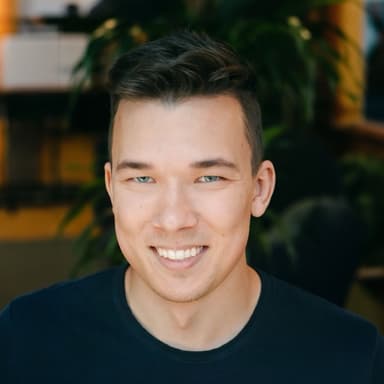
Vitalii Dodonov
Co-founder and CTO, Stan
Navigating the Creator Economy
The co-founder of Stan on deleting the transaction fee at $1M in revenue, and what happened to the business in the twelve months after.
Where to watch and listen
“You can go to TikTok, make an account, create viral content, accumulate a lot of attention. The question is, what do you do with that attention?”
Most creator platforms take a cut. Stan stopped. In late 2022, at roughly $1 million in annual revenue, Vitalii Dodonov and his co-founder John Hu removed transaction fees entirely and put the whole company on a flat monthly subscription. Revenue grew 8.5x over the following year.
Vitalii Dodonov is the co-founder and CTO of Stan, a creator commerce platform doing about $30 million in annual revenue with a team of 30 and zero transaction fees. 85,000 active Creator-Entrepreneurs run their businesses on it. It has facilitated more than $600 million in creator earnings. The entire model is a $30-a-month subscription, built on one $5 million seed round from Forerunner Ventures, with additional backing from operators including Gary Vaynerchuk and Steven Bartlett.
The decision at the center of this conversation is the one almost nobody in the category made. Competing platforms charge somewhere between 10 and 20 percent of what a creator sells. That take rate is real revenue, and giving it up at $1 million ARR is giving up the fastest-compounding line in the business. Dodonov and Hu argued the opposite case: a platform that profits from a creator's success is a platform whose interests diverge from the creator's the moment that creator gets big. Mike walks him back through the room where that call was made — who pushed back, what the argument against it was, and what finally settled it.
The path into it is not the standard one. Dodonov studied chemical engineering and computer process control at the University of Alberta, worked at Deloitte and then eBay, and taught himself to build before co-founding Stan in 2021. He talks about the constraint that shaped the company more than any strategy did: a small team means the operative question is never what to build, it is what to refuse to build.
The through-line is a thesis that sounds strange coming from a monetization company. Dodonov's view is that monetization was never the hard part for creators. Audience is. Distribution is the bottleneck, churn in the creator economy is structural rather than a product failure, and building for that reality is what determines where the category goes next — including Stanley, the AI content agent Stan built in 14 days and launched in March 2026.
What the conversation covers
The transaction fee decision
Late 2022, around $1M ARR. Removing the cut entirely: who was in the room, the argument against it, and what pushed them over.
The 8.5x year
What happened immediately before the inflection, and what nearly broke on the way through it.
What a small team refuses to build
Talent density, deletion discipline, and why the team is small on purpose rather than by necessity.
Churn as a category truth
Why creator churn is structural rather than a product failure, and what that does to unit economics.
Audience, not monetization
The counterintuitive bottleneck thesis, and what it means for where Stan goes next.
Stanley, built in 14 days
An AI content agent shipped in two weeks, and what it changes for a solo creator competing with a marketing team.
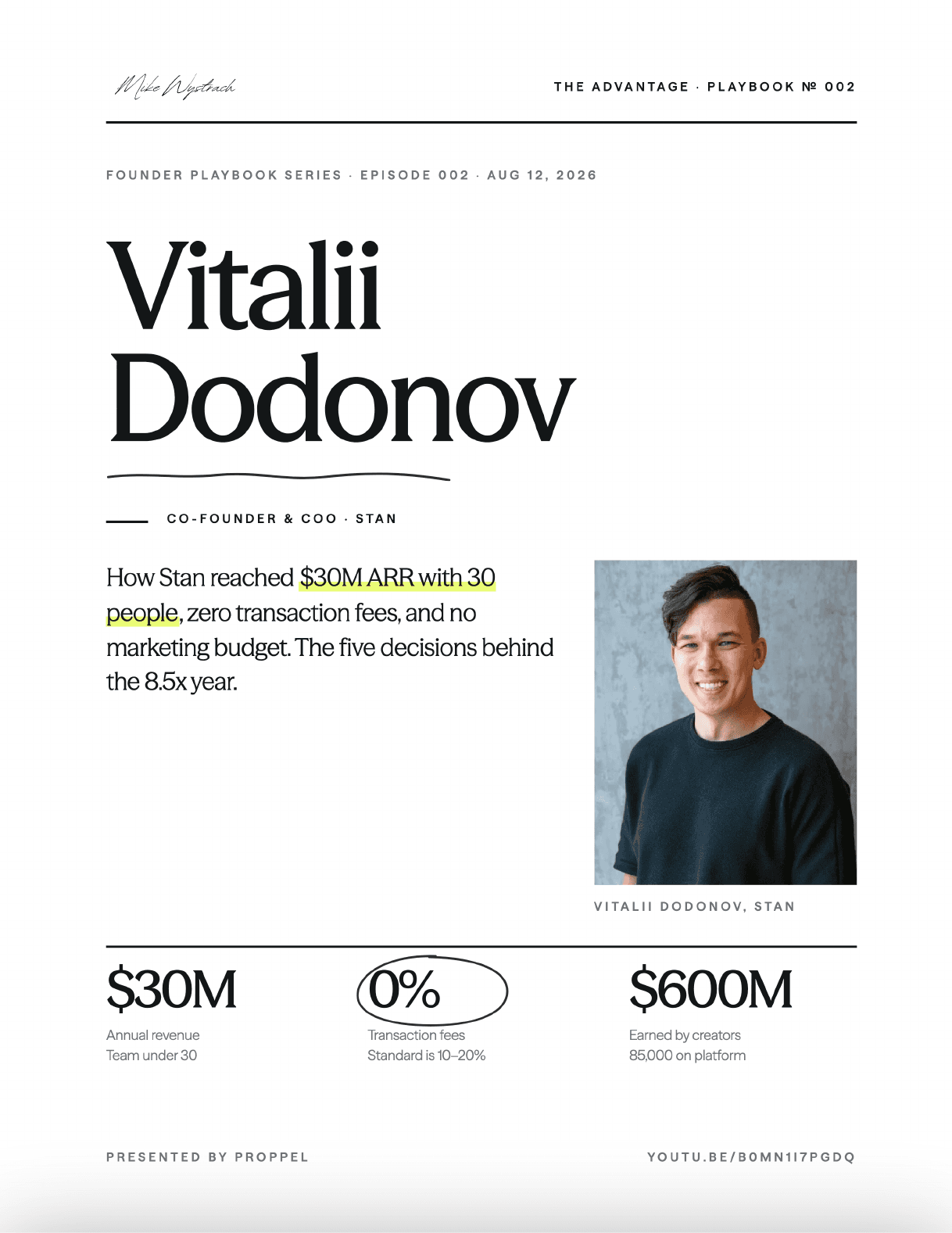
The Episode Playbook
The Stan Playbook
The five decisions behind the 8.5x year — verbatim quotes from this episode, what actually happened at each step, and a run-this-week checklist. Free.
Get the free playbookTimestamps
Mentioned in this episode
People
- John Hu — co-founder and CEO of Stan
- Gary Vaynerchuk — investor in Stan
- Steven Bartlett — investor in Stan
- Isaac Asimov — the science fiction he starts people on
- Cixin Liu — author of the Three-Body trilogy
Books
- The Three-Body Problem — Cixin Liu. The trilogy he recommends over business content
- We Are Legion (We Are Bob) — Dennis E. Taylor. Mike's recommendation back to him
Companies & products
- Stan — the creator commerce platform
- How We Built a $1M+ AI Agent in 14 Days — Stan's own write-up of building Stanley
- Stanley — the shipped product, on the App Store
- Forerunner Ventures — led the $5M seed
- eBay — hired him as a senior engineer off his side projects
- Amazon — the mid-six-figure offer he turned down
- TikTok — the attention layer the whole thesis was built on
- Petfolk — Mike's company, on being your own first customer
Concepts
- Time in the arena — his test for finding a co-founder
- Creator-Entrepreneur — why Stan capitalizes the word Creator
- Building in public — the go-to-market, not just the marketing
- Gas in a tank — his chemical-engineering model of word of mouth
- The drop zone — learning by osmosis from the people in the room
Show notes
Vitalii Dodonov is the co-founder and CTO of Stan, a creator commerce platform that's generated over $600M for it's creators. Every other platform in the category takes 10 to 20 percent of what a creator sells. Stan takes nothing.
Presented by Proppel. Hire A-player marketing and ops talent from the US and LATAM, and get 10% off your first hire: https://www.weareproppel.com/theadvantage
Mike's IG: https://www.instagram.com/mikewystrach/
In late 2022 Stan was doing roughly $1 million a year, and a slice of that was commission. They had added the cut for the reason everyone adds it: the rest of the category had one. Then Vitalii and his co-founder John Hu built the spreadsheet that killed it. They deleted transaction fees entirely and put the business on a flat $30 a month. Revenue went from $1 million to $15 million to $27 million.
Giving up a take rate at $1 million ARR means giving up the fastest-compounding line in the business. Mike walks him back into the room where that call was made, who pushed back, and what settled it. Vitalii is also clear that removing the fee is not what caused the 8.5x. The growth came from building a product people talked about, on no marketing budget.
A team of 30 changes the operative question: it stops being what to build and becomes what to refuse to build. And the thesis underneath is strange for a monetization company. Monetization was never the hard part. Attention is easy to accumulate and almost nobody knows what to do with it. Distribution is the bottleneck, and creator churn is structural rather than a product failure. That produced Stanley, the AI head of content Stan built in 14 days.
Chapters
00:00:00 Introduction
00:07:46 He Turned Down A Mid-Six-Figure Amazon Offer
00:14:01 Time In The Arena Beats Founder Dating
00:17:56 What Do You Do With The Attention?
00:21:50 They Added A Commission Because Everyone Else Had One
00:22:29 The Spreadsheet That Killed The Commission
00:24:26 Removing The Fee Was Not What Drove The Growth
00:27:38 $1M To $15M To $27M
00:29:54 Crossing $30M ARR With Fewer Than 30 People
00:30:14 No Marketing Budget, And Gas In A Tank
00:32:49 What A Personal Head Of Content Actually Does
00:39:31 Every Founder Is About To Need A Digital Identity
00:43:48 At 30, Optimize For The Rooms You Sit In
Vitalii Dodonov
Stan: https://stan.store
LinkedIn: https://www.linkedin.com/in/vitddnv/
IG: https://www.instagram.com/vitddnv/
PRESENTED BY PROPPEL
Your business is only as good as the people in it, and finding real A players is one of the hardest things you'll do. Proppel specializes in marketing and operations talent, placing top people from the US, LATAM and beyond.
Whether you need video editors, graphic designers, or media buyers from LATAM, or managers, directors, heads of department and VPs in the US, they'll help you build the team you actually need to grow.
It's all performance-based. You pay a one-off fee only once you actually hire someone, so no retainers and no ongoing costs. Every hire comes with a three-month guarantee.
Get 10% off your first hire: https://www.weareproppel.com/theadvantage
Full transcript
Mike Wystrach in conversation with Vitalii Dodonov. Lightly formatted from the episode audio.
speaker-0: What is the easiest thing to sell? It's your time. Like you can sell your time to people who are looking up to you for something through the lens of your content. Creator to us is very much a founder who chose to work for themselves, who just realized owning your own distribution and commanding attention is very helpful for you building your business. Everyone needs to be doing this, whether you're just out of school, it's like graduating, or whether you're the founder of the of the highest caliber, like you need to be telling your stories. You can go to TikTok and you can make an account, you can create viral content, you can accumulate a lot of attention. The question is, what do you do with that attention?
speaker-1: Today's guest is Vitali Dedanov. He's the co-founder and CTO of Stan. Stan, for those of you who don't know, is a creator, it's a platform for the creator economy that helps creators monetize. I think it's gonna be massive. I think AI, as it disrupts and changes things, is going to create an opportunity for a lot more people to be creators. They are absolutely killing it. To give some numbers here, they've gone from Zero to over $30 million in sales in five years, 85,000 customers. They've created over $600 million in revenue for their creators on their platforms. Vitali is going to go over from creation, how they came up with the idea all the way to scaling the business to what's coming down the pipe as they think about becoming not only the store for all these creators, but now becoming the AI creative distribution manager. A quick one before we start. This show is brought to you by Propel. They find brands like yours exceptional marketing and operational talent in the US, Latinam markets, and beyond. For now, the links are in the show notes, and all of our listeners get 10% off your first hire. Okay, let's get into it. I'm super excited to speak with Vitali. Vitali, I already said this at the beginning, but I'm gonna try to pronounce it. You're gonna correct me when I get it wrong. But it's Vitali Dodonoff.
speaker-0: Yes, perfect.
speaker-1: There we Good. Vitales at the intersection. For me, the two things that I'm really excited about. So one is the creator economy. I think the creator economy is just this massive economy that I feel, especially as AI continues to move and change the world we live in, I think this economy is going to grow massively. So really excited to learn at what you guys are doing in the creator economy. But now you're merging your own AI platform into helping the creator economy. So I'm just really excited to learn what you guys are doing at Stan. But you guys also have a differentiated approach to what you're doing. So but before we get there, one of the big things that I really like to talk to to any founder is like, how did you get into this? Like your your background. Give me a brief intro into you as a person. I know you you are an immigrant into Canada, but give me kind of a qu a quick background on your story before you you started a company and then how you how you kind of got into saying, Okay, I'm gonna start my own thing.
speaker-0: wow, okay. Let me let me try a one minute pitch of how I've come to where I am today. I was born and raised in Russia, that's that's where I grew up. Fun fact about my story is I've made eight hundred skydiving jumps, that was my first job, which is how I made money to pay for my first year of college.
speaker-1: Risk is something you've had you've you never had a problem with risk, obviously. Or calculated risk at least.
speaker-0: A and risk aware, but I do have like a way to make decisions without being like stuck because you know, in the plane it's either in or out and anything in between is dangerous. I came to Canada to study chemical engineering. never worked as a chemical engineer for a day in my life, self-taught myself programming, Google Substack for folks who are coming from those times, YouTube. started working in consulting and then moved to eBay, who hired me because of one of the side projects that I've built. I couldn't get a kind of a proper job because it's like I didn't have the the education and traditional background, but I showed them what I've built on my side and it's like, you know what, we are we're gonna hire you as a senior engineer, which was very delightful to me at the time, like trying to make my way in in a new country. And my ambition has always been to work for myself. So this is just the I I'm very much driven by freedom and I want to work on things that I'm genuinely passionate about. And and I wanted to remove money from being a motivator for me. So I felt that in order for me to get there I need to reach financial independence of source, and the way to get there is to build your own company. and as I was working on a few projects on a side, like no matter what I was doing, I've realized that in order for you to to build a company that's commercially viable, you can't be just good at one thing. And I was really good at engineering at the time, like everything I've learned by myself. But you need to be good at everything that's required to to build a company. And like at that time I didn't do very well at kind of sales, marketing and kind of positioning the product for distribution. But then one of the shared customers that one of the customers that I had at the time introduced me to John, who is my co-founder now at Stan, who was remarkably good at the marketing and the salesmanship and and the vision and the story. And we felt that by building a company together, with me bringing the the technical expertise and the the systems thinking and him bringing the intimate understanding of the problem and the vision for what the company could become, like on a mission to help anyone make a living and work for themselves, we could create something transformational together.
speaker-1: So walk me back a few the a few steps. So were you already thinking like I wanna do a startup or did like how did you get from Deloitte, ebay to now I wanna I feel like I'm ready to do a startup? Like what what was walk me like your mindset? was it like I'm gonna do a startup now I need to figure out an idea or was it like I have this idea, I can't let go of it and I've gotta I've gotta figure out how to make this thing?
speaker-0: I did not want to do a startup. my mind actually works in a very, I guess, maybe not peculiar way, but here's how I look like at life broadly. Like I think it's very naive to like expect that we know where we are going and then we know what we want. Like most people, myself included, like don't truly know what is that we want, but we kind of have a feel for it's like like it's somewhere in that direction. The way I've approached everything, like I think as we walk on our journey w Life presents us with an opportunity that you can say a yes or a no to. Like for example, the way I ended up in Canada, people like I was like, Vitaly, why did you go to Canada? Like the story behind that is I was sitting on a plane about to to jump with one of my clients. I was doing a video for them, like I was 16 at the time, and and and he asked me, it's like Vitaly, why don't you go study in Canada? And I'm coming from like very much leave below your means kind of paycheck to paycheck family. Going abroad has never like crossed my mind. But then he asked the question and my dad was also on the plane and a couple days from then he approached me and said, Vitaly if you wanted to go study in Canada, like I can lend you the money to do that. So I found myself in a situation where now I have an opportunity that I can say yes or no to, but then it's like like there's no like there is other things, but then it's like like really there is just this one. And then and then you either go or not go. The same thing with kind of Building a company is my internal compass was genuinely oriented towards like I want to work for myself in the endgame. I'm in a new country. I have a big debt that I need to pay back for my education. The biggest risk for me is not to lose the job. The biggest risk for me is to get kicked out of the country. And I will never make the amount of money required to pay my debt back. So it's like there is a risk awareness tolerance kind of in place. And then like you leave day by day and it's like the opportunity presents itself. Do you say yes or no? Like do you say yes or no? Do you say yes or no? And driven by the internal compass and kind of like feeling the way like towards it. Like when I met John and I knew what I knew at the time and I evaluated risk from from my point of view. I felt like the the risk was worth it. and I went all in.
speaker-1: And so when you and and so John was there like when you guys, you and John started talking about a startup or like walk me through a little bit about kinda how did you go from was it an idea, was it, hey, we should really do something and then you explored ideas, kinda how those early days, what what did those kind of look like?
speaker-0: So it was it was 2021. I was working for eBay at the time. The month I met John, Amazon reached out and they and they sent me a very attractive, like mid-six digit offer reaches like for someone who is out of school and it's like remarkably good. That that I could take an opportunity is like, okay, I work for 10, 15 years, I retire, like I do whatever I want. Like that's pretty good. And then as I was doing this like on a side, I was like, okay, I Like this is a decent, like conventional path I was interested in from the security point of view, but it's like it has never been the the end game. Like as I was doing all of this, for two years I was working on a side project called Vini at the time, which is like a financial monetization platform to a degree, which is more so me exploring my curiosity and trying to just like learn how to build for the most part. Like I've learned everything I know in engineering just by trying to build the products that that I was passionate about without like necessarily thinking whether it's going to be viable, like i in i in the marketplace or no. So and and and one day as I was hoping on a call on on an interview call with one of the customers of that side product, like it was a Sunday, Sunday night, he he texted me and is like, Hey, I I met someone, he is building something similar. His name is John, he's building a platform called Stan. So Stan was three months old at the time. John started working kind of on it because he came from the point of view of being a customer of the problem and understanding the problem. really well. So twenty twenty one, TikTok just came to to the United States. it was the middle of COVID and it's like everyone was stuck at home consuming and creating a lot of content. So it's like people who are trying to figure out this attention game on the internet. What they didn't have a good grasp of is the monetization of that attention. Say you have a hundred thousand followers, like what do you do with it? No one knew at the time or very few people knew. And it was like very brand kind of advertisement dependent, but there was a lot more people who could do something with it. So when when when John looked at it and and he started making content because he wanted to understand the problem first, like from the consumer psychology point of view, he felt that there was a very big market and the product opportunity to be built there. So he came with a vision of these are the people who need help and this is how we can we can help him. So when we had a conversation and and John was sharing his vision for the product that he wanted to build that he started working on with the with the offshore team at the time, I was kind of looking inwards and it's like Just reflecting, I've I've already solved from the technical point of view, maybe seventy percent of what's required with a side project that I'm working on since like shared customer was using his product and and my my product there was there was a big amount of overlap. And and the question is like if if there is truly a big market opportunity to go and solve that, like I do want to work for myself and that's a way for me to to do that. Do I trust this person to do that with like do I want to build this business with someone or do I want to continue working for myself and like continue doing the path that I have. And after exploring this with John for for a few conversations, like we also were remote to each other at the time. So he lived in SF back then and I was in Toronto. So it was purely over Zoom, middle of COVID, you couldn't get anywhere. We th through those conversations and just connecting on the shared immigrant background, like the absolute hustler, like killer executor energy, whatever we want, we are just gonna go and find our way to to get there. We felt that together we will go probably significantly farther than than our own And it was more so betting on the direction that had potential. but more than that, betting on each other and the journey that lay ahead of us, like believing that worst comes to worst, it will be a hell of a ride. And and we went for it.
speaker-1: Yeah, which is I mean, you hit on so many things that I talk about all the time. The first one is like that the stories you read about in whether it's TechCrunch or whatever, like they're packed together in these neat founder stories. There there's usually a lot more that goes into that that's hard to explain. It's very nuanced. It's like, well, like it's not as simple as that true kind of simple founder story. Second one, which I think is so important, I always if you're a first time founder, there is nothing better than getting a co-founder because it is a tough journey. It is tough, even on the good days, it's tough. It's a great journey. It's amazing. I think one that's highly rewarding, but there's nothing better than having someone who's by your side, thick and thin, you know, in that foxhole with you. and I think you said a lot of the things that I think like people always say, What does the ideal founder look like? And I I I say, Well, there's lots of different models, but the one thing I think founders share is this hustle grind. culture and this idea that like no matter what we'll figure it out, we're just gonna do it. And I think it's it's so interesting to hear you kind of combine all those things. Again, it's a big reason I wanted to do this is like it's hard to tell that that real s the real story in a, you know, in a paragraph. And the reality in startups is that like they're not as c and they're always clear even like looking backwards and explaining it now. And it's funny, like you were saying, I could only imagine the pressure your parents, you have a s amazing offer And it's like you're gonna get out of debt, you gotta have like this amazing, like very clear path of success. And now hindsight, of course, like you guys are doing phenomenal. It's easy to like, my god, that's so easy. You had but you're like, No, when we took this bet we had, you know, nothing going and and I had this great offer. It's great to see that that that jump is not you know, I always try to tell people is like the jump is always scary. It may not look scary for you, but it's like always scary. But it and this is truly someone who knows that jump, which is awesome. Like you really But it's that calculated jump and it is not just kind of jumping with no parachute on your back, but it is really thinking through and and managing that downside. But phenomenal. So you guys, so you make the jump, you join Stan. I think you and your co founder have kind of very you know bene you know, mutual like skills that are opposite of each other. You, the technical co founder, he's kind of more the you know, the salesperson, I think I'm hearing. What was like When you thought of Stan, what did you think like was the problem that we're solving? And then how much you did that problem kind of evolve as you the more you got into the weeds and realized like, like we thought it was this, but it was really this? Like did did you feel like you or do you did you just nail it from day one where you're like, Nope, we knew the problem, we created the solution and and it's kind of been that ever since?
speaker-0: Mike be before I answer that, can can I share a few more kind of tips on
speaker-1: Of course, please.
speaker-0: Yes. Because I think for your audience, like a lot of people in my systems, like they're talking about how do you find a co-founder? And it's like one of the most difficult questions. And I fundamentally like agree with you that it's very difficult to walk that journey alone. And it's not just like you have it or don't have it like solo. It is like there's going to be days that you're going to be so destroyed by everything that comes against you that having a person to call who like gets it, you will be pissed at your customers, you will be pissed at your employees, you will be pissed at like every single thing that's happening. And if you have no one to just, you know, give a call into like bitch two for for lack of a better term. It's l like that camaraderie I think is like what holds many companies together. And I've been very lucky in finding the the co-founder that does the the degree of a relationship. So so John was initiating my wedding last year. So we are very close, both as friends and as as partners in business and just being able to meet someone who is playing that role for you in your life. Like that's that's what holds everything together. The tangible lesson that I wanted to to share for for folks who who are looking for a co-founder. There's a term that I like to use Time time in the arena. Like a good way to think about like if you're looking for a co-founder, like you can go and do some sort of a founder dating and like do the conventional pieces. The problem with that is like it's very similar to dating. Like when you're approaching it intentionally and like go hardcore on the apps like try to say, all right, I need to find myself a partner. Like it's very difficult. Like oftentimes relationship happens kind of organically and you just need to be in places where it's likely to happen. For for John and myself, like our story, the the through line through this is both John and I were working in our own individual paths, trying to like build the future the way we envisioned it, and our paths crossed at the right time. I was not looking for a co founder, like John was closer to looking for a technical co founder because he like had more clarity like on the vision. But I was in the arena for a couple of years trying to build a product in this category. And John was in the arena for a couple of years trying to find the business kind of idea vision in this category. And then, you know, something brought us together to do this, but we've been around for a long time. So for for founders who are considering finding co-founders, the best like piece I think that they can do is to just be working on things that they're genuinely passionate about, because that will attract People who are also passionate about those things and it's just a matter of time before they meet someone with complementary skill sets who they will be able to share the vision of going somewhere together.
speaker-1: I could not agree more. And I think the same thing. I always give my friends advice. If you want to meet someone as a significant other or a partner, they're generally the same. It's like do a lot of the things you love and then you'll meet people who are doing the same things you love and they're gonna they're gonna hold similar passions, similar but like that's why it's like if you're excited about a niche product, whatever it is, get into the f get into publishing on it, write about it, get into publishing your own, put your content in the ecosystem. But it's no different, you I my advice I always give to to friends is like if you're into hiking, go join a hiking club because the the your significant other is probably doing that, but your significant like the person you wanna meet is doing the things you wanna do. If you like traveling, like it's always that which is I think to your point when you try to force fit it, when you say, Okay, I need a founder, it it it you don't get that serendipity. And I do agree that like there is no magic You just gotta be, you know, I always call it like you gotta take swings of the bat and then you hope you make contact. But it you s you hit on all all those things that I I think is is like if you wanna do the thing, start doing it. And then you're gonna meet other people who are doing the thing that you wanna do. And and that's probably the best person you're gonna find a founder from. So it it it sounds like so you guys found this and I think it's amazing you guys found this. So you come together, you're You know, and and there's also those serendipitous moments where one person recognized, Hey, you need to talk to this person, which is amazing. Did do you guys know exactly what the problem was solving or were you kinda like, Hey, there's something here and it took refinement and you kinda had it wrong, or did you get it right right at the beginning?
speaker-0: I think we gotta try it very close to the beginning, which was very lucky, but it also came from a very particular place that I think others can learn from. So so the way we we we framed the problem and and exactly what was the opportunity is you can go to TikTok and you can make an account, you can create viral content, you can accumulate a lot of attention. The question is, what do you do with that attention? Because like at the end of the day, for you to continue playing the game and continue to create quality content that takes time, the time needs to come from somewhere. And if your content isn't making money for you, then it's difficult for you to practice the craft. Like that is genuinely good. Like you're just out of time to do that well. So our thesis early on was if you have audience that is kind of looking at you that you've established your personal brand identity, on social media, there should be a way for you to monetize it one way or another. When we looked at the range of things that were available, c like in twenty twenty one, like you can do like a Whip Wix website, you can do a Squarespace, you could do a Shopify store, you can build a custom website. And it's like those in theory would be fine, but the amount of effort it takes to set it up and like to run it is like actually very, very difficult. As in like if if you imagine someone like in the Midwest who doesn't have a computer but has a great story to share and build, you know, a viral TikTok account, they're probably not gonna build a website and try to figure out the e commerce angle towards it. So we just said there's probably a better way to do this. so we landed on the notions like, okay, well, what is the easiest thing to sell? Like it's your time. Like you can sell your time to people who are looking up to you for something through the lens of your content. The second easiest thing to sell is a form of a digital download, which is like an ebooks. Think about it like as a 20-page PDF where you just document your entire expertise and share with someone. Vitali's 20-page guide on vibe coding, how to build and launch a product in 10 days from zero to 100 customers. People who've heard about my story of doing that a few times, that they will get educated about from my content will be very excited to download or buy that. from me. and we just wanted to make it as easy as possible. So like it's stand store is fundamentally like the easiest way on the internet to sell any kind of a digital product. That's where we started. And then we innovated not just on the technology side and it's like we build a genuinely good product, but where we innovated is on the notion of building in public and working with our customers. to actually get the point across. And this is where I I think full credit goes to to John and being able to imagine this whole story. The the number one thing that I would encourage anyone to To think about when they're trying to start a business, that like the best company to start is the one that you're going to be a customer of. Because only being that gives you the level of intimate understanding that you become the best person to solve that problem. So because John at the time was a creator himself who built his audience on TikTok, he could use his own intuition to basically understand what kind of product is required that he as a customer would use. So when he went out and started talking, and it's like called reaching out to other creators who are there, he was speaking the language with them. That would be willing to try the products and would be able to help us spread the word about the products. So one of the earliest kind of innovations that we did that put us ahead of like all the competitions is not just the technology aspect, but also the go-to-market aspect where we've learned how to work with creators in a way that they would be like massively spreading the word of mouth, telling the story of how this product helps him live life on their own terms.
speaker-1: And then one of like was one of your your guys one of the big differentiators, at least from my understanding, is like you guys are a platform that allowed you to do this, but you weren't a commission based platform. So many of these are or like a fee base where, you know, almost all of them have some degree of like we take a cover on on and you guys were just a flat fee. Was that something that was like from day one, John and and you guys were like, This is how we're gonna differentiate, or did that come over time as well?
speaker-0: it came over time. Stan had a commission like in the very first like versions. So so so we we first we we built a free tool, we we tried to give it to as many people as we can so we can see how they use it and like how they like it. Then we we put a SaaS model on it where we would charge a certain amount per month and then we validated and it's like, okay, people are willing to pay for this. Then we're kind of more learning from competitors in our space and it's like, all right, charging the commission seems to be like the you know, the default way to go about this, so let's just do that as well. And you know when you're like early days like a found like you don't know what you're doing, you're like, Yeah, let's just do this, let's see what easy
speaker-1: Easiest way is just copying what other people are doing 'cause it's like they're smarter than us.
speaker-0: Like we have we have a c hundred customers, like worst case, you know, three of them are gonna get upset. That like we'll we'll we'll navigate. But then I remember like there was a point in time I probably still have that Excel spreadsheet where it's like, well, let's assume five to ten percent commission. Let's assume the unit economics of like how much an individual customer is making. Like how much money are we going to make with this? And there was like a number that wasn't like insignificant, nor was it like particularly too big. And then I I remember thinking about it and it's like one of the strongest themes that we have in comments on our content, like another wonderful thing about making comments like and building in public is customers like engage with you and they tell you everything they think about what is that you're doing. So one of the common threads is like, well, how much is the commission on this platform? Like is this better than X or is this better than Y? So from there we've learned it's like clearly commission is an important component to them. So when when we were looking at removing commission, like the question wasn't it's like, well, what if we remove all the commission, we are going to just leave all of that money on the table, and position ourselves as like we are in service of the creator. We don't want to be the middleman. Like if you make a million dollars on the platform, imagine how you're going to feel. If I'm going to come in and say, well, Mike, $100,000, give it to me because I just gave you a piece of software. It just doesn't feel good. And we're like, well if he if you if you played the other side of it and it's like, hey We are building software here, like we are really good at it. We are trying to help as many people as possible. Let's remove the commission. If you make the money, you keep all the money. We will focus on acquiring all the customers that we can potentially help. And instead of getting commission, we'll just get the larger share of the market because we have a better offer. And that's what happened.
speaker-1: And when when did you guys make that? 'Cause like your your revenue growth from twenty two to twenty th like i is just like absolutely phenomenal. D was that kind of the pivot that like was just like we you or did were you already doing great and then this just kinda helped accelerate it even more?
speaker-0: I don't think commission in itself w was a factor. We did it like pretty early on, maybe in the first three to six months. Like Stan from the very early days was a no commission platform. That was a big kind of point of our differentiation. The the distribution I think primarily came as a combination of two things. Like the product was so good people were willing to talk about. And we were very good at coordinating people talking about it in a productive way, where the kind of the the strength of the funnel and the kind of the surface area of that word of mouth was increasing over time.
speaker-1: Let me pause here for a second and introduce you to our title sponsor, Propel. Every business I've built has had a huge, huge, huge piece with international talent. And as we started building the advantage, we wanted to bring in international talent focused around media, podcasts. And we started doing a lot of research and we came across Propel. And we were really excited first and foremost to use them for us. And we later reached out as a sponsor. Here's the best part. It's all performance-based. You only pay one off fee once you actually hire someone. That means no retainers, no ongoing costs, plus every hire comes with a three-month guarantee. I think bringing on international talent is really hard, really rewarding. As we all know, bringing a talent onto your team is the most important part about building a business. And with Propel, I can speak for ourselves, they have been a huge part of our ability to recruit great talent to our team. Every advantage listener gets 10% off their first hire. For more information, check out the show notes. And do you think so, like again, I c I totally agree with everything you're saying. I I but one of the things I I've always found for me in the the two businesses I've found between Freshly and Pet Folk was people always ask like why those. And I was like, I was the first customer. Like at Freshly, I wanted to eat better and I didn't want to do the cooking. And I just wanted the product to exist. So I was like, I gotta go figure out how to make this. And at Pet Folk, I had a puppy and I went to the vet and I was like, this is a miserable experience. And my sister's a vet, so I was like, How do we make this better? Like this is absurd that this is this bad. And and I always pe I people say, like, I can just as a customer, and I always say, like, I'm there's an old hair club for men where he says, I'm not only the president, I'm the I'm the first customer. And I always think that's a great way because who better who understands the problem a and you said this is is John is like, This is this is the problem and this is the solution. And I do think when you look at the core of businesses that grow virally or or it is usually that like you get that product market fit and that is just You understand the pain point the customers live in every day and you can speak to it. I mean, clearly you guys built a superior product. I think to me, as as someone who like is now getting in the content game, but I think not necessarily for monetization, it does make a ton of sense. Like why if I get more successful, why am I gonna give you more money? Like that like and so the flat commission the flat structure makes a ton of sense. But what do you think like but still even with Great product market fit, which you guys clearly landed. A great product and amazing. Like your guys' growth is phenomenal. I think I can share these numbers 'cause 'cause we published we gave you guys them. Is it okay to share the twenty two and I should ask before the like your revenue numbers?
speaker-0: y yes, I think you can find them if you Google them. So it's public
speaker-1: Perfect. So I have and you you fact correct me if I'm wrong here, but I have you went from one million in twenty-two to four to almost fifteen million in twenty-three to twenty seven million in twenty-four. Like those are off the chart for a any company, but like especially a SaaS company. Like what did you guys also kind of really find a gr a strong go to market? Or like what do you think was the magic? I mean, obviously you have people talking about it virally. Was there other things you guys implemented that you think like really helped this, you know, it was the the the gas that got the fire to to grow that quickly.
speaker-0: It's like it's simpler than most people would imagine. Like it's really coming down to two things. We we built a product that is worth talking about. And it's like there is like how to put it, there is okay products, there is good products that get the job done, but they're not like wow, exciting enough for people to like talk about it. And then there is great products that inspire people to tell all their friends about, like just because how good those products are. Just just to give you a sense of the number that we internally like very proud of, to date, we helped our customers make over six hundred million dollars in sales. So it's like like if you're a customer, like and and you make a certain amount of money, you're able to leave your job, you're able to pay medical bills, you're able to do the trip with your kids that you've been dreaming about. This is like a talking worthy, worthy experience. So so we we build a product that can like create a level of impact for people. And then we realise that in creating that sort of impact, they have the intrinsic willingness to share and to tell their story. and the the so it's like number one, build a great product. and and and number two, build the engine that will basically channel all of the stories that are going to come out from there. Into the content engine, the the building in public that will allow your customers to distribution of those stories. So many more people are going to hear, get excited to try the same thing, give the product a shot, and some of them are going to experience the version like of the same story. Like it literally comes down to those two things. For for the first four years of the company, going all the way to thirty million ARR, which I'm actually one one of the numbers I'm I'm very proud of also is is is crossing thirty million ARR with with less than thirty people.
speaker-1: I was gonna I was gonna bring that up. That's absolutely phenomenal. I was doing the math on on f freshly when we sold and and I I felt really good about we were manufacturing, so a little different, but we were I think two hundred thousand per employee. So you guys are five X better on that metric. It's a phenomenal metric and congratulations on that. So
speaker-0: We did that and we did that profitably. and and and the way we did this is like specifically there was no marketing budget. We we haven't done any form of traditional advertising. And even lately when we kind of finally went to you know social platforms and and tried with us and it's like really isn't working for us, like on on the unit economics. The engine fundamentally and the one that we've discovered early on and doubled down on is build a product worth talking about, create productive ways for your customers to talk about in a way that gets their stories spread, that requires more customers for you. And if your market is large enough, like this is, you know, kind of no chemical engineering background speaking means like gas in a tank. Like give it enough time, the gas is going to fill the whole space. That's that's what brought us here.
speaker-1: That's and in and I think the other thing that I would like I always tell people is like the creator economy is is still relatively new, but it it is a massive. I think Goldman Sachs out and you correct if if is but I think I I read fifty billion dollar market currently and growing at one of the fastest of any industries. I I think people still think of this as like, you're an influencer. It's like, no, these are small businesses. This is like the new entrepreneurship is creator economy. I'm a big fan of this and I think you guys and platform like what you guys are building is is is is doing that exactly and saying like, hey, create this this you know, the viral content you're creating and now really build a business around it and how to monetize this and how to and and and I think it's also add value to those that, you know, as as you said with with your vibe coding is like people want more content. They want to see these things. So it it to me is like it's just such an exciting part of where I think one of the biggest parts and the fastest growing in the economy is really gonna be this creator economy. And I think we say it kind of still I think people say it of like just because it's relatively new, is like, you're an influencer. It's like no different than like, you know, you're an entrepreneur and you know, 30 years ago, 40 years ago was viewed as this like, you're not a real business person. And I I just think like it's amazing. So Stan is the company. And then now Stanley is the AI. And I think you've been prolific about your guys' usage in in AI, your personal usage. Obviously, just even through twenty-one to today. And as everyone knows, AI is like probably while we're recording this, there's five new announcements that have happened in AI. But y walk me through first of all what is Stanley, how is it different, and then a little bit about like you're at the forefront of AI usage. You talk a lot about it. You and and so like. It'd be great to see how those two things marry because I imagine they they're probably closely aligned and on like your involvement with AI and then your enablement of Stanley for for your guys as customers.
speaker-0: Very excited to to talk about this. Well, first of all, what is Stanley? Stanley is the product that we are heads down, are now focused on bringing to the world because we believe this is going to have massive impact. It is it is your personal head of content. So basically what it does, it runs all of your content systems for you so that you yourself can spend one hundred percent of your time doing the job that you love to do, while Stanley builds your distribution so that whatever product idea you want to bring to the world, you're going to have audience to receive it. How did the idea of Stanley came together? and this is where it kind of starts starts making sense. When we when we looked at the numbers of why people succeed and not succeed on Stan, a large percentage of people were struggling with Stan, not because they couldn't sell digital products on their store, but because they didn't have the audience to sell to. Like that's the biggest challenge you have. You can have all the expertise in the world in anything you want, but if you don't have people who are going to learn about it, like like it doesn't matter what products you have. So it's like what is the best thing that we can do? To help people. And for many years, like pre-AI, pre-2024, like I would say, did all sorts of traditional things. And it's like, let's improve the funnel, let's work on churn, let's build this features, let's build that features. But the answer has never been about store. Like the answer was about understanding the journey of the customer and actually solving the right problem that they have. So when someone doesn't have an audience to sell to, it doesn't matter what store they have, they will not be able to sell it. They just don't have distribution. So the question that we asked is like, well, what if we can tangibly help them build distribution? And And this is where Stanley comes in. So, as as your personal head of content, what Stanley would be able to do is to work with you personally to understand your story, your value proposition, help you develop your thesis, how you want to show up, your personal brand, your digital products, if your interest is to use a distribution to sell digital products. And it will build an attention layer that will allow you to, whenever you want to go out there and either sell something or partner with someone or get an investment or fund someone, you will be able to tell the story in a way that people are going to. So, Stanley, for example, I do a lot of content across platforms, Instagram, X, LinkedIn now. Like Stanley runs all of it. And like me as a founder who works 24-7 on building the company, I want to build the company. Like I this is what I love doing, this is where I want to spend 100% of my time. I do content because I know that I need to do content, because content creates a lot of value for me from finding the best employees out there to employer brand to like investor relationships, like et cetera. So I do this because that's an important work to do, but now I don't have to do that anymore. Stanley does that for me. I just get to live the life worth living and creating a story worth sharing. That Stanley's job is now to maximize the distribution of.
speaker-1: So and and so who do you like 'cause I what I'm thinking is is like this opens a whole new avenue for people who are excited to like start creating content. Maybe they have a certain domain expertise, maybe there's something they're passionate about, and then would love to turn that into a business at some point. So even if they're dabbling. But like this is kind of like the easy way to be like, Okay, get into it, start creating the content. Then you basically have this amazing which you know Two years ago you couldn't afford to hire this professional who's gonna help be your content, like, but now this person's gonna help you build a content distribution strategy and you're gonna just be able to do those things. And at the same time, you have stand store, which is gonna help you monetize as you get that distribution reach. So it's kind of like it to me, a little bit like when I I heard this was like, this is like content creator at a box. It's like almost like how do we help all the problems. Is that is that the right user? Who's the perfect user for this that you feel like is like the the person that today is a no brainer? You should sign up and start using this ASAP.
speaker-0: Mike, that that's really interesting because i if you look at those products in isolation, they they actually target slightly different ICPs and customer demographics, but they're very much connected. Maybe let's start here. Let like let's define a creator and we are being very intentional about the term, like in all of our communication we capitalize the word creator, like for example, because for us it's it's an identity statement. Creator to us is very much a founder who chose to work for themselves. Who just realized that owning your own distribution and commanding attention is very helpful for you building your business. That allows you to do that actually solo, as opposed to like team capital the traditional way. This is the world that kind of we are coming from, like we're serving creators. Over time, we expanded our definition broadly to creator, creator-entrepreneur, where it's like, okay, well, if you are able to show the world of being a creator and the power of owning your distribution to entrepreneurs who are not yet creators. That will create a lot value for their business. Then later on it's like, well, if you are able to serve creator entrepreneurs and th they're now discovering this, like can we actually go to founders and help them understand that if you are building a company and if you're building it in public and you are telling the story. Like you are able to attract significantly better talent, you are able to tell better narrative to investors, you are able to build trust with customers because they see how you're working on the problem that you're passionate about solving, as opposed to just marketing copy that is very transactional. Our thesis now came to kind of this point where if you project 10 to 20 years out, and you kind of realize that like broadly you are to the outside world is what Google says you are, or whatever technology of, you know, information is going to be like of the future, your digital identity is very important. And a lot of people have way bigger identity in their real life in the eyes of their kind of physical peers in comparison to what the internet knows about them. So we look at it from the place of if you are not intentional with your personal brand and if you are not in the like on the internet, whether it's social media elsewhere, creating your own narrative, it's going to be very difficult for you five to ten years from now to get any opportunities like of value. So everyone needs to be doing this, whether you're just out of school, like graduating, or whether you're the founder of the of the highest caliber, like you need to be telling your story. So the TAM is very large, the the one that we are currently looking at. And now within this TAM, we we obviously have the the sub-segment of creators, which is kind of where we started, kind of just for people who already realize that content is so powerful. our realization was just we can help creators, but they're not the only customer that needs help. And in fact, the the the potential opportunity for us to make impact is like You know, ha half the world's population, like in the most ambitious formulation, but there is of course a sequencing on how we would approach it.
speaker-1: To say that back is like the TAM really covers everyone should be thinking about the this product and be thinking of themselves as a creator. Because I and I totally I I agree that like the future really is about like being able to tell your story, your unique positioning on it. And I also think like we have just just a tremendous opportunity to put a lot of content out, and then that content can then then be surfaced by LLMs and things. But to your point earlier is is you're building a brand, especially for founders. You're building a brand not only with your customers, but with your p future employees, future investors. And you know, it's just it's such an opportunity as you put more content out, people get to see who you are as a founder, which has always been important. I mean, back in twenty fifteen when I started freshly, it was the big thing was that founder TV ad, right? Where you got a thirty second opportunity for the founder to tell the story. And the reason We did that. The reason everyone did that was because that's what the customer wanted to hear is is w the story behind the person. Now, that was the very early days of podcasting. So everyone wasn't starting their podcasts or certainly their Instagram stuff. But that's really what you're doing is you're just telling better version of that and really excited. I mean, on the total system you guys are building, the success is obviously like what you guys are building, the value you're building for your creator network is is shown in the success. As you said, not only the the revenue you guys are doing, but more importantly the revenue you guys are bringing to your creators that are on your platform. I think that the cool thing that I'm really excited about and you know as as we're exploring this is like the value you guys are going to be adding is going to be beyond that 600 million because that the store is going to be valuable, but it's also like that distribution reach is going to be a new KPI of like what what is the the reach we've expanded and and brought to our users. Cause I think That's just gonna be the thing that I think for most creators or most people getting in is like the the hard thing and and you guys are in a unique position to solve that. So really excited. When you guys think about the long term journey or like what is as a founder, is what does success look like? Like what does it look like in ten years have as you guys think about that? Like what is what does the future look like as you guys think about, you know, continuing to build, scale? How do you guys think about defining success? Cause you know, by so many measures, you guys are already Amazingly successful. But like, you know, now and and I'm gonna hit on it in a minute, but you just turned thirty. What does it look like at forty? Like, you know, clearly you're an ambitious person. What do you think the business, what do you think your your world looks like when you flash fast forward to forty?
speaker-0: Journey ahead. I I had a good deal of reflection on this, and I think I'm still in the process of internalizing what what the actual objective is. But I will start with an anchor on on our mission. Our mission is to help people work, work for themselves. In our current definition, with our current focus on Stanley and the founder ecosystem, our next milestone on this journey is to like internally define goal, every third founder in the ecosystem. to be a customer of our product. I believe that Every founder out there who is intentional about creating content, both to build personal brand for themselves, by extension for their company, will be much more successful at attracting the absolute best people to work for them, as well as attracting customers who are going to discover their product, their company through through content. If we are able to do that well, we will be able to give voice to people who work in the middle of nowhere, who are struggling to get the distribution, to get their stories heard, and to have wonderful opportunities to To come to them. Couple million founders in in North America, there is a lot more coming into the ecosystem. If there was one foundational bet that I feel rather strongly about, is I think in the future significantly more people are going to be working for themselves than they're than they're going to be working for an employer. And I see Stanley is a fundamental technology in their tool set that I believe will be very instrumental in them finding success on their own.
speaker-1: What are so and then we were talking before and you just turned thirty and you had this amazing trip where you got to do some retrospective. What is some like advice or wisdom that you have at thirty? You've been at this now for five years. What's some advice like I don't know, you wish you'd had when you were thinking about when you were just starting out that you kind of you would love to pay it forward?
speaker-0: As someone who did it for the most part kind of on my own from the very beginning, I used to have a very linear mindset. I like I still remember the the the X like Excel spreadsheet that I put together for like twenty years out and I'm like, this is how much money I'm making now. I need to be increasing it every year by twenty to forty percent. And in order for me to achieve this goal that I have at the end of the twenty years, like this is how
speaker-1: I had the exact same spreadsheet.
speaker-0: Yeah, it's like it's like you know, working backwards and projecting. But you know, similar with like finding success and you know growing business, everything works incredibly probabilistically. If you if you know the outcome and you're trying to like linear fit the story, you're like this is going to be a boring ass story. I would encourage my younger self and people who are there to focus much less, especially like as you're younger and you can take risks, on like guaranteed opportunities and optimize for people you can find yourselves in the room of. There's one particular thing that I think played tremendous role in who I've become today, and that is working for my dad at the age of thirteen. So my parents are separated and the way my dad chose to kind of bring like us together, he gave me an opportunity to work for him in skydiving, where I first started packing parachutes for him and his clients, and then I started jumping with them doing videos. The most valuable thing way beyond money for me working for him was to be surrounded by people who lived at the at the drop zone. Drop zone is like where we do skydiving, like you you move in for a couple of weeks, you hang out there and then you move out, because like it's usually outside the city. Being present in rooms like in in the sauna, over dinners, listening. To how those people think and talk to each other, because like skydiving is expensive. It attracts very particular kind of demographic of successful people. Did so much more to my way of looking at life and kind of finding opportunities than any other way of education. So just learning biosmosis from people around you. So for every person out there who is in their 20s, like my my suggestion would be to optimize for the rooms that you'll find yourself in and the people that you would be working next to. Because once you do that enough, like your income and whatever you're pursuing, like is going to multiply exponentially. and if you're taking kind of a linear path of trying to do a little bit better like every next day, like that's fine, that's the default. But it's not going to get the outsized kind of returns for you. So while you can take risk, take as much risk as you can.
speaker-1: And then a f a few last questions and we're gonna wrap up. So one one thing I'm always thirsty to under or or get is is there anyone particular you think people should be following? Videos, podcasts, anything you think or creators, you guys that are, you know, business are passionate about entrepreneurship, maybe it's it's you directly that people should be following, but anyone you strongly recommend people should be following?
speaker-0: I I'll say this, even though my business isn't creator economy, I significantly limit myself in the amount of consumption that I do of information. And a lot of my best ideas come from, you know, reflections and and reading. I think a lot of good can happen from the first principles thinking, and the best way to develop first principles thinking is to actually read science fiction. like whether it's Asimov, recently I've read the three-body trilogy, like fascinating, like absolutely recommends to to everyone.
speaker-1: Have you read the We Are B We Are Bob? It's
speaker-0: No, I I can't read.
speaker-1: it i there's a different actual name, but it's the subtitles We Are Bob. Read that. You're gonna absolutely it's gonna love it. It's it's also like AI based, very sci fi. You're gonna love it. It was it won all the awards.
speaker-0: The notion is like once you read the science fiction and you like really expand everything that happens to us is like it's a function of imagination. Like if you can imagine it, like you can find a way to make it happen, you need to train your imagination. And the way for you to train your imagination is like to read as much as you possible about things that are way outside of your current perception. So kind of to me, like it it always like was producing more than than you are consuming. Think first principles and like work on your mind like as much as you can through the medium of reading. so maybe instead of recommending content and there is a number of like tremendous like remarkable content creators that that are on my list. but the number one would be to lock yourself.
speaker-1: science science fiction. finally, you you're where's the best place to where our our listeners, our our wa video followers here, where's the best place they can follow you? We definitely will put all of your social and everything in the links below on this, but we're just you know, for anyone listening to this and not actually able to what's the best place to follow you? Go look up more information on you and St
speaker-0: All of the platforms, if you put my name on Google, it will it will help you find it. if if you guys are interested in like how I think and the playbooks and like tangibly how to get the work done, that would be X and LinkedIn. If you want to see behind the scenes of how I'm building and kind of the the the behind the scenes of me building Stan and Stanley, those stories are on YouTube. so just easily discoverable, all there.
speaker-1: Awesome. We're gonna put a bunch of links in there, some of our favorites. But Vitali, thank you so much. Really appreciate it. Awesome interview and looking forward to following all of the future things that you're gonna do. And I know this is early in your journey, so we'll have to do this again for sure. And for sure we're gonna do a check-in at 40 and we can come back and revisit. But really appreciate it and thanks. Have a have a great one.
speaker-0: Mike has been a pleasure.
Get the written version
Every week Mike writes up what he's learning from these conversations and the companies he's building. Free.