WiseTrack Collective
The Advantage
by Mike Wystrach
Issue #21 |
How Andrew Wilkinson Runs His Life on AI Agents, and the Note-Taker We're Switching To
How Andrew Wilkinson Runs His Business and His Life on AI Agents
Greg Isenberg × Andrew Wilkinson · ~47 min | Watch →
Andrew co-founded Tiny, the publicly traded holdco people call the "internet Berkshire Hathaway." He built MetaLab in his twenties without raising a dollar and used the cash flow to start buying internet businesses one at a time (his memoir, Never Enough, is worth the read). Fair warning: this one gets technical. Vibe-coding, agent harnesses, vector databases. If that's not your world, don't bounce. I've pulled the operator lessons out below.
The default has shifted. Most operators have moved past the search-bar phase. The question now is whether AI is still a tool you reach for or the layer your whole operation runs on. Andrew's made that jump. That's what makes him worth studying.
The part that intrigued me most was the family office. His finance team was looking at a wealth-management tool, Addepar, that runs $50K to $100K a year. Instead of buying it, his CFO, a guy with zero coding background, rebuilt what they needed in about two weeks by talking to Claude. Andrew traded headcount for roughly a $40K-a-month AI bill. That isn't nothing, but sit with the direction of the trade: an expensive software line item and a chunk of back-office headcount, both replaced by one motivated non-engineer and a model.
Then there's what he's built on his own data. Andrew routes his transcripts, emails, and notes into a vector database trained on his holdco's books, so he can query the whole portfolio in plain English. 132 minority investments and their current values, an "eye of Sauron" across two dozen companies. For anyone running a portfolio, and that's exactly what I do at Cutting Horse, that's the thing I couldn't stop thinking about.
What keeps it honest is that he refuses to oversell. He calls today's agents "Zapier zaps with intelligence." Capable, but you still walk them through everything step by step, like a genius baby. He runs a small product almost entirely through agents and admits debugging eats half his time. That's the part most AI content leaves out.
The expensive software line falls first. A non-coder rebuilt a $50K–$100K/yr platform in two weeks with Claude. Ask which of your tools are now cheaper to rebuild than renew.
Your own data is the unlock, not the model. Pointed at the open internet, AI is table stakes. Pointed at your transcripts and financials, it answers questions only you could answer.
Debugging is the hidden tax. The productivity gain is real. So is the cost. Budget for both, and plan for supervision, not magic.
Steal Andrew's best prompting tip. Before you ask a model to generate anything, tell it to interview you first with multiple-choice questions. You answer a handful of A/B/C/D prompts, and it builds off your actual answers instead of its guesses.
The Note-Taker We're Switching To
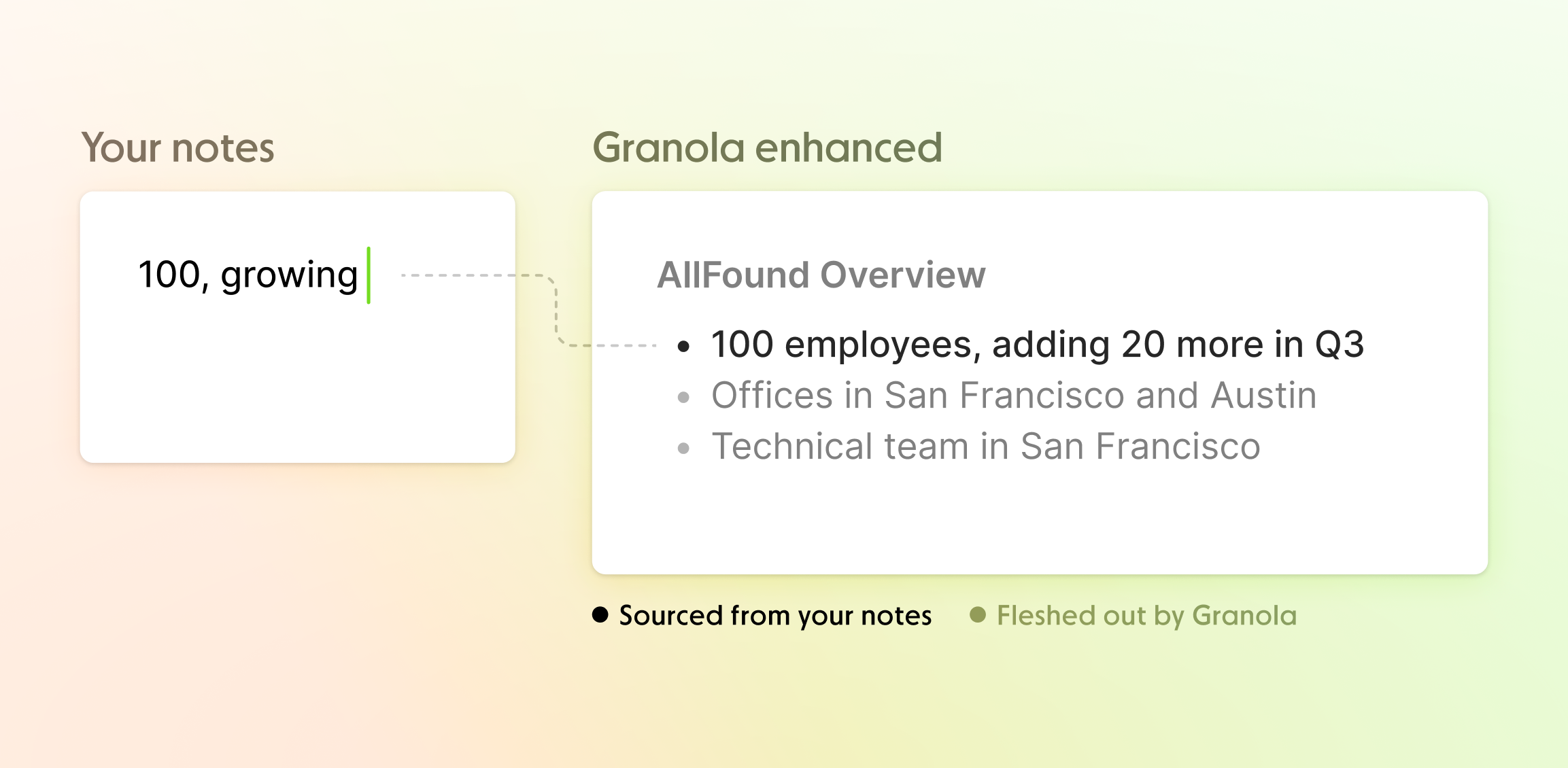
Your words in black, Granola's in gray — every line traceable to the transcript
Granola is an AI notepad that sits on your laptop, listens to whatever meeting you're in, and writes the notes for you. No bot in the call. No "Granola has joined the meeting" pop-up. Just a quiet local app that captures the audio and turns your sparse bullets into a clean summary with action items linked back to the transcript.
The founding idea, from CEO Christopher Pedregal, is that your notes stay yours. The AI cleans up and fleshes out what you wrote instead of replacing your judgment. What you typed stays in black, anything it added shows in gray, and you can click any line to see the exact quote it came from.
Full disclosure: I have not used Granola yet. We started with Quill about six months ago. It works, but it is not accurate enough, and accuracy is the whole game with a note-taker. We did the research, and Granola is the clear upgrade. Six months ago it was not the standout. Now it is. That is how fast this space moves.
Here is the thing I want you to take away regardless of which tool you use: get on an AI note-taker. Not having to take notes and having your conversations automatically organized and summarized the moment they end is a genuine game changer. It changes how you think, how you follow up, and how you retain what actually happened versus what you think happened.
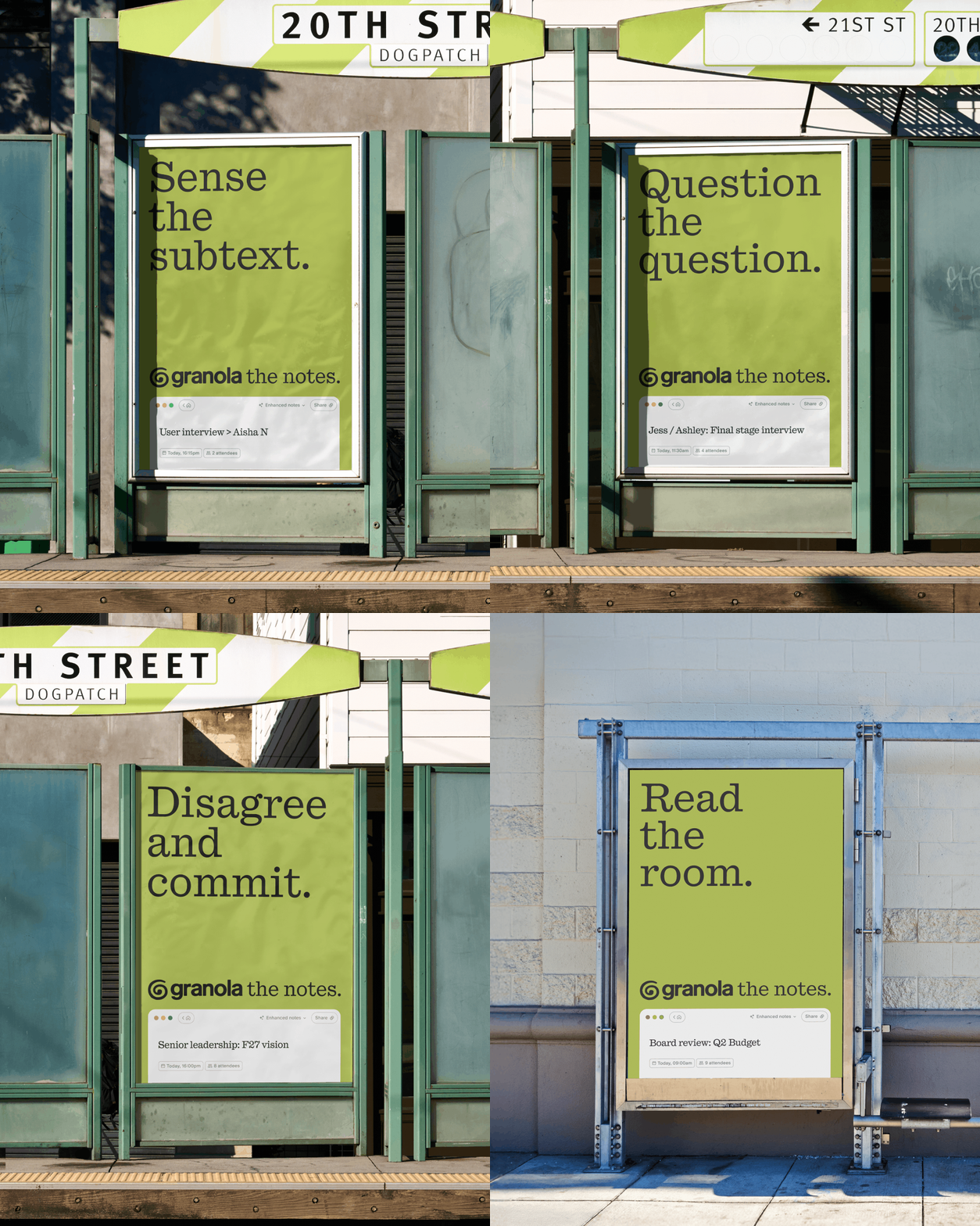

Granola's recent out-of-home campaign
Pedregal is no first-timer. Stanford CS, then Gmail, Search, and Maps PM at Google, then Socratic, an AI tutor that hit 10M+ monthly active users and won Apple's App of the Year before Google acquired it. Granola just raised a $125M Series C led by Index at a $1.5B valuation, with revenue up 250% the prior quarter. That is a real business pulling away from the field.
What makes it different from every other note-taker is what it doesn't do. No bot in your Zoom. No announcement. It sits locally and captures device audio. For anyone who has had a call or conversation derailed by a third-party bot in the room, that one design choice is the whole pitch. Privacy by default, no social friction. Under the hood it's GPT-4o and Claude, and every line links back to the moment in the transcript it came from.
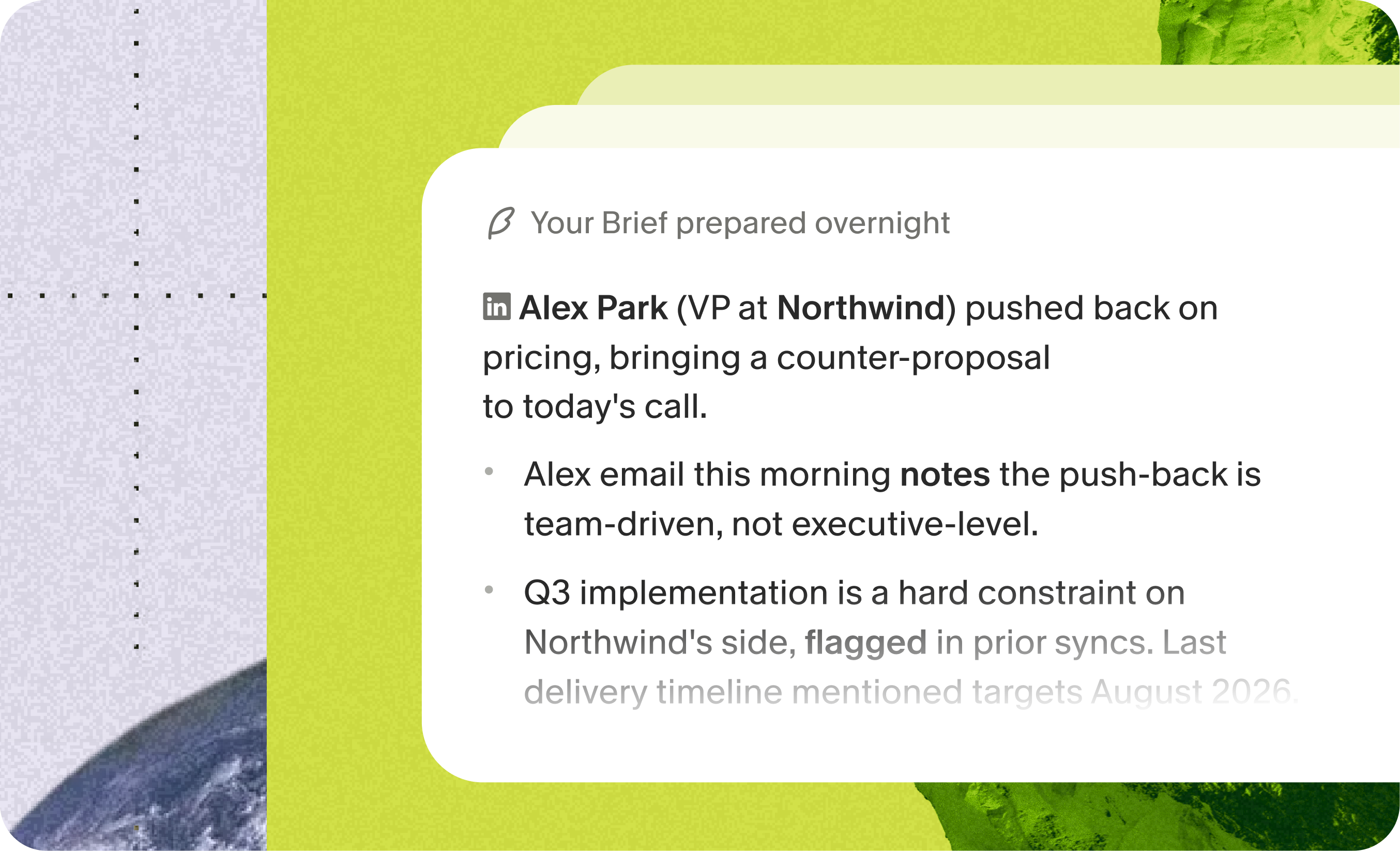
Briefs: Granola preps you before you even join the call
Last month they shipped Briefs. Open a meeting note as you join and Granola hands you a short two or three bullet brief: who you are meeting, what you discussed last time, and what matters now. Overnight it does the prep. It checks who is on the call, digs through your past notes, pulls from Gmail if you let it, and runs web research when it needs to. Every fact is cited, and you can see the exact steps it took. It is the difference between walking in cold and walking in like you spent twenty minutes prepping.
This team ships constantly. Briefs, an AI chat that already knows what you are working on, a full iPhone app for in-person and phone calls, all in the last few months. Most tools plateau the day you sign up. Granola gets visibly better every few weeks.
The use cases that matter most to us are in person. At Cutting Horse, that means founder meetings, interviews, and networking conversations where you want a clean record of what was actually said. At Petfolk, it is team meetings, hiring conversations, and any room where someone is making a decision that will matter later. Google Meet and Zoom work too, but the real unlock for us is the in-person capability without a bot in the room.
My recommendation is Granola. We started with Quill. Granola is better.
Free tier you can try forever (capped history). Business is $14/user/mo for unlimited; Enterprise $35/user/mo adds security and admin. Start free — you'll know inside a week.
Thanks for reading.
Mike Wystrach
Founder · Operator · Investor
→ Know an operator still using AI like a smarter search bar? Forward it to them.
→ Follow me on LinkedIn for daily insights.
P.S. — Andrew built MetaLab without raising a dollar, which is its own kind of advantage. If you're on the other path and gearing up to raise, I put everything I learned raising $107M for Freshly (and nearly dying with it along the way) into a free guide → Raising Venture Capital.
The Advantage | WiseTrack Collective
© 2026 WiseTrack Collective. All rights reserved.
Keep reading
Get the rest of the story.
It's free. Drop your email to finish reading — plus a new story every week from building Freshly, Petfolk, and Cutting Horse.
Don't miss the next one
Get The Advantage every week
Frameworks, lessons, and real stories from building companies — straight to your inbox.