Episode 31 hr 3 min
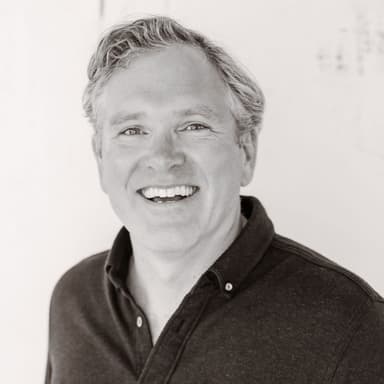
Sam McBride
CEO, Kettle & Fire
Start in a Niche. Just Don't Plan to Stay There.
The CEO of Kettle & Fire on the ceiling every niche has, the hiring test he will not skip, and why the idea was never the advantage.
Where to watch and listen
- Employee at RXBAR
- #4
- RXBAR sale to Kellogg
- $600M
- Where the CrossFit business stalled
- $6M
- Rival bars doing the same thing
- 4
- Invested in Kettle & Fire
- $44M
- Colter's cheque size
- $40-150M
Follow Sam McBride
“There were like four other RXBARs who were paleo, CrossFit, Whole30 focused, date-based plus protein. And we just were better.”
Sam McBride joined RXBAR as roughly its fourth employee and was there when Kellogg bought it for $600 million. His most portable lesson is about the room you start in: the CrossFit gyms that made the product make sense instantly are the same gyms that capped it at about $6 million. The niche was the training ground, not the destination.
Sam McBride joined RXBAR about a year after it was founded, when it was three grade-school friends working out of a warehouse surrounded by pallets of bars. The business had never raised outside money, which he describes as the reason it was unusually profitable: they had never been able to waste any. It sold to Kellogg in 2017 for $600 million.
The part of the story that gets skipped is the ceiling. RXBAR started inside CrossFit boxes, where paleo and Whole30 needed no explanation, and it grew there on an inside sales team calling gyms and an email list. That model worked and it topped out around $6 million. McBride is blunt that the niche was the training ground rather than the destination, and that retail is what actually drove the run to roughly $130 million.
Crossing over meant solving a communication problem rather than a product one. Saying paleo lost the mass shopper and told the paleo shopper nothing new. Retailers wanted to put a product called RX BAR in the pharmacy set, which McBride calls death, so they capitalized the X until it stopped reading as a prescription. The famous move, putting the ingredients on the front of the pack, came out of a demo at a condo association meeting where nobody reacted to Whole30 and everybody reacted to hearing the ingredients read out loud.
He now runs Colter Ventures on a deliberately concentrated thesis: $40 to $150 million a deal, no fund timeline, and involvement at operator depth rather than board depth. Kettle & Fire is where that went furthest. He sat on the board for years and his firm put in $44 million across two investments before Brian Hack, the CEO, proposed they swap seats and run it together. McBride took the CEO role and Hack moved to president and CFO. His stated filter for a business is not the P&L. It is whether he trusts the people, which is the same reason he took the RXBAR job in the first place.
What the conversation covers
The $30,000 offer
At 21, a year out of a finance job he had just walked away from, he offered to work six months below any hourly wage threshold on one condition.
The ceiling on a niche
Direct-to-consumer plus CrossFit was working and stalled near $6M. Why that number was both heroic and the entire market.
The pharmacy set problem
Retailers read RX BAR as a prescription. Capitalizing the X was a typographic fix to a distribution problem.
The condo association demo
Whole30 got blank faces. Reading the ingredients out loud lit the room up, and that became the front of the pack.
Race cars
His name for a product wearing every claim it has ever earned, and what RXBAR moved to the back of the box instead.
Hiring for the environment
A final round that tested only values, two weeks in customer service for every hire, and firing people during training.
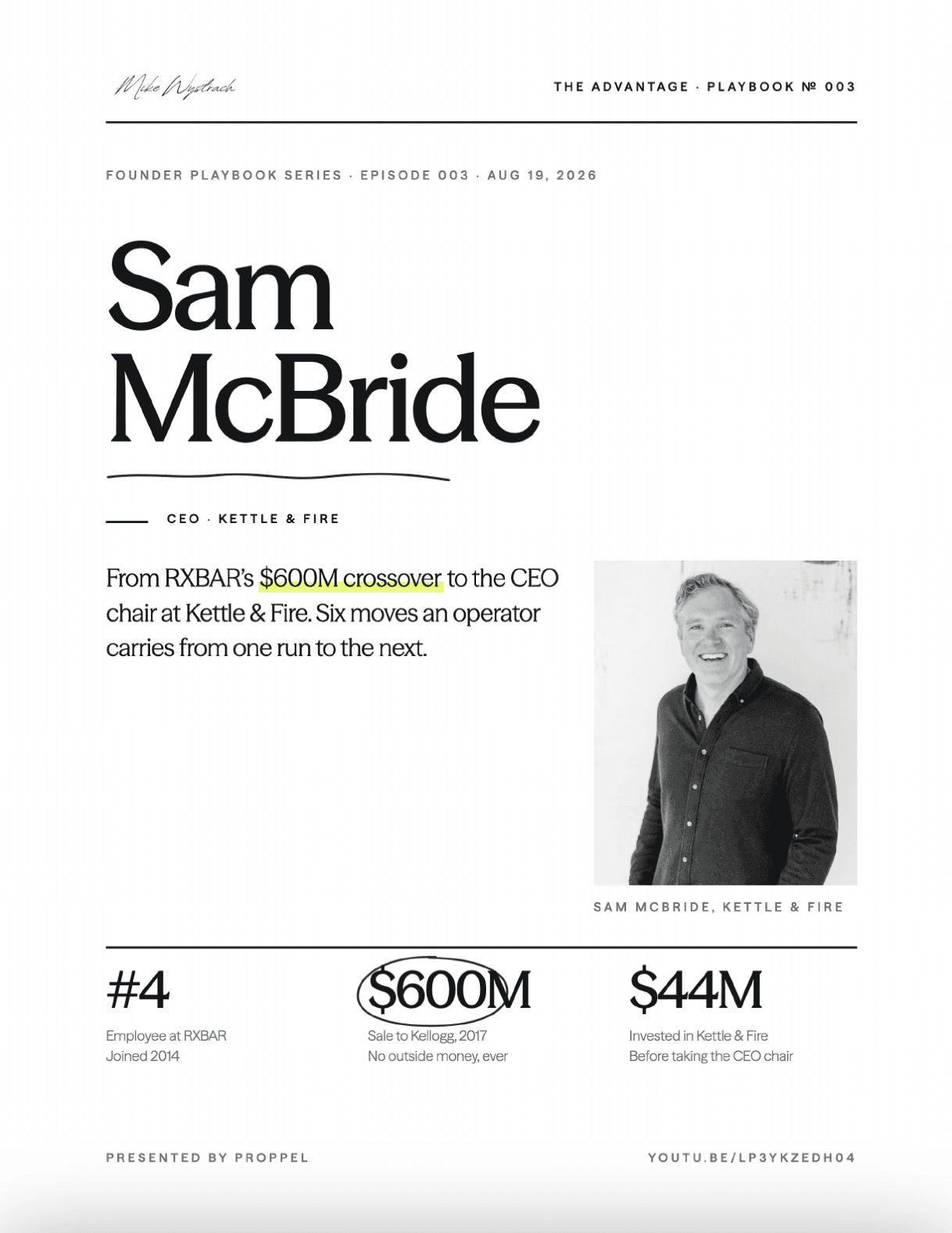
The Episode Playbook
The McBride Playbook
Six moves across both runs, RXBAR and Kettle & Fire — verbatim quotes from this episode, what actually happened at each step, and a run-this-week checklist. Free.
Get the free playbookTimestamps
Mentioned in this episode
People
- Peter Rahal — RXBAR co-founder, grade-school friend, now building David
- Jared Smith — the other RXBAR co-founder. Sam played basketball with him growing up
- Jesse Stewart — another grade-school friend, hired into RXBAR early
- Brian Hack — Kettle & Fire CEO who proposed they swap seats. Now president and CFO
- Scott and Victor — the creative director and copywriter behind the RXBAR repack, ex Leo Burnett
- Jalen Brunson — his example of someone who has won at every level, high school through the pros
- Tyler Cowen — the economics writing he recommends
Companies & products
- Kettle & Fire — the bone broth business he now runs. Colter put in $44M across two investments
- Colter Ventures — his firm. Fewer, bigger bets at $40 to $150 million
- RXBAR — where he was roughly employee four, from 2014 to the sale
- Kellogg — bought RXBAR in 2017 for $600 million. Now Kellanova
- Kashi — one of the better-for-you Kellogg brands they pitched to run after the deal
- Bear Naked — the other one they wanted under their leadership
- Quest — the bar company they looked up to on content and tactics
- David — Peter Rahal's next bar. Sam notes it did in 15 months what RXBAR took three years to do
- LiveWatch — the direct-to-consumer home security business he joined at 21. Now part of Brinks Home
- Piper — ran the RXBAR sale process. Their banker Janica took it to market
- Leo Burnett — the agency Scott and Victor left before the RXBAR repack
- CrossFit — the niche the business started inside, where RX means as prescribed
- Whole30 — the other diet the early product spoke to, and the word that got blank faces
- Amazon — half of the early $6M, alongside direct-to-consumer
- Freshly — Mike's company. Started as F3 Foods, renamed with the agency Tether
- Nestle — bought Freshly. Mike on what scale actually looks like from the inside
- Cutting Horse — Mike's firm, same concentrated thesis as Colter
- Bridgewater and Patagonia — Mike's pair for the same point: opposite cultures, both hired to theirs
- Farnam Street — the other thing he reads
Concepts
- Race cars — a pack wearing every claim it ever earned, committed to none
- The pharmacy set — the shelf a name can accidentally choose for you
- Crossing the chasm — getting from a niche that gets it to a market that does not
- The free display — an empty stand on the counter is the reorder trigger
- Fire fast — the second-best outcome of a values interview
- Two weeks in customer service — every RXBAR hire started there, and some ended there
- Signal and noise — what the grind is actually teaching you early on
- Read the people, not the P&L — his filter for a business
Show notes
Sam McBride is the CEO of Kettle & Fire and the founder of Colter Ventures, where he writes $40 to $150 million checks into a handful of businesses at a time.
This episode is presented by Proppel. Hire A-player marketing and ops talent from the US and LATAM, and get 10% off your first hire: https://www.weareproppel.com/theadvantage
Full show notes and everything mentioned: https://mikewystrach.com/podcast/sam-mcbride
A year out of school and working in healthcare M&A, McBride sold a $10 million piece of business to a division he did not work in. He asked his MD what that was worth to him and got a story about how long the man had waited for his yacht club membership. He quit. Then he called a
mentor who was buying home security companies and offered to work for $30,000 a year for six months, on one condition: he wanted to be an executive immediately. He was 21.
Every decision since has the same shape. He joined RXBAR as roughly its fourth employee and was there when Kellogg bought it for $600 million. He put $44 million into a bone broth company he had sat on the board of for years, and took the CEO seat when its chief executive proposed they
swap and run it together. The most portable thing he says is about niches.
McBride is blunt that the niche was the training ground rather than the destination. The time in it is what made every later decision obvious, which is why he tells founders to start narrow and plan the way
out at the same time.
He is unsentimental about the job itself. One problem after another, almost no credit, and getting kicked in the head often enough that you stop expecting otherwise. Once in a while there is an outcome. The other 99% is the part you have to like.
Chapters
00:00:00 Operating Is Solving Problems For Almost No Credit
00:02:45 The Yacht Club Story That Ended His Finance Career
00:04:00 He Offered To Work For $30,000 A Year At 21
00:13:12 RXBAR Was Three Grade School Friends And A Warehouse
00:19:51 The CrossFit Business Topped Out At $6 Million
00:32:31 There Were Four Other RXBARs
00:35:30 The Values Interview That Ran The Final Round
00:41:31 Selling To Kellogg For $600 Million
00:50:28 Fewer Bets, Bigger Bets, And Kettle & Fire
00:59:27 Start In A Niche. Just Do Not Plan To Stay There.
Sam McBride
Colter Ventures: https://www.colterventures.com
Kettle & Fire: https://www.kettleandfire.com
PRESENTED BY PROPPEL
Your business is only as good as the people in it, and finding real A players is one of the hardest things you'll do. Proppel specializes in marketing and operations talent, placing top people from the US, LATAM and beyond.
It's all performance-based. You pay a one-off fee only once you actually hire someone, so no retainers and no ongoing costs. Every hire comes with a three-month guarantee.
Get 10% off your first hire: https://www.weareproppel.com/theadvantage
All episodes: https://mikewystrach.com/podcast
Instagram: https://instagram.com/mikewystrach
Full transcript
Mike Wystrach in conversation with Sam McBride. Lightly formatted from the episode audio.
speaker-0: From two million to a hundred and thirty million in three years. I think that's like insane phenomenal growth. I
speaker-1: For $30,000 a year, but like I wanna be an executive right now. The idea, there were like four other RX bars. We just were better. You gotta be in it because you like it. We'd fire people in training. So the first two weeks at RX Bar you spent in customer service, we'd be like, hey, it's whole 30, hey, it's paleo. And like these people couldn't have cared less. And we'd just say the ingredients. And every single person like lit up. The name Rx Bar is actually a problem because retailers back then wanted to put it in the pharmacy set. That's like death. We were uniquely profitable because we had never taken any outside money. So we'd never been able to waste any money. We were super efficient, and it was a really good business.
speaker-0: Sam, super excited to have you on the show today. Excited to dig in. I have been a longtime user of both the products that you help bring to the world. So really excited to learn a lot more behind the scenes and I built those. But thanks for being on today. Thanks. Appreciate it.
speaker-1: Yeah I appreciate
speaker-0: Let me pause here for a second. The show is brought to you by Propel. They find brands like yours exceptional marketing and operational talent in the US, Latinam markets, and beyond. For now, the links are in the show notes, and all of our listeners get 10% off your first hire. Okay, let's get into it. So where I always love to start is when you make that first jump into kind of a startup or startup world, take us back to the journey. I you know, I it it from my background, but let me know if there's something before that. Kind of the first startup was RX Bar. But like you know, you're you were a very, very early employee there. So I imagine that business, you know, look like all very early businesses. you know, what what what got you to take that jump in the startup plan?
speaker-1: Yeah, it's funny. So I when I graduated from college, I was in finance doing healthcare MA. And my wife worked for a PE shop. And my side of the business, we were merging hospitals and surgery centers and things like that. There's another side of the business that operated hospital systems. So my wife's PE firm bought this group of hospitals and they needed someone to come in and operate them. I found out about this through like a did I was at a dinner with her team. And I effectively sold in this like $10 million piece of business, my first year out of school as an entry-level analyst to a group that I didn't even work in. And so we sell in this big piece of business. And I'm like, this is amazing. You know, like this is like me way outperforming expectations as an analyst. So I go to my MD and I'm like, hey, you know. What should I do about this? You know, like this is obviously like not in the job description, not contemplated in my bonus package. And he's like, You gotta go talk to the other MD. And so I go talk to him. He gives me this story about like how long he waited for his membership at a yacht club that he belongs to. And then it basically told me to like take a hike. And I was like, so I'm I'm about a year into my career in finance. Both my parents worked for big companies. They're not entrepreneurs. And I was like, I can't, I can't take this. Like, there's no way I can sit here after this. And so I called a guy who had been a mentor for me, who I worked for in the summers during college. And he had found this home security company to buy. And this was like internet 2.0.
speaker-0: So what year is this?
speaker-1: This is two thousand and nine. Okay. Two thousand nine, two thousand ten. So I'm a year out of school. And so he's like, Hey, I found these home security companies to buy. I'm gonna go buy them and here's the strategy. And I was like, I'm in, I will come do this. And I I made him an offer because at the time, you know, I'm a year out of school. I have really no skills to offer other than like I'm gonna work super hard. So I tell him, I'm like, look. I will work for $30,000 a year for six months. And if after six months of you paying me $15,000 for six months, which is like gotta be below any hourly wage threshold, if I'm still an executive on the team, we renegotiate like a proper package. But like I wanna be an executive right now. I was 21, I graduated school a little bit early. And And that was kind of my first operating experience. So we built these home security businesses. It was a direct-to-consumer home security concept. And we were basically disintermediating the the installer of home security. And it taught me a ton about D2C customer acquisition. And it was a great learning and how to win. The guys who I was working with were more seasoned than me. They were really good operators, super systematic, really, really smart. And that business ended up selling to another sort of like strategic in the home security space. And so it was the first experience for me of like, how do you just go into the void and then figure out how to win?
speaker-0: How how long did that journey take from like starting it to like selling to the strategic?
speaker-1: Yeah. So the it was maybe four or five year process, something like that. And the exit was not like, you know, R X bar, which I'm sure we'll get to. It it it was not like that level of exit, but it was a win. Like we we accomplished what we set out to, built a good business, were able to sell it. It was it was totally
speaker-0: It's always like how important do you think? Cause I always tell people like, you know, yes, you do learn a lot from failure. And I certainly have had failures, but like you also like I think underestimated is like small wins, you just learn a ton from like those teams. And like even if you're a smaller like part of those wins, just like early in your career getting on like teams that that ultimately get to some degree of success compounds and like that. Yeah, I always tell people like when you're really young, like you don't necessarily need like the Facebook meta, like, you know, like Elon, even Elon, who's obviously, or at least in my opinion, the best entrepreneur out there, like his first win was like a moderate win. And but like that moderate win grows into the second win, the third win. How important do you think that first win was?
speaker-1: I think it's it's everything. I mean, i you look at it, you see it in sports all the time, where like there's just groups that are winners, like the Knicks. Jalen Brunson and those guys, they just win. Like they win at every single level. Jalen won in high school, college, and now the pros. And I do think that there's like a certain level of understanding how to win. that is super important. And in in at that point in my career, I was Right at the beginning, totally impressionable. I was learning everything was new. And it definitely taught me it gave me great lessons tactically, but then also just generally speaking, like how do you win? it was huge. It was everything.
speaker-0: So going back, so there's this twenty one it's funny because I had like the almost the same exact situation. I w I started off working investment banking and was so frustrated at like how slow everything went. And I just had this like I laugh now looking because like my hubris was just so huge. Like I just I felt like I was smarter than everyone. Yeah. But it it was that like desire to like want to move quickly, wanna Wanna you know, ultimately also saw myself as like, you know, I'm not gonna do this slow and steady. I'm gonna do this. But that definitely it sounds like you you had that. but then now as like more of a a seasoned person, like now I'm I'm often trying to rein that in a little. Like, how do you see like looking back at that 21 year old you, like, you know, what areas do you think like you think absolutely you had it right? And what areas do you think like, God, I've grown and just seen like God had all these things wrong.
speaker-1: Yeah, I mean, I I definitely think like when you are more seasoned, there's a little more of a regulation of yourself. Like you know, like I know I can come out super intense and like the team can kind of be like, Whoa, you know, like this guy's emailing us at two AM and five AM, like what is going on here? So you have to sort of like regulate certain parts or at least understand how you're going to impact the people that you're working with. Like that would be something. But back then I was just like charging. Like I was so I was honestly so scared that I wouldn't be successful, that I was like, you know, would do would have done anything to just prove that I could do it. and now I think it's a little bit I still sort of feel that same fear, to be honest. But I think it's just a little bit more regulated in terms of how it shows up every day, hopefully. I mean, you still have to bring like a lot of intensity in operating. I think it's important. But
speaker-0: Kind of digging into that a little bit, 'cause like obviously, and we're gonna dig into your success, but like, you know, you've kind of had multiple different levels of success. Just that statement you said is like, honestly, today I'm still like dealing with that fear. Like unpack that a little for us. Like what is that, what is that like? How does that show up?
speaker-1: Yeah, I mean, I just think every if you sort of are if you're driven in a way where your first job out of school, you're twenty, twenty-one years old and you're walking into an MD's office asking for him to compensate you for something you did and then leaving a career path when they don't. Like if you sort of have that in you, I just think every Every next level just unlocks the next one and the next one and the next one. It sort of never ends. And I think operating is that way, right? It's like one problem after the next. You just sort of like get used to that kind of cadence. And I think some people are totally built for it. Like I realize like I c I can't sit still and be happy. It's just not for me.
speaker-0: Yeah, I could not agree with it. It sounds like we have a lot in common. I people asked how much time I took off between Freshly and my next company. I said none. I had actually had them overlapping. and that's probably why I stayed married. Cause like, you know, the energy for me is just like I constantly need to be doing something. So I would be a nightmare if I was at home with nothing to do. so you you sell that business, you know, a a moderate, like let's say a a solid stand up, you know, single double. And then how how do you get introduced to RX Bar? Because at the time when you joined, I think employee like number four or five. and then, you know, doing revenue but still very young, you know, relative to where they got. Like how did how did you get how did you discover them?
speaker-1: Yeah, so so the so the home security business taught me a ton about customer acquisition, D to C and so on. And I have sort of a funny story in between where a a good friend of mine reached out and she's a recruiter and she's like, Hey, I have this client who I cannot I cannot get this this recruiting thing over the finish line. Like I cannot find them a sales and marketing leader. She's like, will you just take an interview with me, with them just so that I'm continuing to send them candidates? She's like, I know that you're not going to take the job. Will you just, we just take the interview. So I'm like, sure, no problem. And so I go take this interview with zero intention of taking this job. And it's with this company that's like a homegrown facility services business. So I'm in the home security space. This is like asphalt concrete roofing and so on. So I talk to the head of commercial or head of sales or something, and it goes well. And he's like, Hey, will you come back in and meet with our CEO? And the CEO is kind of a known guy in Chicago. So I'm like, sure, like I might as well. I've gone this far. I might as well like meet the CEO. So the CEO and I have this 45 minute interview that lasts three hours. We like completely hit it off. And he's like, Hey, I want to put you in charge of all sales and marketing for the whole portfolio. So the business is doing like 200 million at the time, and it's a Bigger business for me than I've been in. I'm like 24 years old. And I'm just like, and this guy's kind of a legend in Chicago. And and I'm just kind of like, whatever. Like, yeah, let's do it. You know, this would be like a totally new experience for me. So I go in and I'm running sales and marketing for this portfolio of companies. And basically the concept was to take what we did in home security and apply it to another industry that had no one doing anything interesting from a tech Standpoint. So this is like, you know, 2012, 2013, call it. And it's like Internet 2.0, where digital is now impacting old school businesses. So we tried to do is build like a more progressive asphalt and concrete business, essentially, from like a sales and marketing standpoint. And we did, and it was successful, but it was sort of plateauing. And Jared and Peter, who founded RX Bar, are two of my grade school buddies. And Peter was the best fan of my wedding. Jared and I played basketball growing up together. They were the only two people I knew who were operators. And they had hired one of our other grade school friends, Jesse Stewart. And so they were all like grinding this out super early days. They were working out of the warehouse, surrounded by pallets of bars. And it was basically a D2C CrossFit business. And I had learned from the live watch, the home security experience, that like, You don't need to like go in and like, at least my approach was not like I need to go in and like negotiate my offer and my setup. I was like very much in the mode of I'm in this entrepreneurial mindset. I'm just gonna start kind of working with them. Like I'll come in on nights and weekends. They're my friends. There's a ton that I had learned in the live watch experience that I thought applied well to RX Bar. So I just kind of started working with them. Like it wasn't even like, Hey, I really want to do this with you. It was just sort of like, you know, we just started working. And then after like a month, they were like, Hey, we should, we should formalize this and you should come do this full time instead of just like on your way home from work and on the weekends.
speaker-0: That's aw and so it's it's funny, like again, another kind of crossover. So like in around the same time, you guys were were definitely ahead of like freshly, but so we were very much involved in CrossFit, me and my co-founder. And so we and and part of the reason I got into CrossFit, I was, you know, trying to get in shape. And that's how a good fit my co-founder's dad actually was really into the paleo diet, really kind of even before it was called paleo diet. He wrote a whole book on and so We were I was just trying to eat like the paleo diet. And like that's how we came up with Freshly was like, okay, like having someone cook it for you. So our original and then cru y our X bar obviously, and I I'd love for you to tell that was like, you know, you guys were huge in the CrossFit community. And so you know, we got introduced and we're like, we're gonna do the same playbook. So our actually original playbook was we had a bunch of refrigerators in CrossFit gyms. And then like very quickly we're like, okay, this is not gonna work. This is like a horrible idea. But we r really tried to copy your guys' model as like, okay, we're gonna, you know, these everyone in CrossFit was very indoctrinated and and still it's like, you know, CrossFit was so smart to like realize that like nutrition plus exercise is like the the yeah the gold standard. And so everyone was already like like wanted paleo and paleo diet. But like so was so that was already there a little when you when you got there. But like you guys took that to the next level. I mean, you guys were almost synonymous with like CrossFit.
speaker-1: Yeah. So like this was the amazing marriage of my pr past experience and how they had started the business. So Peter was like you. He's super into CrossFit. He was eating p a paleo diet roughly or like doing whole 30s. He was very much into that. And RX bars, you know, like in CrossFit, if you do the workout RX, that means doing it as it's prescribed. And that's like a big thing in CrossFit. It's usually very hard to do that. Not all the Athletes at these boxes can do it. And so the product is really like for people who know, it's kind of named like CrossFit Bar. You know, like that's kind of the origin of the name is R X bar was was a knob to CrossFit. So Peter, when he first started, when he found not even when he founded the business, when he first made the product, he would make it and then take them into his CrossFit box and like cut them up for people. So it was truly like a CrossFit origin. And in 2014, when I joined, about a year after they founded the business, it was almost entirely focused on CrossFit. So it was selling to CrossFit boxes and a D to C business that essentially serviced CrossFitters who found out about the product through the boxes. And so the the insight that that I think we all knew this, but The home security business was built with an inside sales team. So we had an inside sales call center in Kansas that would call people, dial for dollars, and email marketing was huge too. And so our first growth path was to basically rebuild that kind of inside sales mentality, but focus totally on CrossFit. And we never raised any money. So we didn't have the money to like go into traditional retail or build up a bunch of inventory. So we started with a like D to C plus B to B inside sales model that was supported by email marketing.
speaker-0: And so that was and that was the was that B2B inside sales was primarily still just getting more boxes or were you guys branching out into like
speaker-1: It was almost entirely focused on boxes originally. And we figured out, like you guys, for us, the refrigerator was the the shipper. So we started realizing like if we sell them a couple boxes, they eat them, like boxes of Rx bars, they eat them and then they never reorder because they just sort of forget. And so we started giving them free displays. Because when those were empty, they would automatically reorder. And we had the we had the economics down where we knew these were profitable accounts for us and it could essentially fund the growth of the business.
speaker-0: And so and and I have these stats down, but let me know if they're wrong. Business went from two million to a hundred and thirty million in three years. And I I think that's like insane phenomenal growth. But I also want to like go back to like I think people don't appreciate that like the growth mechanics that you have today, like social media and stuff, didn't really exist at the scale we have to so like That growth at that time was like you you guys were at the front runners of getting that kind of parabolic growth, which is now a little more common. So, you know, it yeah, like back then that was like so uncommon to get do an art to do a like a bar, that would be f 30 years of growth from a bar company. And so to do it in three years is like just off the and that was was that really just predicated around this inside sales team?
speaker-1: Well, so it's funny because we thought we were so successful with this digital D2C model plus this kind of like niche, you know, B2B channel through CrossFit. And we really only got that business to like six million bucks. But at the time that was like heroic,
speaker-0: Like you.
speaker-1: you know? And Peter with David, they have done what we did in three years in like 15 months, you know? And so The speed of this stuff has changed so dramatically. But back then, we looked at Questbar as kind of like the leader in the space. And that was who we looked up to from a tactics standpoint. They were like creating content and they had podcasts and they were like so ahead of the game on the content thing. And so we, I think in a lot of ways, we were on the very cutting edge of influencer. So we were seeding CrossFit people and fitness people like. Crazy. And back then you didn't you couldn't track influencer. And it wasn't like they had to say, hey, this is an ad. We were just like seeding everybody. And we weren't paying anyone really because we didn't have any money, but we were just getting the product into all the right hands. So we were really early on the influencer side of things, but we really only got that business to like six million in the early days. Six million was like pure D to C CrossFit and Amazon. And then we went into retail and retail is what really drove that that growth.
speaker-0: Yeah, and I think the amazing thing about like RX bars is as like, 'cause like, you know, certainly crossfit has gotten like kind of like the the bro rep, like, you know, but what you what you have seen, like when you look at Quest or other bars that have really originated from like pure fitness, like of that, they they still stay very in that niche. Like the, you know, you but like you guys really were able to like jump over to mass stream. I think part of it was like your your bars are pht phenomenal. So first I mean, obviously product market fit, you can't fake that. but then the second thing was like like I think the the principles of like just all natural and like you're, you know, I loved like when you guys think of cause again, the like you guys did so many things that were groundbreaking. But like one of the groundbreaking thing was like the the label. Like and you guys like continued to evolve and and when did you guys get to where you just listed like the the ingredient the the me the ingredients on the front of the label? Cause that was like That was the thing to me that was like, you know, this again, this was before it's, you know, again, all these things like that. You guys were one of the first to do that, where you just like put the ingredients and they were all natural and they were on the front. And like you guys really owned that fact. And I think like that to me is like one of the biggest things, at least for me, is because like the again, the name is like very like you wouldn't think that name is a crossover name and your your your product was such a crossover product.
speaker-1: Yeah, it's funny. In in those early days, so we when we were building the business, D2C and CrossFit, we always knew that wasn't going to be enough. It was a small market. and we had bigger ambitions to b build a bigger business. So the question for us was always, how do you cross the chasm from this niche to the mass market? And we knew we had product market fit for paleo and whole 30 people. And we thought that clean label. Plus protein was a winning formula for the mass market too. But the question was always, how do you explain the product? And the name RX Bar is actually a problem because retailers back then wanted to put it in the pharmacy set. And we were like, we do not want to be in the pharmacy set. That's like death. And so we when we repackaged, we we capitalized the X so that it wasn't like uppercase R lowercase X, which feels like even more tied to prescription. and what the main challenge for the repackaging was how do you communicate the value prop in a way that speaks to the paleo CrossFit whole 30 audience, which had gotten us there. So they don't think, hey, our X bar has changed or left the like kind of the mission. But it doesn't say paleo because people don't think paleo things taste good. And or they're like, I'm not paleo, so I'm not gonna eat that because it says it's for paleo people. So listing the ingredients on the front was the translation of that. It was if you're a paleo person, you read these ingredients, you go, okay, I can eat this. And if you're a mass person, you're just like, okay, egg whites, almonds, dates, cashews, like that looks clean to me. And there's 12 grams of protein. So it was always a question of like how do you communicate it? And there's a funny story. So What really drove it home for us, so on the back of our old packaging, there was like these little icons that showed two eggs. And back then it was half a fig, but it showed those core ingredients, but it was tiny, like a little thing on the back of the pack. So we would go to these, we would demo all the time in Chicago. Like we were just cutting up bars for people anywhere they would let us do it, CrossFit gyms, whatever. And our friend from high school called us and she's like, Hey, I'm running the co-op at this condo association. And we're doing a condo association meeting. Do you guys want to demo bars for this condo association meeting? And we're just like, yeah, like we'll literally show up anywhere and and give people bars. And so we're doing it like we always do at this little tabletop. And I'm sit standing on Jared. And we'd be like, hey, it's whole 30. Hey, it's paleo. And like these people couldn't have cared less. Like they were just like, okay, cool. And then we'd be like, there's, and we'd just say the ingredients. There's egg whites, almonds. at the time fig and dates, and every single person like lit up was like, like they like you could just see them understand. And so we took that learning into the design process and we're like, this is really what we're trying to communicate. And it came out that way.
speaker-0: Did you when you guys did that, did you guys use a branding agency who kinda helped you flush that out or did you guys do that internally?
speaker-1: Yeah, we used these two guys who had left Leo Burnett. one's a creative director and the other's a copywriter. They're named Scott and Victor. And they're a small independent crew and we worked with them on it. And a couple of the alternate paths are behind me. I got like the original prints framed up into this big piece. it's sort of funny to see like the other directions that that were offered up.
speaker-0: So it's I mean, I I think this is kind of like, you know, to to people early founders or or potential founders out there, like I think similar journey for freshly. So we originally actually started our title was F three foods, which stood for fresh, fast, and fit. And so very s very similar, we started kind of selling to gym people. So we were like, and they already got it. Like we were again selling in boxes. So it was like paleo and like we didn't there was no further education. So it was like very aligned. And then then Very similar again, like the hustle culture. Like we would we we didn't care who would buy our product. So we would just go. I mean, we would sell everywhere. And we went to literally any county, any fair, anything that we could we could solicit to people. And very similarly, what we realized is like you we would say paleo, but then you gotta educate someone on paleo. And they're like, I don't and so then it became like we were like, okay, it's just fresh, all natural. So like and so fresh, all natural. And then what we realized is like people are like, it's fresh, it's fresh, it's fresh. So When we did the rename, we were like, well, what like people were like, well, what do people care about? It's like the number one thing is fresh. Like the number one thing. So like, and again, I always tell people like it really helps on doing a branding to like to tell an individual who's like really good at this, and this is what they do for a living. But so we sat down with with this great team called Tether, and we were they're like, Well, what matters? And we were like, Okay, you know, paleo, blah, blah, blah. And they're like, okay, for people not doing this, what matters? And we're like, fresh, all natural. So they came up with the name Freshly, and immediately were like, Yes, that's it. Freshly, it's like, that's the name we've always been looking for. But it was crazy because, like, as we and very similar, we started very narrow. I'd say we probably only got to about a million dollars in like the the CrossFit, kind of very focused paleo. And then we switched to Freshly, and it was just like a rocket ship. And because what we realized is, and I always think like, The hard part for founders is like you have so many things about your product that you're obsessed with and you're fast. And like the the mass consumer actually only cares about one or two things. And your job is to like figure out what are those one or two things. And then you can always layer on after like what the things are. But there's usually like people have room for one thing, maybe two things, but they certainly don't have room for 10 things. And anytime you have to educate them on the sub thing, like that never works. If you want to go mass, at least in my experience.
speaker-1: And it's like a classic strategic framework of what are you not going to focus on that seems like it could be sort of useful? Like for us on the front of pack, we removed gluten-free, non-GMO, paleo. We put it all on the back because we were like the only thing we want them to see is clean label. And then a protein clo call out. And like that's it. And everything else they can learn after the fact. But I see so often we we call them race cars, these products that come out and look like race cars. They've got badges everywhere. And it's like you clearly have not really committed to what your value prop is.
speaker-0: We did the same thing. I mean, so we were my my co-founder has celiac. So we were always because we were like our first customers, so we were a hundred percent certified gluten-free. So we were like, everyone's gonna care about this, like we're gonna put this, and we had all these labels. And then slowly we just realized like remove, remove, remove and just put all natural. Cause like for us, that's all our c and so everything to your point is noise. And the more noise I think people think it's additive, but it's actually reductive. Like what you wanna do is just like And it this is one of the like early lessons as a founder because you want to tell more, more, more. And you're like, and our product does this, and and and it's like, get rid of the and you can only say one thing, that's it. And and that's what people anchor to. It's but it's always challenging for founders because like you're in love with your product for like 50 different reasons. but it's an interesting exercise. I mean, that like I w again, I was following this like, you know, before you guys had done that, and then after. And then it was amazing to me because we were like, Again, I was, you know, deep in the CrossFit. So like we we were we were part of that early six million revenue. And it was amazing when like all of a sudden, like people are showing up to the office that are absolutely not into it, but they're like, I love this bar, you got to try this. And it was like, wow, these guys really figured it out. What are some because like I think it's always easy hindsight to look back, and I'm sure everyone's like, my God, you were so lucky you joined this bit, like, whoa, that's I would I want to do that. But like I think what people forget, like when you join that business at thr I'm sure your parents are like, don't do this. What are you doing? This is a mistake. Like, give us some of like the early scary things. Cause I always think like people like there had been a ton of them, but like when you join that business, I'm sure it was like it was not obvious that you guys were gonna later sell this business for, you know, multi hundred million dollar exit. Let me pause here for a second and introduce you to our title sponsor, Propel. Every business I've built has had a huge, huge, huge piece with international talent. And as we started building the advantage, we wanted to bring in international talent focused around media, podcasts. And we started doing a lot of research and we came across papel. And we were really excited first and foremost to use them for us. And we later reached out as a sponsor. Here's the best part it's all performance based. You only pay one off fee once you actually hire someone. That means no retainers, no ongoing costs, plus every hire comes with a three month guarantee. I think bringing on international talent is really hard, really rewarding. As we all know, bringing a talent onto your team is the most important part about building a business. And with Propel, I can speak for ourselves. They have been a huge part of our ability to recruit great talent to our team. Every advantaged listener gets 10% off their first hire. For more information, check out the show notes.
speaker-1: Yeah, I mean, it's funny. It's like even when we sold, like right before we sold, people would still ask us, like, are you doing this full time? And we're like, we're like, yeah, we are doing it full time, very full time. but it's to me, it was the team, like I at that point I'd been through so many of these like super entrepreneurial experiences that I wasn't afraid of something small. And I was confident that if you were smart. And focused on the business, you could grow a business. Like you can make good decisions, you can outcompete people, you can outwork people. It doesn't have to be the idea. Like when we were in the early days of RX Bar, there were like four other RX bars who were paleo, CrossFit, whole 30 focused, date-based plus protein. And we just were better. Like we were out competing them. And the thing that gave me confidence in RX Bar. was the people. Like I knew Peter and Jared really well. I knew Jesse really well. and I just knew like no matter what, I'm gonna be working with people who I trust and whose values I know are really strong. And I know that they're working super, super hard. And so I kind of figured the downside is like we make a pretty small but profitable CrossFit oriented business. And the upside is We get the timing right and we make a bunch of good decisions and, you know, are super committed to it and it goes really well. So to me, it all like the way I think through the businesses is always almost through the people. Like it's not through a PL or like a strategic document. It's like, are the people the right people to work with? and do I align with the with the people? Cause you know, like when you're operating, like you're in it day to day. Like you've got to really feel like the people next to you are are doing the right things.
speaker-0: Yeah, and I I mean I I I love your take and we'll talk I'd love to talk through kind of the acquisition 'cause people always ask, like, man, with that and I was like, look, there's no doubt, like when you're building a business and you sell, it's a huge moment. But I always like my analogy is always like hiking and and like climbing mountains. Like if you're only in it for the peak, then you shouldn't like no one likes you gotta really enjoy the journey. And to me is like, yes, you get to the pink peak, it's fun, but it's never it's never as great as you thought. Like, my God, like is the like But what you really do look back, at least for me, was like the journey. Like the journey was like the fun part. Like I look back and and and and and certainly the economic benefits were awesome. But like for me, the people I met, the people, the journeys, like we we get our group together and our group at like our core freshly group is still like fifty people and the stories and we laugh. And you know, we we it's fun to look at it with rose colored glasses now. But you just laugh at like, my God, we were so crazy. Like we did And I I think that's my thing to everyone is like the the best part about the startup journey is the journey. The yes, you you I'm in this game to win as as as certainly you are, but like you gotta enjoy the journey if you don't get out of the game. Cause like that's like it the the rewards aren't fruitful enough, e no matter how great they are, if you're not like having a fun time on the journey.
speaker-1: I completely agree. We we got to the point when we were recruiting towards the once we really figured out our recruiting and like what we were looking for, either Peter and I or I would do the final round. And it was always just pure values-based interview. And there's probably still stuff on Glassdoor about it, but it was a very unique approach to this values-oriented interview. And I got to the point where I was just like,
speaker-0: Can you real quick just hit hit on a few of those things? Like what what what were like the the value based that you have to cover?
speaker-1: So we realized that finding the right people was so much more important than whether or not they could do a specific task. Especially because we were growing so fast, things were changing so much. We just realized if you weren't the right type of person, no matter how smart you are, you were just gonna get run over.
speaker-0: What were those kind of attributes that you would say is like right right?
speaker-1: It was it was what we focused on was self-awareness, humility, but also confidence. And it's this unique blend where you kind of know where you're at, what you're good at, what you're not good at, what you know, what you don't know. So you're humble enough to sort of like look at yourself objectively. But then you're not, you're not you still have the confidence to act because we were so action oriented and we were moving so fast, we needed you to ask. Act, but we needed people to say, Hey, I don't have the resources, or like, I've not done this before, and I'm gonna drop a ball. Because when you're growing that fast, it's really like, can you maintain? Can you basically not fall on your face? And we were running downhill so fast, we just realized we needed people who were really good in that environment, who could change quickly, who could adapt and learn. And So we tailored the whole interview process around that concept of like fleshing out by the time it would get to one of us, all of the, you know, we knew this person could do the job, like they could functionally do whatever job we were hiring for. But what we were trying to make sure of is like you're not gonna come in and be someone who can't handle the environment. And so I would start the interview by saying, Hey, this is purely a cultural interview. Like this is about you as a human. This is not about our X-bar. And The second best outcome to us realizing like you're the right person is realizing you're not the right person because we will fire fast. And if you sort of like do a good job on the interview, but it's not real, we'll figure it out super fast and we're not committed to like seeing that through. If we realize we've made a mistake, we'll, we'll fire really fast. And we did, like we'd fire people in training. So the first two weeks at RX Bar, you spent in customer service, like truly in customer service, hands on the keyboard, no other job responsibilities. And there were a couple of people who were fired in customer service because they showed a lack of humility and a lack of attention to the to the customer. But so we'd start the interview, say that, and then we'd ask them this series of questions that was meant to sort of tease out are you really being open and honest and are you actually aware of what has made you who you are? and it was incredible. Like our hit rate was so high. We had almost no attrition. Our the team that we built through that process was absolute best in class.
speaker-0: That's that's amazing that's and it's so important. I always tell people it's like there's no such thing as good or bad culture, but there you have to define who what your culture is and then hire into that. And like I think the the companies that win own it on their sleeves. So whether you're Bridgewater or whether you're Patagonia, like you could not have more opposite cultures, but they hire to their cultures. And I would just say, like, what makes a company good is like you get people that are bought into that and Again, you you could argue there's no right or wrong. Patagonia obviously did amazing. Bridgewater has done amazing, but they hired very different people. It's the key is it's just and then authentically show up like that. And I think that's just like the key with building a great business is like and you guys nailed that. And so so it's so when you when you think about that hiring process. You the you had two very senior executives do that last hire, just fully focus on culture for the stickiness. Like and and we're gonna finish this story, but then do you kind of run that through now all comp now you're an investor and advisor? Is that like one of your big recommendations? Like, period, is like really have that last interview done by a very senior person for culture fit.
speaker-1: I think the way you the way you hire and the way you define values can be different. Like to your point about Patagonia versus Bridgewater, there can be different styles in terms of how you bring it to life. The main recommendation is that you have a clear culture. Like to your point, culture exists one way or the other. And so you're either crafting it and designing it very intentionally, or it is just existing. And if it's just existing, that's the worst scenario because You have no center of gravity and you don't know what the expectations are. So it doesn't have to be that the final round interview is exactly that way. And in our final round interview, like when we hired a real HR leader, she was like, You guys are gonna get sued. And like, especially after we sold the business, she's like, This, she's like, You guys have to understand, like you guys are now targets and like you gotta be sort of careful with this stuff. And we didn't actually listen to her. We were like, no, this is too important. Like we're gonna do it, but we hear you and we'll like sort of keep that in mind. But I think you can bring it to life in a bunch of different ways.
speaker-0: So and then let's pivot into that. So you guys get acquired by Kellogg for six hundred million dollars. how did that come how did that come to fruition?
speaker-1: Yeah. So we went through a very traditional banked process. So we went to a group of bankers, did a bank bake off, and then chose Janica from Piper. And she ran like a very tight, you know, we'll send out a one pager, see who's interested. That'll bring us to 30 bidders. Those 30 will turn to 10. We'll do 10 management presentations. That brings it down to five final bidders. And then for us, those five went down to three. And then those three were sort of the final bidders in the process. But it was like a very traditional banker led process. And I think things have changed a bit. Like back then, we didn't talk to anyone really before, during, or after. Like it was like she was taking this business to market and we were doing the management presentations and things like that. But yeah, it was a very traditional process.
speaker-0: Know the Piper team very well. Big shout out to the entire Piper team. They're great. but did so so obviously to run a like that bake off, you guys had decided, hey, we're we're ready to sell this. We feel this is the right time. was that just feeling like, hey, you'd taken it to where you guys thought you could get it, or what was kind of the impetus to to run that process?
speaker-1: Yeah, I mean, back then it was like if you got to a hundred million and it didn't matter if you were profitable, you were a target for acquisition from one of the big strategics. And we were uniquely profitable because we had never taken any outside money. So we'd never been able to waste any money. We were super efficient and it was a really good business. we were in our late twenties. We kind of thought the range of outcomes for this business is probably between like three fifty and 500 would have been like our guess going into it. And it just seemed like it would have been crazy not to do it. Yeah. Frankly. Like we were young. We had done all this. We had executed so well and it had gone so well. so that was kind of the impetus for it, really, was like we think there's a big opportunity and we'd be sort of crazy not to take it.
speaker-0: And then so you guys ultimately go with Kellogg, an amazing, I mean, again, huge congrats on that. how long like now you go, you know, as much as I'm sure Kellogg said, Hey, we're gonna be hands off, we're gonna let you guys do things. then like slowly, like, you know, things change. How long did you stay at Kellogg's in your role? And like, how did you how did you feel about that whole transition? Yeah.
speaker-1: I mean, one of the unique selling points with Kellogg was that they didn't have a better for you arm of the business. Like General Mills had a better for you arm. Pepsi had different business units. and we were like, hey, we built this awesome team. We love our business, and we want to keep going. Like, we're not trying to run out the door here. and we think we should run Kashi and Bear Naked and all the other better for you brands that you guys have acquired over the years. And Kellogg had sort of publicly acknowledged that they had, they had done a bad job of the Kashi integration. They bought it, they integrated, they pushed it back out, they kind of missed the organic movement. And so they were very aware that they had not executed all that well going into it. So we thought there's this opportunity, we have this great team, put these other brands under our leadership, and then we'll go out and acquire more brands. And Peter and I would sort of joke, we're like, one of us is going to be the CEO of Kellogg someday. You know, like we're driving all the growth in this business. And and Kellogg, to their credit, they were really good about they really did leave us alone. Like they didn't force us to integrate in any real way. They allowed us to like do our own thing. And they were a really good acquirer. the after about a year though, we could We kinda I'll never forget Peter and I are sitting in this conference room talking. We're just like, like, man, like we just can't get them over the finish line on some of these projects we want to move fast on. Like they just move way slower. And honestly, they should move slower. They're a way bigger business. It's a global business. Like there's real reasons for that. But we just kind of realize like, you know, this probably isn't the r the thing that's gonna keep us fired up for a long time. And so, So we told him, hey, we think it's like time for us to transition out. And our CFO at the time moved into a president CO role and he led the business from there.
speaker-0: Yeah, it's a I mean, I I think at least in my experience again, N of one was was very similar where like even if the the the big machine wants to change and they really do, like it's just hard the big machine is the big machine. And and to your point, like I think, you know, as I've gotten, you know, more seasoned and see how hard it is to run, you know, big huge organizations and all of the cogs and and different thing going, it's it's just it's tough. It and But I I did I I do think like, you know, we were you sell your business, you're you're handing over the reins and and and and that person's gonna do what they want to and that's a that's a part of the the handoff, for sure.
speaker-1: Yeah, and you you gain sort of a respect for them too in a way that like we went in as these challenger company and then spending some time there, you do realize like some of the criticisms are not necessarily they are valid, but the business is that way for a good reason. Like they're running a huge global business.
speaker-0: And and so we people always say, like, 'cause you know, we had we we I love the Nestle team. I think they're great people. we didn't necessarily see eye to eye on directives of how to do things, but like, you know, I I always tell people, like, I like the people of Nestle are really, really from like from the people working in the facilities to the top are great people. they really do care about like what they do, which is delivering food. And I think people don't understand the magnitude of like s like volume that they have. And and we didn't when you get into like production supply lines and you're you're buying wheat on a a six year out because you you buy so much that you like like the Ukrainian war makes an impact on like your like like it's just a different scale and and and certainly there's tons of room to and they would be the first ones to say there's tons of rooms and opportunity to improve across the board. But you do realize like It is turning a cruise ship first. Like we were like this little like hot rod like, you know, speedboat and we're sort of like, you could do the same thing. And it's like, you get in the ship and you're like, okay, yeah, this is a a different beast here. It's it's just like you know, not easy problems to solve, I guess is what I'd say. It's like it it looks easy on the outside and you get in the inside, you're like, yeah, these are really yeah kind of like tough things to solve.
speaker-1: Yeah, I agreed.
speaker-0: so we so you leave you leave Kellogg. you start, and I know we're also that we I've I spent so much time there, so we're button up against a little time, but so you start it's a it's culture ventures, right? Culter, culture venture, yeah, culture ventures. and you start doing the investments. walk us through kind of a little of the thinking there. Like you leave, you're an operator, you but you know, it's hard. I it's it's funny because like the whole circle, it's hard to take an operator out of an operator seat for too long.
speaker-1: Yeah. Yeah. So Coulter, when we when we sold, everybody was like, are you guys gonna raise a fund? You know, it'd be so easy for you guys to go raise a fund. And I sort of felt like, you know, I starting my career in finance, becoming an operator, I had always thought I'll go back into the investing business at some point. but I want to come in with a real edge. I want to know how to operate these businesses and not just be someone who's studied them. And then I also felt like I don't feel good taking someone else's money before I figure out if I'm actually good at this. And so the first phase of of Coulter was me investing off of my own balance sheet in businesses, getting involved either at the board level or just as like an investor who they could call to figure out if I was any good at it, you know? And had the good fortune of investing in a handful of really great brands that have done well. But along the way, I also sort of realized I don't love having 15 different investments that I'm sort of half in all of them. I really want things that I can go deep on. And so Coulter has evolved to me looking for investments north of 50 million. And Kettle was the first one that where I had the opportunity to do that. And so Kettle, I'd been on the board for eight years. The early investors wanted to sell. And we came to an agreement and invested just a little under 50 million into Kettle a few years ago. and it gave me the ability to really focus on it. So what I want to do with Coulter is have fewer bets, bigger bets that I can spend more time on. And so the original at Kettle was me to be an active board member and be sort of involved, but from a board level. And over the last year or so, it's sort of I've gotten more and more involved. And Brian Hack, the CEO, came to me a few months ago and just said, Hey, like there's so much opportunity in front of us. He's a CFO by training. What if we do this together formally? You come in as CEO, I go to president and CFO, and we can lead the business together day to day, rather than you being a board member who sort of flies in and out. And it was a no brainer for me. I love the team. I love the product. I think there's so much opportunity for Kettle. but that's kind of the model for Coulter now. Well so and not not to for me to be the CEO, just to be clear, but for me to be few bad.
speaker-0: Concentrated. Yeah. And yeah. So first of all, on kettle and fire, because we were I was also a very, very early adopter on kettle and fire. I've had it in my in my pantry for seven years now or whatever. We were my my co-founder is like a very passionate front of the edge. And he and so kettle and fire is bone broth. if you're not a I think it's largely, at least that's what I use. I don't know if there's massive expansion beyond that, but I've always been on the bone broth. And for those of you I think bone broth is kind of this like w why would I if you've never done it, go out and order some kettle and fire and and replace it. I replace it at the end of the night, with I love, love, love this product. I never I was when my co founder told me, Hey, you should start using bone broth, he's probably one of your guys' like earliest, biggest advocates. I was like, There's no way. Like, I'm not like I love the taste. it's like part of my life. I love it. It's been part of kind of like my whole recovery and how I think about like getting the cow. collagen and so but a huge shout out there because like I love the product so to the original founders and and what you guys are doing. I I I'm a huge fan of it. and I I know it's still you guys are still in like the early like awareness stage. I it's gonna get to where like everyone's doing this and and you guys have, I believe, the best product out there. So again I'm a huge that's why I said at the beginning before we got on air I was like I'm super excited about this interview because like I'm an avid user Of both products, so it's fun to always see the people behind the products.
speaker-1: Thank you. I appreciate that.
speaker-0: yeah, and it's funny because cutting horse. So I started a venture firm, Cutting Horse, which is the same exact thesis, which is like rather than do this spray and pray model, is like make concentrated investments where where we as ex you know, or current operators could come in and really like lend actual tactical advice. And what I saw as a a person as an entrepreneur is like VCs had less and less less operating experience. And And it's not that they didn't mean well on their advice. It's just like there's a difference between like what you learned at your MBA and what you actually see in practice. And so what I had at least found is like a lot of the things that I was being advised by people that had it be operators were like the exact opposite of what operators would say. It was like, like, hey, we need to we need to expand. We need to do this. We need to go hire a CMO or hire C levels. And it's like, no, we don't. Like we need to like really radically prioritize. We need to make sure we get like very domain people in. You know what, you're not gonna hire yourself out of a problem. Like it's just like the exact opposite that so it's it's funny. You saw that same approach of like concentrated investments, really bringing operator expertise. I would say, like, look, we don't have a crystal ball. We've just made so many of the mistakes that we can tell you not to make. So, like, that's like where you know, and it most businesses, I would say like 80 to 90 percent of business is the same. It's processed people. and then yes, there is that last 10 or 20 that's like the domain specific. But so as as this, but this second journey, you really joined now one as like the CEO, but two a little later stage. Like how has this been different than kind of previous jobs?
speaker-1: Yeah, I mean, it's different in that RX Bar, I was part of a team that was part of that early core that grew the business. So I was sort of always there to anyone who joined the business. Kettle's a little different, but it's as close as I could get to that because I've been around the business for eight years. So all of the leaders I've known, at least on some level, and the product and business generally I've known pretty well. And so Coming in, it's not like I'm coming in totally cold as an unknown person as the CEO. but it is a later stage business than what our X bar was certainly when I joined. you know, it's different in that way, but it's also like people, process, staying focused. It's still kind of the same principles that run through it, no matter what scale you're at. So it it to me it feels similar even though it is definitely a different scale.
speaker-0: It it it is funny how much like it's like the problems change but they're still relatively the same thing. It's like do you have to change the pro constantly update the process 'cause you get to scale. But it's like I was tell it's like more of like process, process, process. Then do we have the right people to execute the process? but at all every level it's like it's it's still whack a mole. It's I always laugh, it's like people would be like, Did you ever when did you get to where like everything just ran smoothly? I was like, I I've never seen that. I don't know if I've ever like I don't even Even as I joined Nessa, you realize like it's just it's just whackamole. There's no there's no st state you get at least I haven't found it, where like everything's just smooth and easy. maybe you have a few days like that, but certainly not months like that. Yeah.
speaker-1: Well, it's like it's like if you love solving constant problems and getting almost no credit most of the time, like operating is for you. You know what I mean? Like if you enjoy just sort of like getting kicked in the head repeatedly and just getting up and solving the next problem, the next problem, the next problem, that's really what this is. And like once in a while you have an outcome. To your point, like you reach the top of the mountain and then everybody, you know, you're a hero. But it's like ninety-nine percent of it was just a a total grind. And so if you don't like that, if you don't want the grind, it's a really hard path. You cannot take the path to optimize for the outcome. You gotta be in it because you like it.
speaker-0: You got a lot. And I I think you hit the so I always we I look at like three skill sets, especially earlier companies. The earlier the company is is one grind. I like I this is not like trying the realities that are the only way to win as a startup is like you outwork because especially if you're a young founder, because you don't know what you don't know, and the only way to learn is by doing, doing, doing. As you get older and this is this is now your you know third time. You you do have a lot of shortcuts and you you know a lot. So you could do a lot more effectively in your time. But like I tell people like, look, when I was starting freshly, like I didn't know what a CMO was. I didn't know what a C I I didn't know. So like my only way was just to to grind. And yeah, you know, it's like it meant you had to be working fourteen hour days. And it's not like set as like a hustler like cold or like pride. It's like, no, that like I wish I didn't have to. It was like that was the only like we didn't Like everything was like learning on the fly. Like we didn't we didn't know anything. Like we had it and and so that grind is there. The second one is problem solving. You have to love solving problems. And you said this is like our like what we found is like consistent. And we we when we found this out later when we asked everyone what's the number one thing you love about working here. And our entire executive team said challenges. They actually really enjoyed the challenge. You gotta enjoy that. Like they like problem solving. So those are kind of the two key things to me. And then we had another rule which is no assholes. 'cause like there's a degree of like we wanted people to disagree. We wanted, but like at the end of the day, no one likes working with like a true asshole. It's like it's just like life's too short. and and you could have a bad day, but you had to correct that. Like you couldn't you couldn't keep showing up as an asshole.
speaker-1: Yeah, yeah, for sure.
speaker-0: So when you go, and then we'll wrap up. So, first of all, congrats on everything. I mean, you're you're you're killing it. Again, those of you who have have not tried Kettle and Fire, please go out. If you get one thing from this, just go try it. I promise you you're gonna love it. but if you were gonna go, if you're gonna give advice, if if we have young founders on this or or people thinking about founding companies, like outside of everything you said on here, like what's the one piece of advice you give to people kind of starting companies? What is like the one thing you think? people really need to anchor to or or be aware of.
speaker-1: I think in those early days you're so action oriented. And that's the right thing to be. Like to your point, you have to just move through this stuff and learn. And staying super close to your customer in those early days, like CrossFit didn't end up building freshly. And it was a great start for RX Bar, but the business would never have gotten where it got with without moving beyond it. But spending time in that niche market. And understanding truly the consumer and why they like the product helped us make every subsequent decision that allowed us to scale the business. So I would not be afraid of starting in a niche. It's okay to start there and spend a good amount of time figuring the business out in that, in that niche.
speaker-0: And then two more questions and I'm gonna let you go again. Very much appreciate you coming on today. the next question is are there any things outside of like outside of work, but like that you think are important kind of I you know, I I call them like practical edges, like things that you've done in your life to really make you a better operator that kind of live outside of your, you know, the things you do outside of work that make you better at work.
speaker-1: Yeah, I mean, something I do in work, out of work, just like in life in general, is I feel like one of my superpowers is I will learn from anybody. Like I have no I I there's everybody I interact with, no matter how successful in business or life or whatever, I feel like there's something I can take from them, either some perspective or some tactical learning. And I think that's a huge thing of being a good operator is constantly sourcing information and parsing through it and figuring out what's good signal and what's noise. And that's one of those things to your point, like in the early days, you have to grind so hard because it's really hard for you to know your first time through what's signal and what's noise, what's a real driver and what's a distraction. But as you go through that more and more and more, you get better at figuring that out. And so I think learning from all your different interactions is is really key.
speaker-0: Final question, is there anything the audience should be outside of this? Anything they should be listening to, watching, shows, podcasts, anything that you think is is just like gotta gotta be gotta have it on your on your radar.
speaker-1: Man, there's so there's so many, there's so many resources out there these days. I love Farnum Street. I think they're really good. I think Tyler Collin, if you like economic stuff. but I would just be there's so much information out there. You just have to be a constant sponge. And also you gotta drink bone broth.
speaker-0: Well, gotta drink bone broth. So first and foremost, if you get anything from this, go drink some bone broth. I I promise you, if if all you got from this podcast was that, you're gonna be very happy you listen to this. but Sam, thank you so much for spending time with us. congrats on all the success. Super excited to continue to follow Cat on Fire and what you're doing. Don't screw it up. I've been a long time a long time fan, so keep keep the keep the machine rolling. But again, thanks a ton for coming on.
speaker-1: Yeah, thank you. This was fun.
Get the written version
Every week Mike writes up what he's learning from these conversations and the companies he's building. Free.